




Yes—your foreign-owned US gaming LLC can need tax filings even when it earns no revenue. A foreign-owned, single-member LLC generally must file Form 5472 with a pro forma Form 1120 when it has reportable transactions with its owner or another related party, including owner funding; separate owner-level and state obligations require their own checks.
- US gaming LLC tax filing, no revenue, foreign owner: owner contributions can trigger reporting even before your first sale.
- Form 5472 reports specified related-party transactions; no revenue does not automatically remove the filing requirement.
- An EIN identifies your business; an ITIN identifies an individual for federal tax purposes.
- Corpulate provides US LLC formation and non-resident tax compliance consulting; filing requirements depend on your circumstances.
Does your US gaming LLC need tax filings with no revenue?
No revenue is not a filing exemption. Your LLC's federal tax classification, ownership and transactions determine which returns it needs. For your 2026 compliance check, start with these distinctions rather than your game-store sales dashboard.
Corpulate works with non-resident entrepreneurs on company formation, tax identification and tax compliance. The key distinction here is between reporting transactions and paying income tax: a filing can be required even when no income tax is due.
| LLC tax treatment | What no revenue means | Filing to check | Main limitation |
|---|---|---|---|
| Foreign-owned, single-member disregarded entity | Owner contributions or other reportable related-party transactions can still trigger reporting | Form 5472 attached to a pro forma Form 1120 | This filing does not settle the owner's personal tax obligations |
| LLC taxed as a partnership | No income alone does not establish an exemption if deductible expenditures or credits exist | Form 1065 and applicable partner reporting | Foreign partners can create additional reporting or withholding duties |
| LLC taxed as a corporation | An ordinary domestic corporation generally files even without taxable income | Form 1120 | Corporate treatment differs from default single-member LLC treatment |
Official references: IRS Instructions for Form 5472, “Who Must File”; IRS Instructions for Form 1065, “Who Must File”; IRS Instructions for Form 1120, “Who Must File.”
Why this matters before your first game sale
A pre-launch gaming business can have financial activity without customer revenue. You might fund a business account, pay a developer, buy software or cover formation expenses personally. Those events need classification even if your game has not launched.
Track owner money separately from sales. A transfer from your personal account is not automatically game revenue, but treating it as irrelevant can leave a reportable transaction out of your filing records. A zero-sales screenshot does not document the LLC's full activity.
Foreign-owned single-member LLC: check Form 5472
A single-member LLC is generally disregarded for federal income tax purposes unless it elects corporate treatment. “Disregarded” means its income-tax activity generally belongs to its owner; it does not mean the LLC disappears for every reporting rule.
A US disregarded entity wholly owned by a foreign person is treated as a separate domestic corporation for specified information-reporting requirements. When it has reportable transactions, it generally files Form 5472 attached to a pro forma Form 1120—a limited cover return, not an election to become a corporation.
For this rule, “foreign person” concerns US tax status, not simply citizenship or where you registered the LLC. Establish the owner's status before choosing the filing approach.
Which owner transactions need attention?
The IRS instructions expressly include contributions and distributions within the transactions reportable by a foreign-owned US disregarded entity. Amounts connected with formation, dissolution, acquisition and disposition also need consideration under those instructions.
For your 2026 records, identify:
- Owner contributions: money or property you put into the LLC.
- Owner distributions: money or property the LLC transfers back to you.
- Owner loans: advances and repayments that need their own classification.
- Personally paid expenses: LLC costs paid from your personal account, including formation-related payments.
A payment to an unrelated software provider is not automatically a related-party transaction. However, how you funded that payment can create a separate owner-to-LLC transaction that needs reporting.
Official reference: IRS Instructions for Form 5472, “Foreign-owned U.S. DEs” and the instructions for Part V.
What if nothing happened at all?
A genuinely inactive foreign-owned disregarded entity with no reportable transactions generally does not file Form 5472 solely because it exists. Confirm inactivity from records, not memory. Formation payments, owner funding or reimbursements can defeat an assumption that nothing happened.
That conclusion addresses Form 5472 only. State obligations and any personal filing requirement still need separate assessment.
LLC taxed as a partnership: expenses matter too
A domestic LLC with multiple members generally receives partnership treatment unless it elects otherwise. The IRS generally requires a domestic partnership return unless the partnership neither receives income nor incurs expenditures treated as deductions or credits for federal income tax purposes.
That is narrower than “we made no sales.” Your development costs require tax classification; do not assume every payment is immediately deductible or that every pre-launch payment creates the same result.
Partnership treatment supports shared ownership, but it adds partner-level reporting. Foreign partners also require an assessment of withholding and related forms when the relevant income or transactions exist. Check the operating agreement, ownership changes and prior filings before assuming the default classification still applies.
Official reference: IRS Instructions for Form 1065, “Domestic Partnerships.”
LLC taxed as a corporation: zero income does not end reporting
An LLC that elected corporate tax treatment follows corporate filing rules rather than the default disregarded-entity rules. Ordinary domestic corporations generally must file Form 1120 whether or not they have taxable income.
Corporate treatment separates the company's income-tax return from the owner's return. The trade-off is a separate corporate reporting system; it is not a shortcut around compliance during development.
A foreign-owned corporation also needs a Form 5472 assessment when the ownership and reportable-transaction requirements apply. Do not choose a return based only on the letters “LLC” in your company name.
Official references: IRS Instructions for Form 1120, “Who Must File”; IRS Instructions for Form 5472, “Reporting Corporation.”
Why filing requirements vary
Your 2026 filing checklist depends on these factors:
- Tax classification: disregarded entity, partnership and corporation rules produce different returns.
- Owner status: US tax residency and ownership structure affect which foreign-owner rules apply.
- Related-party transactions: contributions, distributions, loans and other covered transactions can matter without sales.
- Business activity: where work occurs and the nature of income affect owner-level tax analysis.
- State connections: formation, registration and business activity can create separate state obligations.
- Tax year: the accounting period determines which transactions belong together and when the return is due.
Gaming is your business activity, not a separate federal entity classification. Game sales, licensing, sponsorships and development services need analysis under the applicable tax rules; the LLC label does not answer that analysis.
What should you do before deciding not to file?
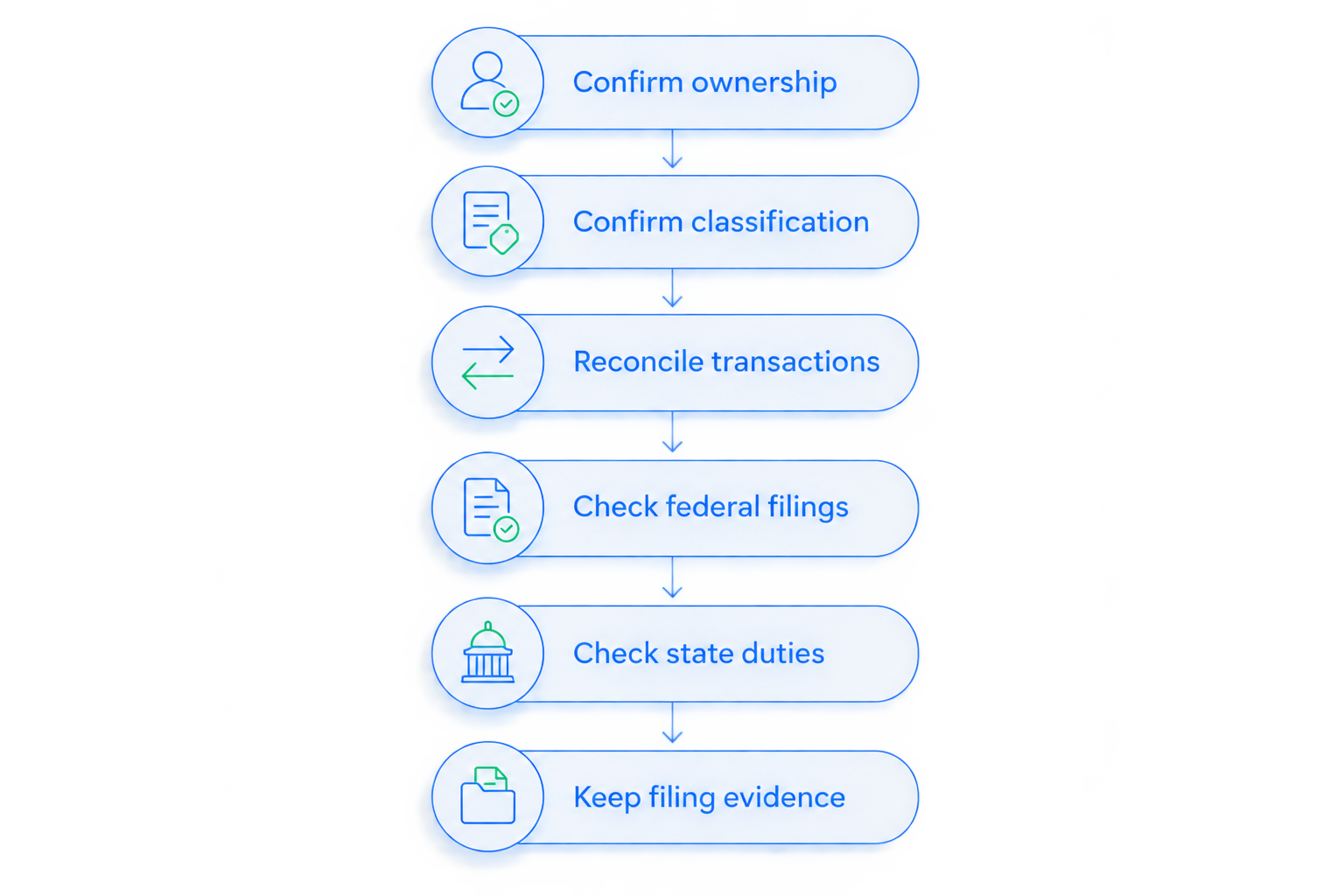
Use this sequence before closing your 2026 books. It separates company reporting from personal tax filing and gives your preparer the records needed to make a decision.
- Confirm ownership. Record each owner's tax status and any ownership changes during the year.
- Confirm classification. Check membership, accepted elections and prior returns rather than relying on formation documents alone.
- Reconcile transactions. Match business statements with personal payments, contributions, reimbursements and loans.
- Check federal filings. Assess the entity return, information returns and the owner's separate filing position.
- Check state duties. Review the relevant state agency's current reporting and tax requirements.
- Keep filing evidence. Retain submitted returns, extension records, delivery evidence and supporting books.
For a gaming-specific launch checklist, read selling your first indie game as a non-US founder. Keep launch tasks separate from tax deadlines: postponing release does not automatically postpone reporting.
When are Form 5472 and the pro forma return due?
For a calendar-year foreign-owned US disregarded entity, Form 5472 and its attached pro forma Form 1120 are generally due April 15 following the tax year's end. A timely Form 7004 generally provides a six-month filing extension.
For returns with an April 15, 2026 deadline, that extension generally moves the filing deadline to October 15, 2026. Confirm any applicable IRS relief and the current submission instructions; foreign-owned disregarded entities have specific filing procedures.
An extension to file does not extend the time to pay a tax that is due. It also does not extend state deadlines automatically. Filing the wrong return is not a substitute for extending the correct one.
Official references: IRS Instructions for Form 5472, “When and Where To File”; IRS Instructions for Form 7004, “Extension Period.”
What happens if you miss Form 5472?
The IRS states that failure to file Form 5472 when required, or failure to maintain the required records, can trigger a $25,000 penalty. Additional penalties can apply if the failure continues after IRS notice.
That $25,000 penalty is a reporting penalty, not a percentage of game sales. A business with no revenue therefore still needs a filing assessment. If a deadline has passed, assemble the records promptly and obtain advice on corrective filing and any available relief without assuming relief is automatic.
Official reference: IRS Instructions for Form 5472, “Penalties.”
Does the foreign owner also need Form 1040-NR?
Form 1040-NR is a separate question from the LLC's Form 5472 obligation. A nonresident individual generally needs a return when engaged in a US trade or business, subject to the applicable rules and exceptions, even when that activity produces no income.
Living abroad and owning a US LLC do not, by themselves, settle whether you have a US trade or business. Work location, activities, income character and any applicable treaty require assessment. Do not treat either “US customers” or “no US customers” as a complete tax analysis.
An EIN identifies the business. An ITIN identifies an individual who needs a US taxpayer identification number but is not eligible for an SSN; it is not automatically required just because you formed an LLC. An ITIN application or renewal must meet the IRS eligibility and documentation rules.
Official references: IRS Instructions for Form 1040-NR, “Who Must File”; IRS Instructions for Form W-7, “Who Is Eligible To Complete This Form.”
Does no revenue remove state filing obligations?
No revenue does not automatically remove state reports, franchise taxes or other entity-maintenance duties. Requirements depend on your formation state and any other state where registration or tax obligations arise.
For your 2026 checklist, consult the relevant Secretary of State or corporations agency and state revenue department. Use both: keeping an entity registered and meeting its tax obligations are different tasks.
Do not assume closing a bank account closes the LLC. If you abandon the gaming project, assess formal dissolution, final returns and any outstanding state requirements rather than simply stopping activity.
When should you get filing support?
Corpulate is best suited to non-resident founders seeking US LLC formation and tax compliance consulting together. That support is relevant when you need to distinguish the LLC's information return from your personal return or coordinate EIN and ITIN requirements. Consulting does not guarantee an approval or tax outcome.
Any Corpulate service fee is a one-time cost for the agreed service, not a monthly subscription. Separate that scope from government fees, future returns and continuing legal obligations.
Clarify your LLC filing requirements
Discuss your LLC classification, owner transactions and non-resident filing questions.
FAQ
Does my foreign-owned gaming LLC need to file taxes if it made no money?
Your foreign-owned gaming LLC can need filings despite having no revenue. A foreign-owned single-member disregarded entity generally files Form 5472 with a pro forma Form 1120 when it has reportable related-party transactions, including owner contributions.
Does putting my own money into my LLC count as revenue?
An owner contribution is generally not customer revenue, but it can be reportable on Form 5472. Record it separately from game sales and distinguish contributions from loans.
Do I need Form 5472 if I paid formation expenses myself?
Personally paid formation expenses require a Form 5472 assessment because the foreign-owned disregarded-entity reporting rules cover formation-related transactions. Keep the invoices and evidence of who paid them.
Is an EIN enough to meet my LLC’s tax obligations?
An EIN does not satisfy tax-return or information-reporting obligations. It identifies the business; you still need to determine which filings apply.
Do I need an ITIN just because I own a US LLC?
Owning a US LLC does not automatically require an ITIN. An ITIN is for an eligible individual who needs a US taxpayer identification number and cannot obtain an SSN.
What is the penalty for not filing Form 5472?
The IRS states a $25,000 penalty can apply for failure to file Form 5472 when required or maintain required records. Continued failure after IRS notice can produce additional penalties.
Can I ignore the LLC until my game launches?
You should not ignore the LLC before launch because owner transactions and state obligations can arise without sales. Check its classification, records and deadlines before deciding no filing is required.
One last thing
Your personal bank statement can be part of the LLC's tax records. If you paid formation or development expenses yourself, excluding that statement can hide the very owner transactions that require attention.
Before you label the year inactive, reconcile personal payments as well as the business account. That check matters more than whether your game reached its release date.
Related guides
- Forming a US LLC: tax obligations to plan for
- W-8BEN or W-8BEN-E for non-US game developers
- Starting a US gaming business without living there
Author: Hassaan Ullah Khan, IRS CAA
Official sources