




Non-US indie developers’ business planning is the process of organizing game ownership, sales contracts, tax identification and filing duties so you can sell a game through a legally consistent business. This business checklist for non us indie game developers starts with your actual sales model—not the assumption that you need a US company to reach US players.
- Use this business checklist for non us indie game developers before choosing a US LLC or UK LTD.
- Corpulate provides company formation and tax ID support; banking, platform acceptance and tax outcomes are not guaranteed.
- An EIN identifies a business; an ITIN identifies an eligible individual for federal tax purposes.
- Confirm game ownership, the contracting seller and filing obligations before accepting revenue.
Why business planning matters for non-US indie developers
Your first game creates several separate relationships: you own or license intellectual property, a platform distributes the game, and a seller receives the proceeds. Those roles need to agree across your contracts, payout details and tax documents. A company registration alone does not connect them.
Living outside the US adds another layer. Your country of tax residence still matters, even when a US company receives payments or a UK company signs the publishing agreement. Selling to US players does not, by itself, establish which company structure you need.
Corpulate’s company formation and tax ID services are best for non-resident founders seeking help with US or UK setup and related filing requirements. Corpulate supports formation, EIN, ITIN and non-resident tax compliance work; those services do not establish ownership of your game or replace a review of publishing contracts.
For your 2026 launch, choose the seller first, then arrange the company, identifiers and records around that decision.
Build your indie game business checklist
Define who sells the game
Start manually with a one-page description of your business. State where you live, who developed the game, who owns it, which storefronts you intend to use and who will receive payment. Include direct website sales, publisher advances, downloadable content and freelance development if those activities apply.
Next, distinguish your customer from your contractual counterparty. A player buying a game and a platform sending you proceeds are not necessarily the same party for contract or tax purposes. Read the agreement rather than deciding from the payout description.
Do not form a foreign company solely because your audience includes US players. Compare the platform’s seller requirements with the legal and tax position of operating from your home country. Your 2026 checklist should document that comparison before you submit formation paperwork.
- Name the intended contracting seller.
- List each planned revenue stream separately.
- Record your residence and where you perform development work.
- Save the platform’s seller and payout requirements.
- Identify any publisher or co-founder approval needed before changing sellers.
Confirm ownership of the game and its assets
Build an asset register before paying someone to organize your company. A spreadsheet is enough: list the code, artwork, music, sound effects, fonts, middleware and marketing materials, then record the owner and permission supporting each commercial use.
Paying a freelancer does not automatically answer every ownership question. Check the written agreement and applicable law, including whether rights were assigned or merely licensed. For licensed assets, examine distribution restrictions, attribution requirements and whether the licence covers the intended seller.
If you developed the game personally before forming a company, decide how the company will obtain the necessary rights. An assignment transfers ownership; a licence permits specified use without necessarily transferring ownership. That choice also deserves tax advice where rights cross borders.
- Record the creator and rights holder for each asset.
- Keep signed contractor and co-founder agreements.
- Save commercial licences and required attribution text.
- Check open-source obligations before distribution.
- Document any transfer or licence to the selling company.
Choose the seller and formation jurisdiction
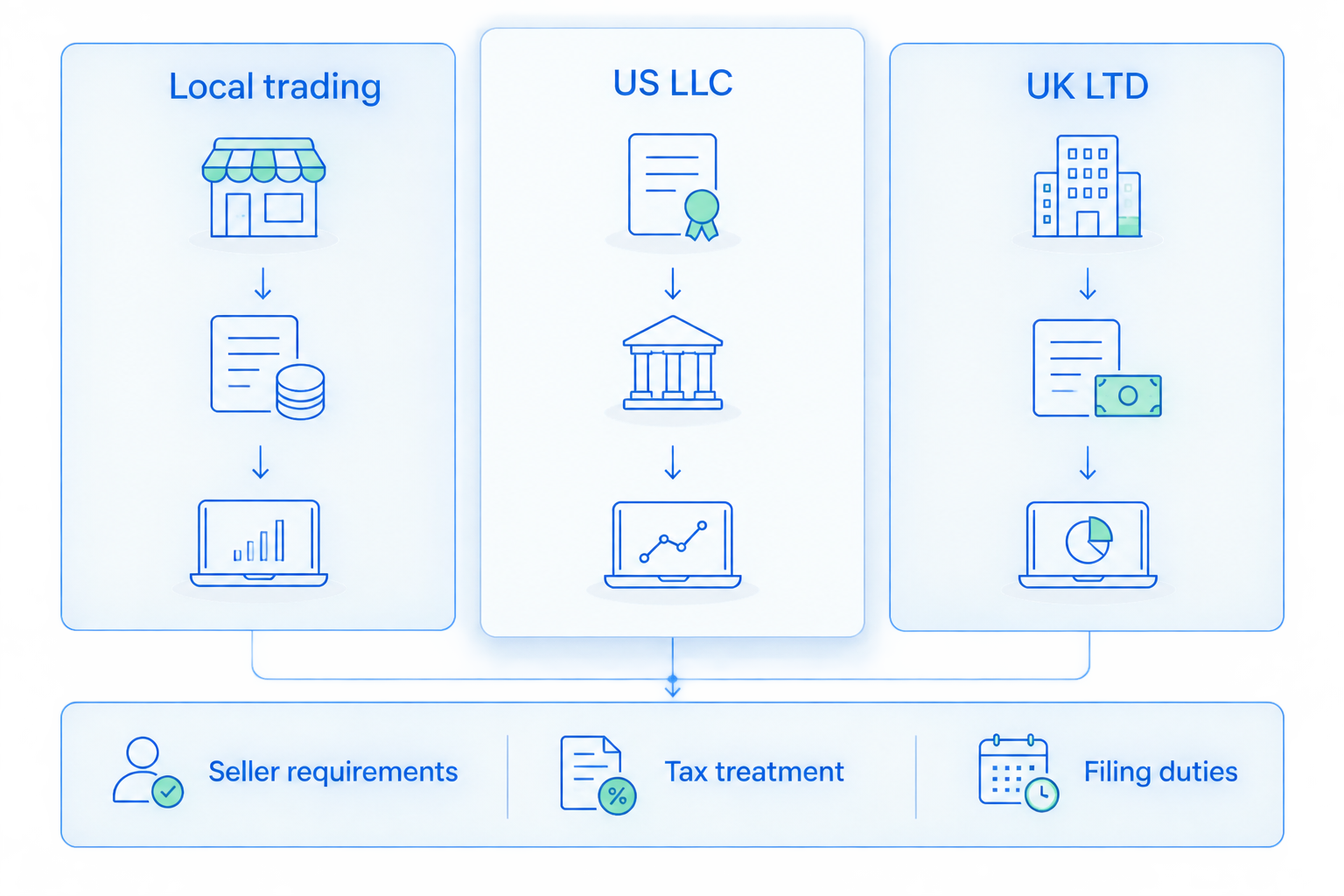
Compare your existing local trading position, a US LLC and a UK LTD before selecting a jurisdiction. An LLC is a state-created limited liability company; an LTD is a UK private limited company. Neither label alone answers how your home country will tax the business or its owner.
For a US LLC, check the formation state’s filing requirements, registered-agent rules and continuing obligations. A registered agent receives specified official and legal correspondence; that role is not the same as providing every address a bank or storefront requests.
For a UK LTD, examine Companies House requirements covering directors, shareholders, an appropriate registered office, ownership disclosures and applicable identity verification. Non-resident status does not remove those requirements. Use current Companies House incorporation guidance and the chosen US state’s official filing guidance for your 2026 decision.
Corpulate’s company formation support is an assisted route after you choose the structure. Formation assistance does not guarantee a payment account or platform approval.
- Compare home-country treatment of each structure.
- Check the US state or UK registration requirements.
- Separate registered-office, agent and trading-address functions.
- Confirm who will own and manage the company.
- Read the non-resident gaming business guide before committing.
Separate business and personal tax identification
Distinguish the 2 tax IDs before submitting an application. An EIN, or Employer Identification Number, identifies a business for US federal tax administration. An ITIN, or Individual Taxpayer Identification Number, serves an eligible individual who needs a US tax identification number but is not eligible for a Social Security number.
You do not automatically need an ITIN before applying for an EIN. Follow the IRS Instructions for Form SS-4 for a foreign responsible party who lacks, and is ineligible for, an SSN or ITIN. International applicants must use an application method available for their circumstances rather than assuming the online application applies.
An ITIN application uses Form W-7 and requires a qualifying federal tax purpose, identity evidence and foreign-status evidence. A tax return generally accompanies the application unless an exception applies. For 2026 applications or renewals, consult the current IRS W-7 instructions rather than treating an ITIN as a general banking credential.
- Identify whether the applicant is the business or an individual.
- Check the applicable SS-4 submission method.
- Establish the tax purpose before preparing W-7.
- Check renewal requirements before using an existing ITIN.
- Ask Corpulate about EIN or ITIN application support when assistance is needed.
Align contracts, payouts and tax documents
Complete the platform’s onboarding yourself first: inspect the seller agreement, identity requirements, supported business types and payout instructions. This reveals whether the proposed seller can complete the process before you transfer rights or change an existing account.
Keep the company name and tax classification consistent, but do not assume every field should contain the company’s details. For US withholding documentation, a foreign individual generally uses Form W-8BEN and a foreign entity generally uses Form W-8BEN-E. A disregarded entity requires attention to the owner’s status and the form instructions.
A disregarded entity is a business treated as not separate from its owner for specified tax purposes. That tax treatment does not erase its legal existence. Use the current IRS W-8 instructions and the payer’s requirements for your 2026 onboarding; do not choose a form solely from the LLC registration certificate.
- Match the contracting seller to the onboarding application.
- Confirm the account holder permitted for payouts.
- Check who is the beneficial owner for withholding documentation.
- Keep accepted tax forms and platform correspondence.
- Review seller-change restrictions before moving an existing game.
Map US, UK and home-country filing duties
Create a 12-month compliance calendar before launch. Separate company filings, owner tax returns, information returns and indirect taxes such as VAT or sales tax. They serve different purposes, and one submission does not replace another.
A foreign-owned US single-member LLC treated as disregarded can have Form 5472 reporting obligations for reportable transactions, with a pro forma Form 1120 attached. Owner funding and distributions require attention even without game sales. The owner’s potential Form 1040-NR obligation is a separate question, determined by the applicable filing rules and income facts.
A UK LTD brings Companies House accounts and confirmation-statement requirements, alongside HMRC obligations determined by its circumstances. Check Corporation Tax registration and return requirements, and assess VAT separately. Your own country’s reporting rules also remain part of the analysis.
No revenue is not a reliable test for whether filings are due. For 2026 planning, use the IRS Instructions for Forms 5472 and 1040-NR, Companies House filing guidance, and HMRC company-tax guidance.
- Record each obligation and the authority receiving it.
- Establish the company’s accounting period and tax year.
- Track owner contributions, withdrawals and related-party transactions.
- Confirm the platform’s indirect-tax responsibilities and your remaining duties.
- Assign preparation and submission responsibility before deadlines approach.
Keep launch records and define the support scope
Keep 3 record sets: legal documents, transaction evidence and compliance records. Start with clearly named folders and a ledger rather than waiting for your first tax return. Save original platform statements as well as your own summaries.
Reconcile gross game receipts, platform deductions, refunds, withholding and net payouts separately. A bank deposit shows what arrived, not necessarily the full transaction history needed to explain the sale. Record the currency and conversion method used in your books.
If you appoint a service provider, request written deliverables and exclusions. Corpulate’s service fees are one-time costs for the agreed services, not monthly subscriptions; government fees and future filing obligations are separate. Ask which formation documents, tax ID applications and tax filings the engagement actually includes.
- File company documents and intellectual-property agreements together.
- Retain storefront statements and supporting transaction records.
- Record owner payments separately from game revenue.
- Keep submission confirmations and official correspondence.
- Confirm who responds to notices after the initial engagement.
Compare setup routes for your first game
Choose the route that solves your documented requirements, not the one with the most paperwork. These options address different needs; assisted formation still leaves commercial decisions and truthful disclosures with you.
| Option | Best for | Main benefit | Key limitation |
|---|---|---|---|
| Local trading | Founders whose local structure meets seller requirements | Keeps the initial assessment focused on an existing legal and tax framework | Still requires local registration, tax and contract checks |
| Self-managed US LLC | Founders with a documented reason for a US seller | Direct control over state formation and administration | Federal, state and home-country duties remain separate |
| Self-managed UK LTD | Founders whose contracts or business plan support a UK company | A UK corporate seller for the chosen activity | Companies House and HMRC administration require continuing attention |
| Corpulate-assisted setup | Non-residents seeking US/UK formation and tax ID support | Assistance with the agreed formation, identification or filing work | Does not guarantee banking, platform acceptance or tax outcomes |
Before selecting assistance, compare formation quote inclusions and exclusions. Confirm the scope for the initial setup and identify obligations that will need a separate future engagement.
Common mistakes non-US indie developers make
Registering before checking the storefront contract
A company is not useful if the intended seller cannot satisfy the platform’s onboarding rules. Check eligibility and seller-change procedures first, especially when an existing account already holds wishlists, contracts or sales history.
Leaving the game’s rights with the wrong person
Your company does not automatically own code or artwork you created personally. Document the rights it needs, including permission from collaborators, before the company signs a publishing or distribution agreement.
Treating an EIN or ITIN as financial access
A tax identification number is not an account approval. Banks, payment providers and storefronts apply their own identity, country and business checks; supplying an EIN or ITIN does not override them.
Ignoring owner funding before launch
Money you put into a foreign-owned LLC is not invisible because customers have not bought the game. Record it and assess information-return obligations rather than waiting for a profitable launch.
Assuming a foreign company settles local tax
A US LLC or UK LTD does not erase your residence or where you work. Establish the home-country treatment of company income, distributions and management before deciding the structure is suitable.
FAQ
Do I need a US LLC to sell my first indie game?
A US LLC is not automatically required to sell an indie game to US players. Check the storefront’s seller requirements, your local trading options and the tax consequences before forming a foreign company.
Can I apply for an EIN without an SSN?
An eligible foreign applicant can apply for an EIN without an SSN. Follow the IRS Instructions for Form SS-4 and use the application method available for the applicant’s circumstances.
Do I need an ITIN before getting an EIN for my game business?
An ITIN is not automatically a prerequisite for an EIN. An ITIN application needs its own qualifying federal tax purpose; it is not a general business-registration step.
Is a UK LTD better than a US LLC for a non-resident developer?
Neither structure is automatically better for a non-resident developer. Compare seller requirements, home-country tax treatment, management arrangements and continuing filing duties before choosing.
Does my LLC have to file anything if my game earns nothing?
An LLC can have filing obligations without game revenue. A foreign-owned disregarded LLC needs particular attention to Form 5472 reporting when reportable transactions, including relevant owner transactions, occur.
Will company formation guarantee a bank account or payment processing?
Company formation does not guarantee a bank account or payment processing. Each provider applies its own eligibility and verification requirements, independently of company registration.
Where should I check official requirements before launching in 2026?
Use the relevant US state filing authority, IRS form instructions, Companies House guidance and HMRC guidance for the applicable requirements. Also check your home-country tax authority and the storefront’s current seller agreement.
One last thing
Your first business transaction can happen before your first game sale. Funding the company, transferring game rights or receiving a publisher advance deserves a record when it happens—not a reconstruction at filing time. Build your 2026 launch folder around those events, not just the storefront release date.
Related guides
Author: Hassaan Ullah Khan, IRS CAA.
Official sources