




Register your US LLC now if you need the company to sign contracts, apply for business accounts or begin trading in 2026; wait until January if your launch can wait and you want to avoid creating a company before you need it. A late-year formation can create a short first reporting period, and having no revenue does not automatically remove federal or state filing obligations.
- Deciding whether to form llc now or wait until january depends on your launch date and first-year filing obligations.
- Register now when contracts or business operations require the LLC; wait when the business can genuinely remain unformed.
- Foreign-owned LLCs can have IRS reporting obligations without revenue, including reporting certain owner contributions.
- Corpulate supports non-resident entrepreneurs with LLC formation, EIN applications and tax compliance consulting.
Should you register your US LLC now or wait until January?
Form the LLC when you need the legal entity, not simply because the calendar is ending. The decision turns on what you need to do before January and which obligations your chosen state and federal tax classification create.
| Timing option | Best for | Main benefit | Main drawback |
|---|---|---|---|
| Register now | Entrepreneurs who need an LLC for an imminent launch or contract | You can begin the entity-dependent steps once formation is effective | You can create a short first tax period and earlier compliance work |
| Wait until January | Entrepreneurs whose launch and contracts can wait | You avoid creating the entity during the current calendar year | Formation, EIN and account applications still need attention after January |
| Request a delayed effective date | Entrepreneurs whose chosen state permits this approach | You can submit paperwork before the intended legal start date | State rules control whether this works and when obligations begin |
For non-residents, LLC formation for non-US residents also involves coordinating ownership information, a registered agent and the tax-ID application. Your filing date is only one part of that sequence.
Why this matters
A company formed near the end of 2026 does not automatically receive a full year before reporting begins. Depending on its tax classification and state, the company can have obligations covering only the short period between formation and year-end.
Waiting can simplify the starting point. It does not eliminate the obligations attached to a company once you form it, and it does not erase business activity you already conducted personally.
Register now when the business needs the entity
Register now if delaying the LLC would prevent a real business step. Examples include signing a customer agreement in the company's name, applying for a business account that requires formation documents, or entering a supplier arrangement as the LLC.
The benefit is practical: you establish the entity before trying to use it. The limitation is equally important: formation alone does not complete your EIN application, approve a bank account or satisfy a payment provider's checks.
Before filing, identify the actual dependency. Ask whether the counterparty requires an existing LLC, which documents it needs and whether it has a deadline you must meet.
For a 2026 launch, work backward from that requirement rather than choosing an arbitrary formation day. Do not assume that receiving state formation documents means every other application will be ready immediately.
Do not trade under an LLC that does not yet exist
Submitting a formation application and having an effective LLC are not always the same event. Check the state's accepted filing and effective date before representing that the company already exists.
If you sign an agreement before formation, do not assume the future LLC automatically takes over your personal obligations. Get advice on the contract and any transfer or replacement agreement needed after formation.
Wait until January when there is no immediate business need
Wait when your business can remain unformed without losing a contract, disrupting a launch or blocking necessary preparation. January can provide a cleaner starting point for a calendar-year business, but the advantage comes from avoiding an unnecessary earlier entity period—not from receiving a tax exemption.
You can still prepare your ownership details, choose a state, review registered-agent requirements and collect application information before January. Preparation is different from claiming that an LLC already exists.
Waiting has a drawback: the formation and EIN sequence still needs to happen. If your first customer expects to contract with the LLC at the start of January, beginning all paperwork then creates a scheduling dependency.
Decide what must be complete before launch and what can follow. A later formation date is useful only if your operational plan can accommodate it.
Waiting does not cancel earlier personal activity
An LLC formed in January does not automatically own income you earned personally before it existed. Earlier sales, contracts and expenses need to be assessed according to who actually earned, signed or paid for them.
Keep those records separate. A formation decision should not become an excuse to move earlier transactions into a new company's books without checking their treatment.
Consider a delayed effective date where state rules permit it
A delayed effective date separates submitting the paperwork from the date the LLC legally takes effect. Some states permit this, subject to their own limits and filing requirements.
Best for: entrepreneurs who want to prepare a filing before January but do not need an effective LLC beforehand. The benefit is advance preparation; the limitation is that you cannot assume every state offers the same option or treatment.
Confirm the rules with the relevant Secretary of State or equivalent filing authority. Check the permitted effective date, how acceptance is documented and which date controls state reporting obligations.
Do not request an EIN for an entity that has not legally formed. The IRS's guidance on applying for an employer identification number directs applicants forming a legal entity to complete state formation first.
Why the right formation date varies
The same date can suit one non-resident founder and create unnecessary work for another. Review these factors before choosing:
- Launch dependency: Determine whether a customer, supplier or account application actually requires an effective LLC before January.
- State requirements: Check formation rules, annual reports and state taxes with the filing authority and state revenue department.
- Ownership structure: A single-owner LLC and an LLC with multiple owners can have different default federal tax treatment.
- Owner transactions: Contributions, distributions and other owner-company transactions can matter even when customer revenue is zero.
- Tax elections: Choosing corporate taxation changes the analysis; do not apply single-member default rules to every LLC.
- Existing activity: Personal trading before formation needs its own records and tax assessment.
For your 2026 decision, use the state's current instructions rather than a generic claim that every LLC renews on its formation anniversary. State deadlines and calculation methods differ.
What tax filings can a late-year LLC trigger?
A US LLC is a state-law entity, not a single federal tax category. Under the IRS's LLC classification rules, a domestic LLC with one owner is generally disregarded for federal income tax purposes unless it elects corporate treatment; a domestic LLC with 2 or more members generally defaults to partnership treatment.
“Disregarded” means the entity is generally not separate from its owner for federal income tax purposes. It does not mean the LLC has no reporting obligations.
A foreign-owned US disregarded entity can need Form 5472 attached to a pro forma Form 1120 when it has reportable transactions. A pro forma return is the limited corporate return used for this reporting requirement, not proof that the LLC elected ordinary corporate taxation.
No revenue does not settle the filing question
The IRS Instructions for Form 5472 include special reporting rules for foreign-owned US disregarded entities. Transactions involving formation, owner contributions and distributions can be reportable, so an LLC funded by its foreign owner is not automatically filing-free because it made no sales.
The IRS states that failure to file Form 5472 as required can trigger a $25,000 penalty. That is a reporting penalty, not a formation charge or an amount every LLC owes.
For a company formed in 2026, retain formation documents and records of money moving between the owner and company from the beginning. Assess the first reporting period before assuming that waiting for revenue is sufficient.
Keep the owner's personal return separate
Form 1040-NR is the US nonresident individual income tax return. Whether an owner must file it depends on the owner's circumstances, income and applicable rules—not merely on owning an LLC.
The IRS Instructions for Form 1040-NR and Publication 519 explain the relevant nonresident filing framework. Company information reporting and an owner's individual income tax return are separate questions that need separate answers.
Does waiting until January change EIN or ITIN requirements?
Waiting changes when you begin the application sequence; it does not make an EIN and an ITIN interchangeable. An EIN identifies the business, while an ITIN identifies an individual who needs a US taxpayer identification number and is not eligible for an SSN.
A foreign responsible party without an SSN or ITIN can follow the applicable Form SS-4 instructions. The IRS online EIN application has eligibility restrictions, so do not assume that a non-resident founder can use the same application route as every US-based applicant.
The guide to EIN filing for foreigners without an SSN addresses that application issue. Choosing January does not remove the need to provide accurate entity and responsible-party information.
An ITIN is not automatically required just because you form an LLC. Under IRS guidance, an ITIN generally expires if it is not used on a federal tax return for 3 consecutive tax years; renewal depends on whether you need it for a federal tax purpose.
Use the IRS Instructions for Form W-7 to assess an application or renewal. Do not apply solely because you assume every foreign LLC owner needs both identifiers immediately.
How do you choose your LLC formation date?
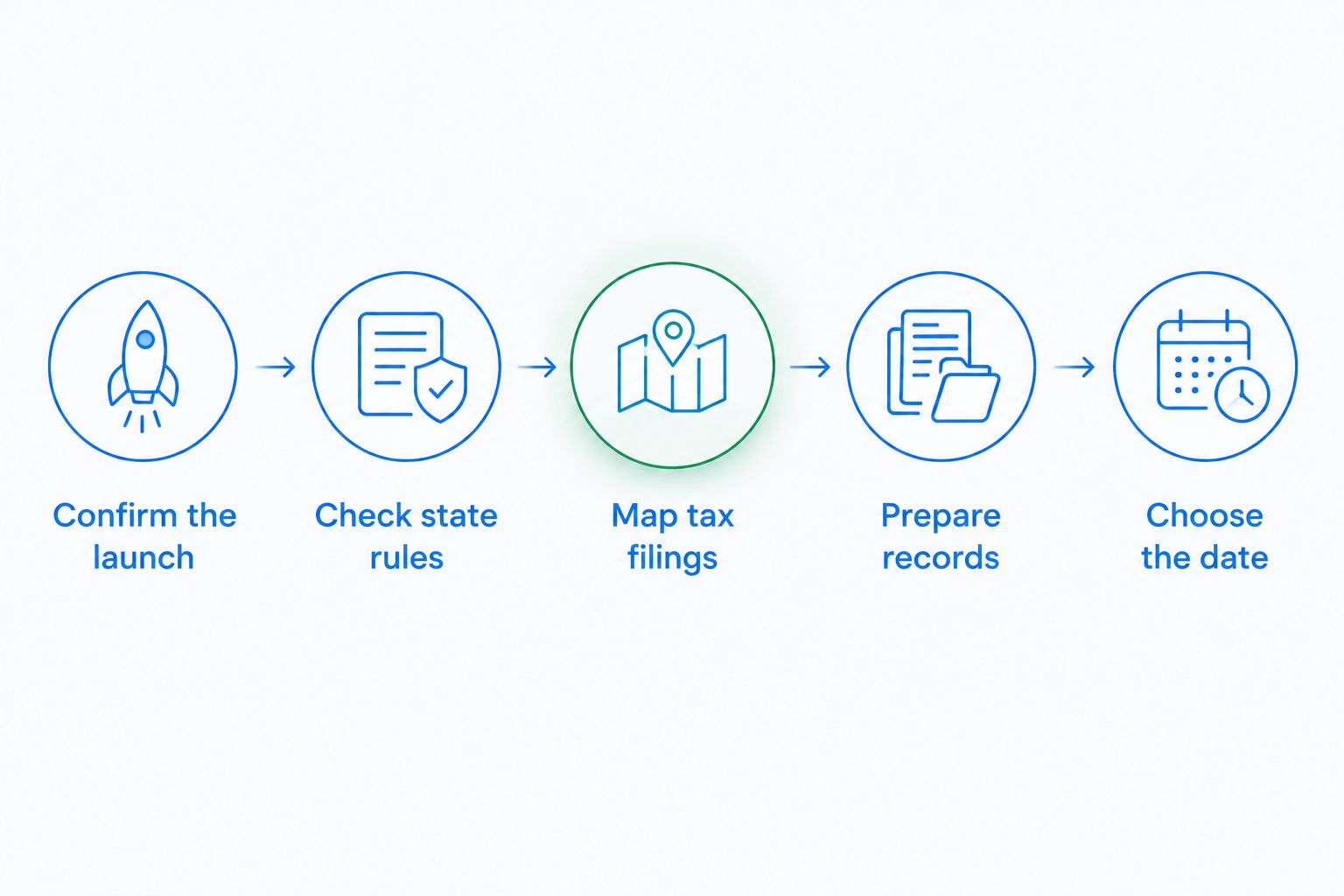
Use this sequence before submitting the state application:
- Confirm the launch. Identify the first activity that genuinely requires an effective LLC.
- Check state rules. Read the formation, reporting and delayed-effective-date instructions for your chosen state.
- Map tax filings. Establish ownership, default tax classification and any intended election.
- Prepare records. Plan how you will document formation payments, owner funding and subsequent transactions.
- Choose the date. Register now only when the business reason outweighs the additional first-period administration.
Corpulate is best for non-resident entrepreneurs seeking LLC formation and tax-ID guidance together. Its formation, EIN, ITIN and tax compliance consulting services address connected decisions, but engaging a service does not guarantee approvals, banking access or a particular tax outcome.
Treat Corpulate service fees as one-time costs, separate from government fees and future filing obligations. A one-time formation service does not remove the company's continuing legal responsibilities.
FAQ
Should I form an LLC now or wait until January if I have no customers?
Wait until January if you do not need the entity before then and your launch can genuinely wait. Having no customers does not automatically remove reporting obligations after formation.
Will forming an LLC in December mean I owe a full year of tax?
December formation does not automatically mean you owe a full year of income tax. Your state, federal tax classification, income and transactions determine the relevant obligations; a short first period can still require filings.
Does a foreign-owned LLC need to file anything if it earns nothing?
A foreign-owned US disregarded entity can need Form 5472 with a pro forma Form 1120 despite earning no revenue. Owner contributions and other reportable transactions can trigger the requirement.
Can I get an EIN before my LLC exists?
Form the LLC before applying for its EIN. IRS EIN guidance directs applicants creating a legal entity to complete state formation first.
Do I need an SSN to form a US LLC and obtain an EIN?
An SSN is not a universal prerequisite for forming a US LLC or obtaining an EIN. State formation requirements and the IRS application route must be checked separately, including the Form SS-4 instructions for a foreign responsible party.
Can Corpulate guarantee that my account will open before January?
Corpulate cannot guarantee banking approval or an account-opening date. Formation and EIN assistance do not replace a financial institution’s eligibility checks and application review.
Should I form a UK LTD instead just to avoid US filing obligations?
Do not choose a UK LTD solely to avoid US LLC filings. A UK company has its own Companies House and HMRC obligations, and the right jurisdiction depends on your business activity and personal tax circumstances.
One last thing
Separate preparation from legal formation. You can use the remaining preparation period to resolve ownership, collect documents and understand reporting requirements without creating an LLC earlier than the business needs it.
The useful question is not simply whether January looks tidier. It is whether an effective company serves a concrete purpose before then—and whether you are ready to maintain its records from that date.
Related guides
- Registered-agent services for non-resident LLC owners
- Using an ITIN to file taxes without a green card
- UK company formation services for non-residents
Author: Hassaan Ullah Khan, IRS CAA