




Yes, you can use an ITIN to file a US federal tax return without a green card if you are not eligible for a Social Security number. Your tax residency determines which return you file, while your ITIN identifies you to the IRS. An ITIN does not grant immigration status, work authorization, or eligibility for every tax benefit.
- Can I use ITIN to file taxes without green card? Yes, if you are not eligible for an SSN.
- Tax residency—not your ITIN—determines whether you generally file Form 1040 or Form 1040-NR.
- Corpulate provides ITIN and tax compliance consulting for non-resident entrepreneurs.
- Renew an expired ITIN when you need it for a federal income tax return.
Can I use my ITIN to file taxes if I don't have a green card?
Yes. A green card is not a requirement for filing with an ITIN. The IRS issues an Individual Taxpayer Identification Number to people who need a US taxpayer identification number but are not eligible for an SSN.
| Your situation | General filing route | Main limitation |
|---|---|---|
| You are a nonresident alien for tax purposes | Form 1040-NR, when required | Income and treaty rules determine your obligations |
| You are a resident alien for tax purposes | Form 1040, generally | Worldwide income generally enters the US tax calculation |
| Your residency changes during the tax year | Dual-status filing rules | A standard full-year return may not fit |
Corpulate ITIN and tax compliance consulting is best for non-resident entrepreneurs who need application and filing support.
For 2026 filing decisions, the official references are IRS Publication 519, U.S. Tax Guide for Aliens, and the IRS guidance titled Individual Taxpayer Identification Number.
Why this matters
An ITIN answers the identification question, not the tax question. You still need to establish whether a return is required, which income belongs on it, and whether a treaty changes the result.
This distinction matters when you run an online business from outside the US. Owning a US company, receiving payments from US customers, and spending time in the US are different facts with different tax consequences. None of those facts, considered alone, supplies a complete filing answer.
Keep immigration status separate from tax residency. A person without a green card can become a US tax resident under the substantial presence test, while a person living abroad can have a US filing obligation without becoming a US tax resident.
Filing as a nonresident: Form 1040-NR
If you are a nonresident alien for US tax purposes and must file an individual income tax return, Form 1040-NR is generally the relevant form. An ITIN can identify you on that return when you are not eligible for an SSN.
Best for: Individuals whose tax residency analysis establishes nonresident status and whose income or other circumstances require a nonresident return.
The advantage is that Form 1040-NR addresses nonresident income categories and treaty positions. Its limitation is that nonresident rules do not simply copy the deductions, filing statuses, and credits available on a resident return.
Do not assume that every payment from a US customer is automatically US-source income. Source rules depend on the income category; for services, where you physically perform the work is generally central. Product sales, royalties, and other income require their own analysis.
For a 2026 filing assessment, use the IRS Instructions for Form 1040-NR alongside Publication 519. Check both whether you must file and whether filing is needed to claim a refund of tax already withheld.
Filing as a resident: Form 1040
You can be a resident alien for tax purposes without holding a green card. The substantial presence test can establish US tax residency based on your physical presence, subject to exceptions and treaty rules.
The test generally requires:
- At least 31 days in the US during the current calendar year.
- At least 183 weighted days across the current year and the preceding two years.
- Counting all current-year days, one-third of the preceding year's days, and one-sixth of the second preceding year's days.
Best for: Individuals treated as US resident aliens for the relevant tax year, after checking applicable exceptions and elections.
The advantage of identifying resident status correctly is choosing the appropriate filing framework. The limitation is significant: resident aliens generally report worldwide income, not just income connected to the US.
For your 2026 residency calculation, count travel days before choosing a return. Certain days do not count, and closer-connection or treaty provisions can affect the result. IRS Publication 519 explains these rules; an ITIN itself does not resolve them.
Why your filing requirements vary
Your tax return depends on your circumstances, not simply on whether you have an ITIN. These factors drive the decision:
- Physical presence: Your US travel history affects the substantial presence test. Count actual dates rather than relying on your visa label.
- Income type and source: Services, business income, investment income, and royalties can follow different sourcing and reporting rules.
- Business structure: A sole owner, partnership member, and corporate shareholder do not automatically have identical personal filing obligations.
- Treaty eligibility: A tax treaty can change how qualifying income is taxed. Citizenship alone does not establish eligibility for every treaty provision.
- Tax withheld: Withholding can create a reason to file for a refund, even when your final tax calculation differs from the amount withheld.
- Residency changes: Arriving in or leaving the US can produce a dual-status year rather than a straightforward full-year classification.
Do not select Form 1040-NR solely because you live abroad today. Review the tax year covered by the return, including any time you spent in the US during that period.
How do I file with an ITIN in 2026?
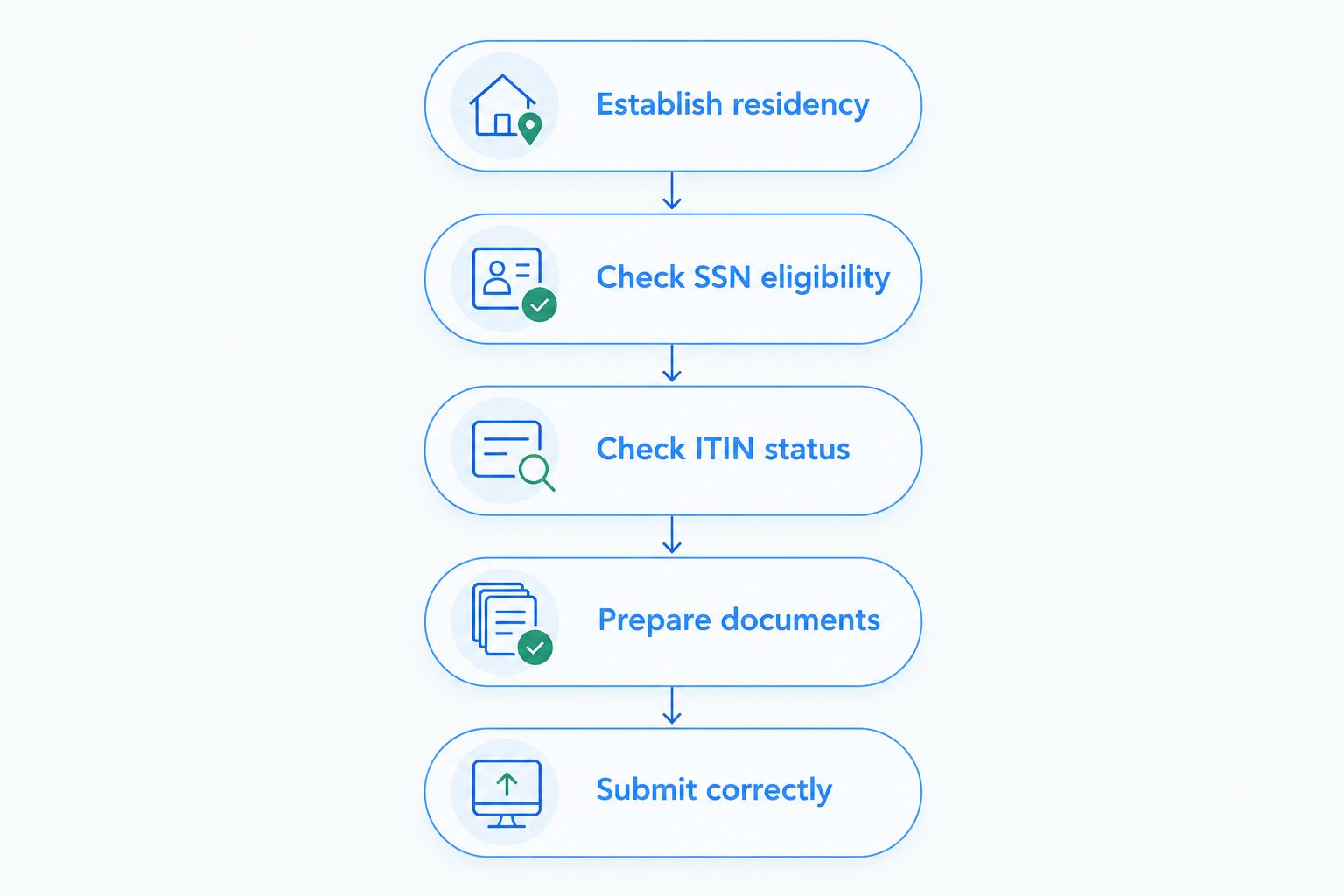
Follow this sequence before submitting a return. It separates the tax decision from the identification paperwork and avoids treating an ITIN application as a substitute for a tax calculation.
Establish residency
Gather your passport travel history, entry and exit dates, visa information, and any relevant treaty-residence facts. Determine whether you were a nonresident, resident, or dual-status taxpayer for the year being reported.
Do this before choosing tax software or completing a form. A system that accepts your identification number does not necessarily support your required return or treaty position.
Check SSN eligibility
An ITIN is for someone who needs a US tax identification number and is not eligible for an SSN. If you qualify for an SSN, follow the Social Security Administration's application process instead.
If you receive an SSN after using an ITIN, stop using the ITIN and notify the IRS so it can combine your tax records. Do not continue alternating between the numbers on different returns.
Check ITIN status
Find your IRS assignment notice and confirm the number and name match your records. A previously assigned ITIN is not automatically ready for use forever.
An ITIN expires if it is not used on a federal income tax return for 3 consecutive tax years. If your ITIN has expired and you need it for a federal income tax return, follow the renewal instructions before relying on it for filing.
Prepare documents
Collect income records, withholding statements, business accounts, and documents supporting any claimed treaty position. Keep personal income records separate from company records, even when you own the entire business.
For a new ITIN application, Form W-7 generally accompanies a federal income tax return unless an exception applies. Identity and foreign-status evidence must meet IRS requirements; ordinary photocopies are not equivalent to original documents or copies certified by the issuing agency.
Submit correctly
Follow the current Form W-7 instructions when an application or renewal accompanies a return. That package has specific submission procedures, so do not assume the ordinary return mailing address applies.
If you already have a valid ITIN, use it in the taxpayer identification field on the appropriate return. Keep a complete copy of what you submit, including supporting schedules and any IRS correspondence.
For this 2026 filing checklist, the official procedural references are the IRS Instructions for Form W-7 and Publication 519. Use the instructions applicable to the return you are preparing, especially when filing a late or amended return.
Get help with your filing requirements
Discuss your ITIN, tax residency, and non-resident filing requirements.
Can I file if my ITIN has expired?
3 consecutive tax years without use on a federal income tax return causes an ITIN to expire. If you need the expired number for a federal income tax return, renew it using the IRS Form W-7 process.
An expired ITIN does not erase your filing obligation. Filing with one can delay processing and affect the handling of certain tax benefits until the identification issue is resolved; follow the current renewal instructions rather than applying for a different number.
Does having an ITIN mean I owe US income tax?
An ITIN does not create a tax bill by itself. Tax liability depends on your residency, income, deductions, treaty position, and other applicable rules—not on the fact that the IRS assigned you a number.
The reverse also matters: not having an ITIN does not remove a filing obligation. If you must file and cannot obtain an SSN, address the ITIN application as part of preparing the required return.
Is an ITIN the same as an EIN for my company?
An ITIN identifies an individual; an EIN identifies a business or another entity for federal tax purposes. An Employer Identification Number does not replace the owner's ITIN when an individual return requires a personal taxpayer identification number.
Likewise, getting an ITIN does not complete your company's filing requirements. Your personal tax position and your business's reporting obligations need separate checks, even when the same person supplies the information for both.
What should a non-resident company owner check separately?
A US LLC can have information-reporting obligations even when its foreign owner has no personal US income tax due. For example, a foreign-owned US disregarded entity with reportable transactions can need Form 5472 attached to a pro forma Form 1120.
A disregarded entity is a business whose income tax treatment generally passes through to its owner rather than being calculated as a separate corporation. That classification does not mean the entity can ignore information returns. Owner contributions and distributions can be relevant reportable transactions under the Form 5472 instructions.
For 2026 planning, check personal returns, entity reporting, and state obligations separately. Do not interpret a company formation confirmation or EIN letter as proof that every filing requirement has been satisfied.
If you also own a UK LTD, your US ITIN does not replace UK company reporting or tax registration requirements. Review those obligations separately from your US personal return.
Official references for the US entity-reporting issue are the IRS Instructions for Form 5472 and Instructions for Form 1120. The correct treatment depends on the entity's classification, ownership, and transactions.
FAQ
Can I use ITIN to file taxes without green card?
Yes, you can use an ITIN to file a US federal tax return without a green card if you are not eligible for an SSN. Your tax residency determines the appropriate return, and the ITIN does not grant immigration status.
Do I need to live in the US to apply for an ITIN?
No, US residence is not a general requirement for an ITIN. You must have a qualifying federal tax purpose, be ineligible for an SSN, and meet the IRS application and documentation requirements.
Can I use my ITIN instead of an SSN if I qualify for both?
No, an ITIN is not the alternative to choose when you are eligible for an SSN. If you receive an SSN after using an ITIN, notify the IRS so your tax records can be combined.
Does my ITIN let me work legally in the US?
No, an ITIN does not authorize employment in the US. It is a federal tax identification number, not a work permit or immigration document.
Will an ITIN guarantee my tax refund?
No, an ITIN does not guarantee a refund or eligibility for a tax credit. Your income, withholding, filing position, and the rules for each benefit determine the outcome.
Do I need a new ITIN every year?
No, you do not apply for a new ITIN annually. An ITIN expires after 3 consecutive tax years without use on a federal income tax return, and renewal is relevant when you need it for filing.
Can Corpulate help with my ITIN and non-resident return?
Corpulate provides ITIN and tax compliance consulting for non-resident entrepreneurs. Application support does not guarantee IRS approval, processing time, or a particular tax outcome.
One last thing
No personal income tax due does not mean no paperwork due. For an overseas entrepreneur, the most useful final check is to list each obligation by taxpayer: you personally, your US company, and any separate UK company.
Put the required identifier and filing beside each name. That simple separation prevents a common category error: assuming that an ITIN, an EIN, or a company registration completes the entire compliance process.
This guide provides general information, not a determination of your individual tax or immigration position.
Related guides
- EIN application for Shopify dropshippers
- EIN filing services for foreigners without an SSN
- LLC formation services for non-US residents
- Registered agent services for non-resident LLC owners
Author: Hassaan Ullah Khan, IRS CAA | Corpulate