




Best for UK and US formation guidance: Corpulate. Best for self-managed incorporation: Companies House. Best for connecting formation with bookkeeping: a UK accountant who explicitly offers incorporation. This 2026 guide compares those routes for entrepreneurs living outside the UK, including their requirements, limitations and next steps.
- Compare the best UK company formation services for non-residents by address support, identity checks and ongoing obligations.
- Corpulate suits non-resident entrepreneurs comparing UK LTD formation with US company formation and tax ID requirements.
- Companies House is the direct filing route, not a substitute for tax advice or registered office arrangements.
- Choose accountant-led formation when you want incorporation decisions connected to an agreed accounting engagement.
Why this matters
Incorporation creates a company; it does not complete your business setup. You still need an appropriate registered office, identity verification, ownership records and a plan for accounts and tax filings. A formation certificate does not guarantee a bank account, payment processing or a particular tax outcome.
For a non-resident founder, the useful comparison is not which provider submits a form. It is which route leaves you clear about the address, documents and obligations you must manage after incorporation. That distinction matters throughout 2026, not just on the day your company is registered.
What makes the best UK company formation service?
Use these criteria before choosing a provider:
- Non-resident suitability: The engagement should accommodate your actual country of residence and explain acceptable identification.
- Registered office arrangements: Establish who supplies the address, whether it meets legal requirements and how official correspondence reaches you.
- Identity verification: Confirm the required process and whether the provider performs verification or directs you elsewhere.
- Defined deliverables: Separate incorporation, address services, tax registration and accounting rather than treating them as one unspecified package.
- Ongoing obligations: Identify who handles accounts, confirmation statements and tax returns after formation.
- Written fee scope: Distinguish a one-time formation service fee from government charges and later filing or service obligations.
A strong choice answers these questions before you commit. Reassuring language without an agreed scope does not tell you who handles the work.
UK formation routes at a glance
These are three service routes, not three equivalent packages. The ranking reflects the problem each route addresses; it is not a claim that every provider includes the same deliverables.
| Route | Best for | Main distinction | Key limitation |
|---|---|---|---|
| Corpulate | Non-residents comparing UK and US formation requirements | Offers US/UK formation and tax compliance consulting | Confirm UK-specific deliverables, address arrangements and later filing scope |
| Companies House direct filing | Founders ready to manage incorporation themselves | Submit the company application directly to the registrar | You must arrange required information, addresses and advice yourself |
| UK accountant offering incorporation | Founders prioritizing accounting continuity | Formation can sit alongside an agreed accounting engagement | Incorporation, non-resident support and address services require explicit agreement |
1. Corpulate: best for UK and US formation guidance
Corpulate provides LLC/LTD company formation, EIN, ITIN and tax compliance consulting for non-resident entrepreneurs setting up businesses in the US and UK. That makes the service relevant when you need to decide between jurisdictions before submitting an incorporation application.
Best for: Entrepreneurs outside the US and UK who want formation guidance that covers both jurisdictions. A UK LTD and a US LLC create different legal and reporting obligations; choosing between them deserves more attention than selecting a company name.
Pros:
- The stated service scope addresses non-resident entrepreneurs.
- UK LTD and US company formation are both within the offering.
- US tax ID services are available when your separate US circumstances require them.
- Tax compliance consulting is part of the stated business offering.
Cons and limitations:
- UK formation alone does not establish a need for an EIN or ITIN.
- Registered office provision, identity verification and ongoing UK filings need a written scope.
- Formation assistance cannot guarantee banking approval or a particular tax treatment.
Before engaging the service, describe where you live, what you sell, where you perform the work and whether you already have a company. Ask which formation tasks are included and which require another engagement.
Treat the service fee as a one-time cost, separate from government fees and future obligations. A completed formation engagement does not remove annual accounts, confirmation statements or applicable tax filings.
Verdict: Buy this route when cross-border formation guidance is part of your decision, after confirming the UK deliverables.
2. Companies House: best for self-managed UK incorporation
Companies House is the UK registrar of companies. Its direct registration route lets you apply to incorporate a private company without purchasing an intermediary's formation service.
Best for: Founders who understand the company structure they want and are ready to organize the required information themselves. Direct filing works as a submission route; it does not resolve personal tax questions or choose an appropriate structure for you.
Pros:
- You submit the application directly to the official registrar.
- Official guidance explains the information required for incorporation.
- You retain responsibility for checking the submitted company details.
- You can appoint accounting or legal advisers separately.
Cons and limitations:
- You must arrange an appropriate registered office rather than assuming registration supplies one.
- You must distinguish public company information from protected personal information.
- Filing directly does not provide tailored advice about cross-border taxation.
For a company limited by shares, Companies House guidance requires at least 1 director and 1 shareholder; the same person can hold both roles. Directors do not have to live in the UK, but the company needs a qualifying UK registered office.
For your 2026 application, consult Companies House guidance titled Set up a private limited company and its identity verification guidance. Follow the applicable verification process before submitting information that depends on it.
Verdict: Buy into the direct-filing route only when you can manage the application and subsequent obligations yourself.
3. UK accountant-led formation: best for accounting continuity
An accountant-led route means engaging a UK accountant who explicitly includes company incorporation in the agreed work. Do not assume every accountant offers formation or accepts directors living overseas.
Best for: Founders whose main concern is how company setup connects with records, annual accounts and tax filings. This route is most useful when the accounting engagement is defined before incorporation, rather than added after transactions have already accumulated.
Pros:
- You can discuss bookkeeping responsibilities before the company starts trading.
- You can define who prepares accounts and relevant tax submissions.
- Formation choices can be discussed alongside your proposed business activity.
- You can agree how records will move between you and the accountant.
Cons and limitations:
- Incorporation must be expressly included; an accounting engagement does not automatically cover it.
- Registered office and identity verification services require separate confirmation.
- UK accounting support does not automatically include advice in your country of residence.
Ask who will handle the incorporation application, which filings the accountant will prepare and what information you must supply. Also establish whether advice about your personal residence-country obligations falls outside the engagement.
Request separate descriptions of formation work and continuing accounting work. This prevents a one-time setup engagement from being mistaken for a complete compliance arrangement.
Verdict: Buy this route when accounting continuity is the priority and non-resident support is confirmed in writing.
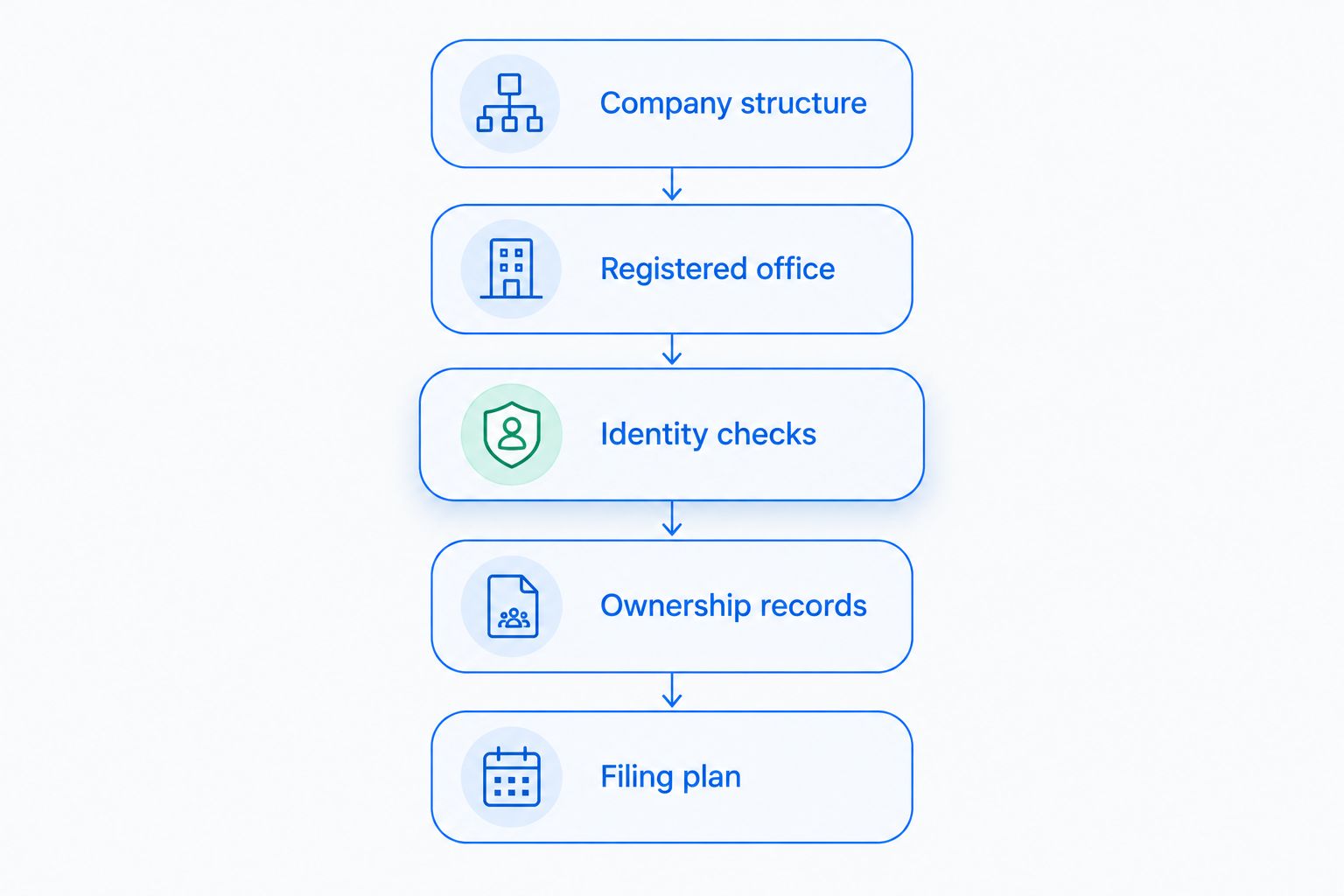
Requirements non-residents should settle before applying
You do not need UK residency simply to be a director of a UK company. You do need to meet the applicable incorporation and identity requirements. Use this checklist for your 2026 setup.
Company structure
Choose the intended company type and confirm the directors, shareholders and share allocation. For a company limited by shares, ownership and management are separate roles even when one person performs both.
Registered office
The registered office must be an appropriate physical address in the company's UK jurisdiction of registration. Companies House publishes this address, so understand the privacy implications before using a personal address.
Identity checks
Follow Companies House's current identity verification requirements for directors and people with significant control. If a provider offers verification, confirm its role and the required documents rather than assuming incorporation assistance includes the process.
Ownership records
Identify people with significant control, commonly called PSCs. Holding more than 25% of shares or voting rights is one qualifying condition, but other control conditions also apply; the percentage test is not the entire assessment.
Filing plan
Record who will handle Companies House submissions, HMRC obligations and bookkeeping. The registrar and the tax authority perform different roles, so submitting information to one does not automatically complete every obligation to the other.
What happens after incorporation?
Keep a compliance calendar from the start. Formation is a legal event, while recordkeeping and filing continue for as long as the relevant obligations apply.
Private companies generally file subsequent annual accounts with Companies House within 9 months of their financial year end. First accounts follow different deadline rules, so do not use the subsequent-accounts deadline as a universal rule. Companies must also address confirmation statements and applicable HMRC requirements.
For your 2026 planning, consult these official sources by title:
- Companies House, Set up a private limited company: Incorporation, directors, shareholders and company documents.
- Companies House, Verifying your identity for Companies House: Identity verification requirements and routes.
- *Companies House, People with significant control (PSCs):* Ownership and control reporting.
- GOV.UK, Running a limited company: Records, accounts and confirmation statements.
- HMRC, Corporation Tax: Registration, reporting and payment responsibilities.
Check the current guidance when taking action. Your activity, accounting dates and circumstances determine which requirements apply; incorporation alone does not answer those questions.
How these routes were ranked
The ranking follows the criteria above: non-resident suitability, address arrangements, identity checks, defined deliverables and ongoing responsibilities. It separates advisory support, direct submission and accounting continuity rather than pretending they are interchangeable services.
No ranking position represents a verified turnaround time, approval rate or banking outcome. Choose according to the work you need performed and the responsibilities you are prepared to retain.
Which UK formation route should you choose?
Choose Corpulate for non-resident UK company formation guidance when you also need to compare US formation or tax ID requirements. Choose Companies House direct filing when you have already resolved the structure and can manage the application yourself. Choose accountant-led formation when the accounting engagement is central to your decision.
Before committing in 2026, request a written scope covering incorporation, registered office arrangements, identity checks, official correspondence and future filings. If you want help defining that scope, contact the team with your residence country and proposed business activity.
FAQ
What’s the best UK company formation service for a non-resident?
The best route depends on whether you need advice, direct filing or accounting continuity. Choose an adviser for unresolved formation questions, Companies House for self-managed submission, or an accountant who expressly includes incorporation.
Can I form a UK company without living in the UK?
Yes, company directors do not have to live in the UK. The company still needs an appropriate registered office in its UK jurisdiction of registration and must meet incorporation and identity requirements.
Do I need an SSN, EIN or ITIN to form a UK LTD?
An SSN, EIN or ITIN is not a UK company incorporation requirement. These are US identifiers; any separate need for one depends on your US activities and tax circumstances.
Does a formation service include a UK registered office?
Do not assume a registered office is included. Ask whether the service supplies an appropriate address, handles official correspondence and creates any later service obligations.
Will forming a UK company guarantee a bank account?
No, incorporation does not guarantee a bank account. Banks and payment providers apply their own eligibility checks and document requirements independently of Companies House.
Is a one-time formation fee the only obligation?
No, a one-time formation service fee does not remove future legal or tax obligations. Separate the service engagement from government fees, address arrangements, accounts and applicable tax filings.
Do I need an accountant before incorporating?
An accountant is not a general legal requirement for incorporation. Accounting or tax advice is useful when you need help defining recordkeeping, filing responsibilities or the implications of operating across countries.
One last thing
Ask who receives an official letter when you are overseas. An address on an application is not enough: you need a clear process for receiving correspondence, recognizing deadlines and assigning the response. Put that responsibility in writing before incorporation.
Related guides
- LLC formation services for non-US residents
- Registered agent services for non-resident LLC owners
- EIN filing services for foreigners without an SSN
Author: Hassaan Ullah Khan, IRS CAA