




Forming a US LLC near the end of 2026 can create tax-reporting obligations even if your business has no sales. A foreign-owned, single-member LLC can need Form 5472 with a pro forma Form 1120 when it has reportable transactions, including owner funding. Choose your formation date only after checking your ownership structure, tax classification, state requirements and first filing period.
- Year end LLC formation tax obligations depend on ownership, tax classification and transactions—not just sales.
- Foreign-owned disregarded LLCs can need Form 5472 even without revenue.
- An EIN identifies the business; an ITIN identifies an eligible individual taxpayer.
- Corpulate supports non-resident entrepreneurs with company formation and tax-compliance consulting.
Why this matters
A late-2026 formation can leave you with a short first reporting period and filing work before the business has earned anything. No revenue does not automatically mean no filing. Paying formation expenses or transferring startup funds can matter independently of customer sales.
Corpulate is best for non-resident entrepreneurs seeking company formation and tax-compliance consulting together. Your practical priority is to establish which returns apply before choosing a registration date, not after receiving a filing notice.
Forming a US LLC before year-end? What taxes should you plan for?
For 2026 planning, separate information reporting, income tax and state obligations. An information return discloses transactions or ownership; it does not necessarily mean tax is payable. State obligations operate separately from federal tax treatment.
| Situation | Main federal reporting question | Main limitation |
|---|---|---|
| One foreign owner; LLC is disregarded for federal income tax | Does Form 5472 apply because the LLC had reportable transactions? | No sales does not exclude owner contributions or other reportable transactions |
| Multiple owners; LLC has default partnership treatment | Does Form 1065 apply, and are foreign-partner withholding filings required? | Income allocations and withholding need separate analysis |
| LLC elects corporation treatment | Does Form 1120 apply, with additional reporting for relevant foreign ownership and transactions? | Corporation treatment changes the tax analysis; it is not simply an administrative choice |
| Foreign individual owns the LLC | Does the owner separately need Form 1040-NR? | The LLC's filing does not replace the owner's personal filing obligations |
An LLC is a state-law business structure, not a single federal tax category. The IRS generally treats a domestic single-member LLC as disregarded and a domestic multi-member LLC as a partnership unless a valid election changes that treatment.
Official sources: IRS, “Limited Liability Company (LLC),” Instructions for Form 5472, and Instructions for Form 1065. These sources explain the classifications and reporting rules relevant to 2026 planning.
Single-member LLC: check Form 5472 before assuming nothing is due
A disregarded LLC generally does not file a separate federal income tax return for its own income. However, a US disregarded entity wholly owned by a foreign person has special information-reporting requirements when it has reportable transactions.
Those transactions can include money contributed by the owner, distributions to the owner, and amounts paid or received in connection with forming or dissolving the entity. Keep records of who paid formation expenses and whether payments were contributions, loans or reimbursements.
For an affected foreign-owned disregarded LLC, Form 5472 accompanies a pro forma Form 1120. Here, “pro forma” means a limited-purpose cover return; it does not, by itself, mean the LLC elected corporation taxation.
The initial penalty for failing to file Form 5472 correctly when required is $25,000. Additional penalties can apply if the failure continues after IRS notification. Treat this as a reporting-risk issue, not a question of whether the business made enough profit to owe tax.
Official source: IRS, Instructions for Form 5472, including the sections on foreign-owned US disregarded entities, reportable transactions and penalties.
Multi-member LLC: plan partnership reporting and foreign-owner rules
A domestic LLC with multiple members generally receives partnership tax treatment unless it elects otherwise. Form 1065 reports partnership activity, and Schedule K-1 reports each partner's allocated share.
A domestic partnership generally must file Form 1065 unless it neither receives income nor incurs expenditures treated as deductions or credits for federal income tax purposes. Do not decide that a new LLC qualifies for that exception simply because it has not launched.
If a partnership has effectively connected taxable income allocated to foreign partners, federal withholding obligations can arise even without cash distributions. “Effectively connected” refers to income connected with conducting a US trade or business under federal tax rules.
Agree on bookkeeping and tax responsibilities before adding another owner. A second member changes more than ownership percentages: it can change the entity's return, allocation records and withholding analysis.
Official sources: IRS, Instructions for Form 1065; “Partnership withholding”; and Instructions for Forms 8804, 8805, and 8813.
Corporation election: understand the return before choosing it
An LLC can elect to be treated as a corporation for federal tax purposes. A domestic corporation generally must file an income tax return whether or not it has taxable income, subject to specified exceptions.
Corporation treatment can separate the company's income tax from the shareholder's tax position. It also introduces a different analysis for distributions and foreign-owner reporting. A qualifying foreign-owned corporation with reportable related-party transactions can have Form 5472 obligations alongside its corporate return.
Do not assume an S corporation election is available. A corporation with a nonresident alien shareholder does not meet the S corporation shareholder requirements.
Official sources: IRS, “LLC filing as a corporation or partnership,” Instructions for Form 1120, Instructions for Form 5472, and “S corporations.”
Why year-end LLC formation tax obligations vary
Your registration month matters, but it does not decide the filing result alone. Check these factors together:
- Ownership: A foreign individual, foreign company or group of members can produce different reporting requirements.
- Tax classification: Disregarded-entity, partnership and corporation treatment follow different return rules.
- Owner transactions: Contributions, loans, reimbursements and distributions need records even before sales begin.
- Business activity: Where you perform services, hold inventory or conduct operations affects the income-tax analysis.
- State connections: The formation state and states where you conduct business can impose separate obligations.
- Tax period: The applicable tax year determines which transactions belong on the first return and when it is due.
Living outside the US does not resolve all these questions. Neither does having a US customer, a US payment account or a US mailing address by itself.
Should you register in December or wait until January?
Form in December only when the business reason justifies the first-period compliance work. Waiting until January avoids creating the LLC in December, but it does not erase obligations from business activity you already conduct personally or through another entity.
| Formation timing | Best for | Advantage | Limitation |
|---|---|---|---|
| December formation | Entrepreneurs with a concrete need for an entity before year-end | Establishes the entity before the calendar closes | Can create a short first reporting period and earlier compliance work |
| January formation | Entrepreneurs whose launch does not require a December entity | Avoids a December formation period | Delays the entity's existence; it does not guarantee account or service-provider approval |
Before deciding, compare your actual launch requirement with the reporting consequences in the guide to registering your US LLC now or waiting until January.
Do not register solely because you expect formation expenses to produce an immediate tax deduction. Startup and organizational expenses have specific tax rules, and forming an LLC does not automatically make every payment currently deductible.
Official source: IRS, Publication 583, “Starting a Business and Keeping Records,” including business startup costs.
What should you do before filing the formation paperwork?
Use this sequence to turn a formation decision into a workable compliance plan. Each step should produce a record you can give to the person preparing your returns.
- Confirm ownership. Record every owner's legal name, tax residency and ownership interest. Explain any planned ownership changes before choosing the tax treatment.
- Choose classification. Identify the LLC's default federal treatment and whether any election is intended. Do not submit an election without understanding the resulting returns.
- Record transactions. Keep formation receipts, owner transfers, loans and reimbursements from the beginning. Separate personal spending from company records.
- Check tax IDs. Determine whether the entity needs an EIN and whether an individual owner has a separate ITIN requirement.
- Calendar filings. List federal returns, state reports, tax payments and extension deadlines separately. Assign responsibility for each item.
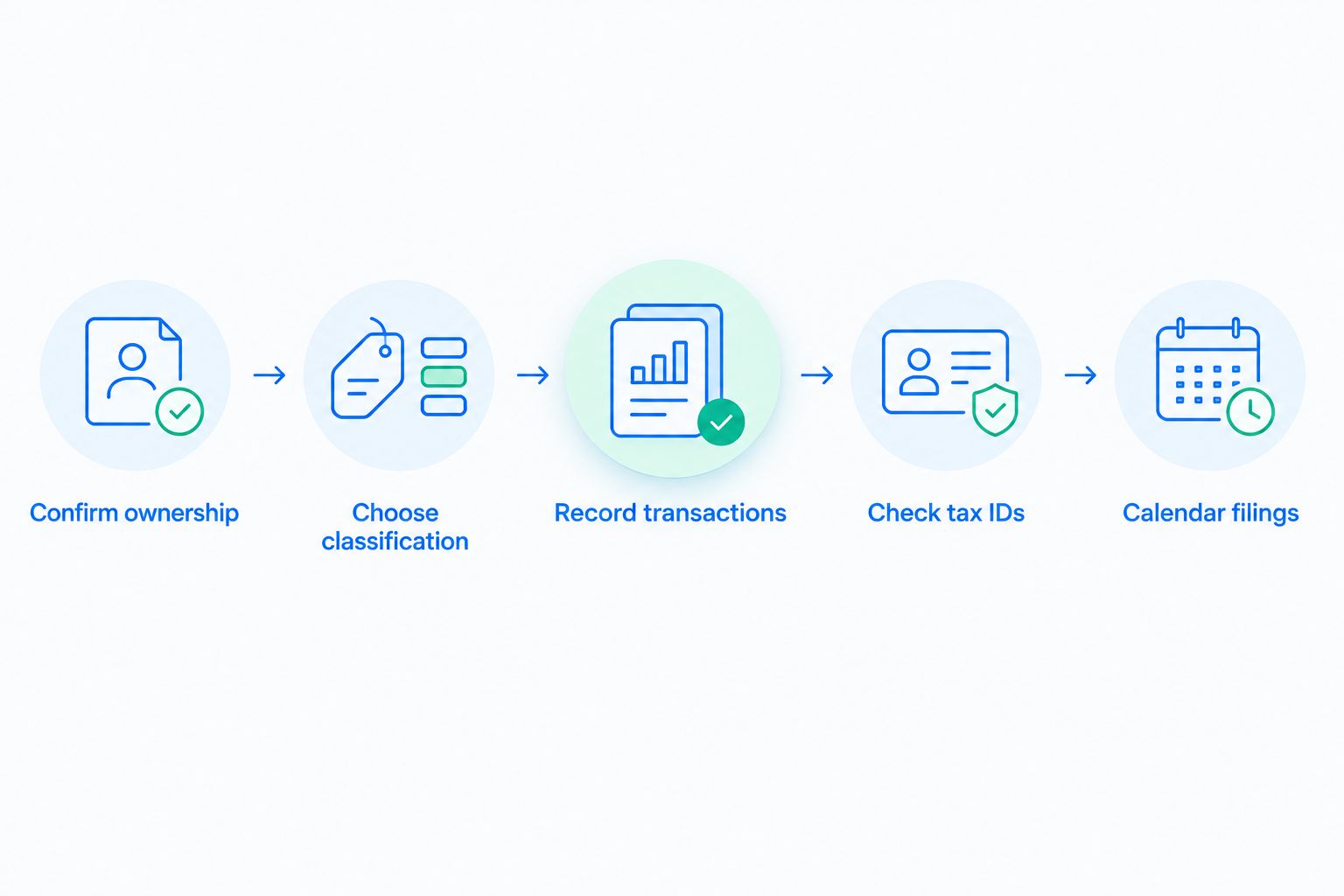
For 2026 transactions, retain statements and receipts even if your tax preparer will not request them until later. Reconstructing owner payments after the first filing deadline creates avoidable uncertainty.
Do you need an EIN, an ITIN or both?
An EIN identifies a business or other entity for federal tax administration. An ITIN identifies an individual who needs a US taxpayer identification number but is not eligible for an SSN. They are not substitutes.
The IRS provides an EIN application route for international applicants who cannot use its online application. Form SS-4 instructions address responsible parties who are ineligible for an SSN or ITIN; follow those instructions rather than entering an unrelated person's number.
An ITIN application uses Form W-7 and generally accompanies a federal income tax return unless an exception applies. An ITIN that has not appeared on a federal tax return for 3 consecutive tax years expires; renewal is relevant when it is needed for a return.
Official sources: IRS, Instructions for Form SS-4, “International applicants,” Instructions for Form W-7, and “Individual taxpayer identification number.”
When are the first federal returns due?
For a calendar-year foreign-owned disregarded LLC, the Form 5472 filing package generally follows the applicable Form 1120 deadline: the 15th day of the fourth month after year-end. A calendar-year partnership generally files Form 1065 by the 15th day of the third month after year-end.
Form 7004 generally provides a 6-month filing extension for these returns when properly submitted by the original deadline. An extension to file does not extend the time to pay tax. Weekend and legal-holiday rules can shift the actual filing date.
Form 1040-NR has separate deadline rules depending on the individual's circumstances. Do not copy the LLC's deadline onto the owner's personal tax calendar without checking it.
Official sources: IRS, Instructions for Forms 1120, 1065, 7004, and 1040-NR.
FAQ
Does my LLC need to file taxes if it made no money?
An LLC can have filing obligations without revenue. For a foreign-owned disregarded LLC, owner contributions or other reportable transactions can trigger Form 5472 with a pro forma Form 1120.
Can I form a US LLC without an SSN?
A non-resident entrepreneur does not need an SSN simply to own a US LLC. State formation requirements and the IRS EIN application process are separate, and international applicants must follow the applicable Form SS-4 instructions.
Does forming an LLC mean I owe US income tax?
Forming an LLC does not by itself determine your US income tax liability. Ownership, tax classification, income and business activity determine the analysis, while information reporting can apply separately.
Does an EIN replace my ITIN?
An EIN does not replace an ITIN. The EIN identifies the business, while an ITIN identifies an eligible individual taxpayer who cannot obtain an SSN.
Can I extend the deadline for Form 5472?
A foreign-owned disregarded LLC generally requests an extension for its Form 5472 filing package using Form 7004 by the original deadline. Follow the special IRS instructions for foreign-owned US disregarded entities.
Does a one-time formation service fee cover future filings?
A one-time formation service fee does not remove future legal or tax obligations. Confirm the service scope and distinguish service fees from government charges, future returns and state reporting requirements.
Can I close an unused LLC and ignore its first tax period?
Closing an unused LLC does not erase reporting obligations from its existence or transactions. Review final federal filings, state closure requirements and owner transactions before treating the business as finished.
One last thing
Your first important tax record might be a payment from you—not a sale to a customer. Before forming in 2026, document who will pay registration expenses and how the LLC will record that funding.
Corpulate's service fees are one-time costs, not monthly subscriptions. Government charges and future filing obligations remain separate; confirm the exact scope before engaging a service.
Related guides
- EIN applications for Shopify dropshippers
- Using an ITIN to file taxes without a green card
- Tax filing services for non-resident aliens
Author: Hassaan Ullah Khan, IRS CAA — Corpulate
This article provides general information, not advice for your specific tax position.