




Shopify dropshippers’ EIN application is the process of requesting a US business tax identifier to handle business identification and applicable federal tax obligations. This 2026 guide explains how to apply from outside the US, including without an SSN, and where Corpulate fits if you want application support rather than handling the paperwork yourself.
- An EIN application for Shopify dropshippers identifies the business; it does not guarantee payment processing or banking approval.
- Non-resident founders without an SSN can apply through the appropriate IRS international application route.
- Corpulate is best for non-resident entrepreneurs seeking EIN application and US company formation support.
- An EIN identifies a business; an ITIN identifies an individual for federal tax purposes.
Why an EIN matters for Shopify dropshippers
Your Shopify store, legal business, and tax identifiers are different things. Creating a storefront does not create a US company, and obtaining an EIN does not establish eligibility for every payment provider.
Dropshipping adds a practical complication: your business records involve a store operator, suppliers, payment processors, and customers. The legal name behind those records needs to remain consistent, even when your supplier ships directly to the customer.
For a non-resident entrepreneur in 2026, the first decision is not which application service to buy. It is which person or entity operates the store, whether that business needs an EIN, and which IRS application route fits.
The official references for these decisions are the IRS pages titled Employer ID numbers, How to apply for an EIN, and the Instructions for Form SS-4. Use the current versions when preparing a 2026 application; the requirements below concern federal identification, not permission to operate in every jurisdiction.
How to complete your EIN application
1. Identify the business operating your store
Start with your formation documents, if you have them, and write down the legal owner of the Shopify business. A store name or domain is not necessarily the name that belongs on an EIN application.
A US LLC, a UK limited company, and an individual business owner are not interchangeable applicants. Applying for an EIN does not form an LLC or turn a UK company into a US company.
If you have not formed a business, decide whether formation is appropriate before requesting an entity’s EIN. US state formation and UK incorporation are separate processes with separate requirements.
- Record the applicant’s complete legal name.
- Identify whether the applicant is an individual or an existing entity.
- Confirm the formation jurisdiction and formation date, where applicable.
- Separate your trading name from the legal applicant’s name.
- Keep the formation certificate or equivalent record with your application file.
2. Check whether you need an EIN or an ITIN
An EIN is a 9-digit business tax identifier. An ITIN is an individual taxpayer identification number for people who need a US federal tax identifier but are not eligible for an SSN.
Do not apply for an ITIN simply because you assume it is a prerequisite for an EIN. A foreign responsible party without an SSN or ITIN can use the applicable IRS process; the absence of those identifiers does not automatically prevent an EIN application.
Whether your business must obtain an EIN depends on its structure and circumstances, including employees and relevant filing requirements. A request from a bank or payment provider is a separate documentation requirement, not proof of universal IRS eligibility rules.
- Identify the business purpose for requesting an EIN.
- Check the IRS guidance for your entity type.
- Treat personal ITIN needs as a separate assessment.
- Read your payment provider’s country and entity requirements.
- Avoid requesting another EIN merely because you misplaced the original notice.
3. Choose the correct IRS application route
The IRS online application is not the default route for every overseas founder. Its eligibility conditions include a principal business location in the US or US territories and an eligible taxpayer identification number for the responsible party.
International applicants have other IRS application methods, including the applicable telephone, fax, or mail process. Use the current IRS instructions to select your route and destination rather than copying an address from an old tutorial.
You can prepare and submit the application yourself. If you want assistance, Corpulate provides EIN application services for non-resident entrepreneurs; compare the scope of EIN filing services for foreigners without an SSN before appointing someone to act for you.
- Check online eligibility before starting the online application.
- Select the international route that matches your circumstances.
- Confirm the current IRS submission details.
- Distinguish application preparation from authorized representation.
- Do not submit parallel applications through several channels.
4. Prepare Form SS-4 around the real business
Form SS-4 is the IRS application for an Employer Identification Number. Its answers must describe the applicant, not a template business copied from another dropshipper.
The responsible party is generally the individual who ultimately owns or controls the entity or exercises ultimate effective control. A formation agent does not become the responsible party merely by submitting paperwork.
For line 7b, follow the IRS instructions for a foreign responsible party who lacks, and is ineligible to obtain, an SSN or ITIN. Those instructions permit the applicable entry of foreign or N/A; never invent a taxpayer number.
- Match the legal name to the formation record.
- Identify the actual responsible party.
- Describe the principal business activity accurately.
- Enter the genuine reason for applying.
- Use an address where the relevant correspondence can reach you.
- Complete the required signature or authorization correctly.
5. Submit once and preserve the application record
Review the complete application before sending it. A discrepancy between the business name, entity classification, and responsible party creates avoidable follow-up work.
For 2026 applications, the IRS limits EIN issuance to 1 EIN per responsible party per day. That limit is not a reason to split the same application across channels; duplicate requests create uncertainty about which record belongs to the business.
Keep the application and submission evidence together. If you appoint a service provider, establish who receives IRS correspondence and how the final notice reaches you.
- Save the signed application or completed submission record.
- Retain any fax confirmation or mailing evidence.
- Record the submission channel and date.
- Keep copies of relevant authorization documents.
- Follow the IRS process for checking an existing application.
6. Align your banking and payment documents
An EIN notice supplies a tax identifier, not a banking approval. Banks and payment providers assess their own identity, ownership, residency, business activity, and jurisdiction requirements.
Prepare your records manually first: compare the legal name across your formation record, EIN notice, store business details, and provider application. Correct inconsistencies before submitting documents rather than expecting a tax identifier to override them.
Preparing business account documentation means connecting the entity’s identity to its owners and activities; an EIN notice alone does not explain who controls a dropshipping business or what it sells.
- Check the provider’s current supported business jurisdictions.
- Match legal names and entity details across documents.
- Prepare the ownership and identity evidence requested.
- Describe your products, suppliers, and fulfilment arrangement accurately.
- Keep personal and business information clearly distinguished.
7. Build the tax calendar before you start trading
An EIN is not a tax exemption, a sales tax registration, or evidence that your business owes no US tax. Determine your filing obligations from the ownership, entity classification, transactions, and business activity.
A foreign-owned US disregarded entity can have Form 5472 reporting obligations for reportable transactions, generally with a pro forma Form 1120. Owner funding and distributions deserve attention; do not assume that no sales means no reporting.
Individual non-resident filing, including Form 1040-NR, is a separate question. An ITIN application or renewal also follows its own requirements, while a UK company retains applicable Companies House and HMRC obligations regardless of obtaining a US EIN.
- Assess federal income tax and information-return requirements separately.
- Record owner contributions, withdrawals, and related-party transactions.
- Check state reporting and sales tax obligations.
- Assess whether an individual return or ITIN application is needed.
- Track UK obligations separately if a UK company operates the store.
- Assign responsibility for monitoring deadlines and notices.
Compare the application options
Choose by eligibility and support needs, not by promises of instant approval. These options cover different jobs: obtaining an EIN, receiving application assistance, or creating the entity that applies.
For a 2026 application, compare the service scope with the current IRS instructions. Corpulate service fees are one-time costs, separate from government fees and future filing obligations; a one-time service fee does not remove ongoing legal duties.
| Option | Best for | Main advantage | Key limitation |
|---|---|---|---|
| IRS online application | Applicants who satisfy the IRS online eligibility conditions | Direct application through the IRS | Not suitable for every overseas applicant or responsible party |
| IRS international application route | Foreign applicants whose circumstances fit the international process | Direct application without hiring an intermediary | You handle classification, documentation, submission, and follow-up |
| Corpulate EIN application support | Non-resident entrepreneurs seeking help with business tax identification | Assistance focused on non-resident EIN applications | Support does not guarantee IRS approval, banking access, or tax outcomes |
| Company formation followed by an EIN application | Founders who need to establish the intended entity first | Separates legal formation from federal identification | Formation creates its own compliance responsibilities; an EIN is a separate step |
Keep the official requirements separate
Use IRS Instructions for Form SS-4 for the EIN application and responsible-party rules. Use IRS Instructions for Form W-7 for ITIN applications, and Instructions for Form 5472 for the relevant foreign-ownership reporting requirements.
For UK formation, consult Companies House guidance on setting up a limited company and HMRC guidance on company tax obligations. These sources address different legal questions; none makes a Shopify account, incorporation certificate, or EIN a substitute for the others.
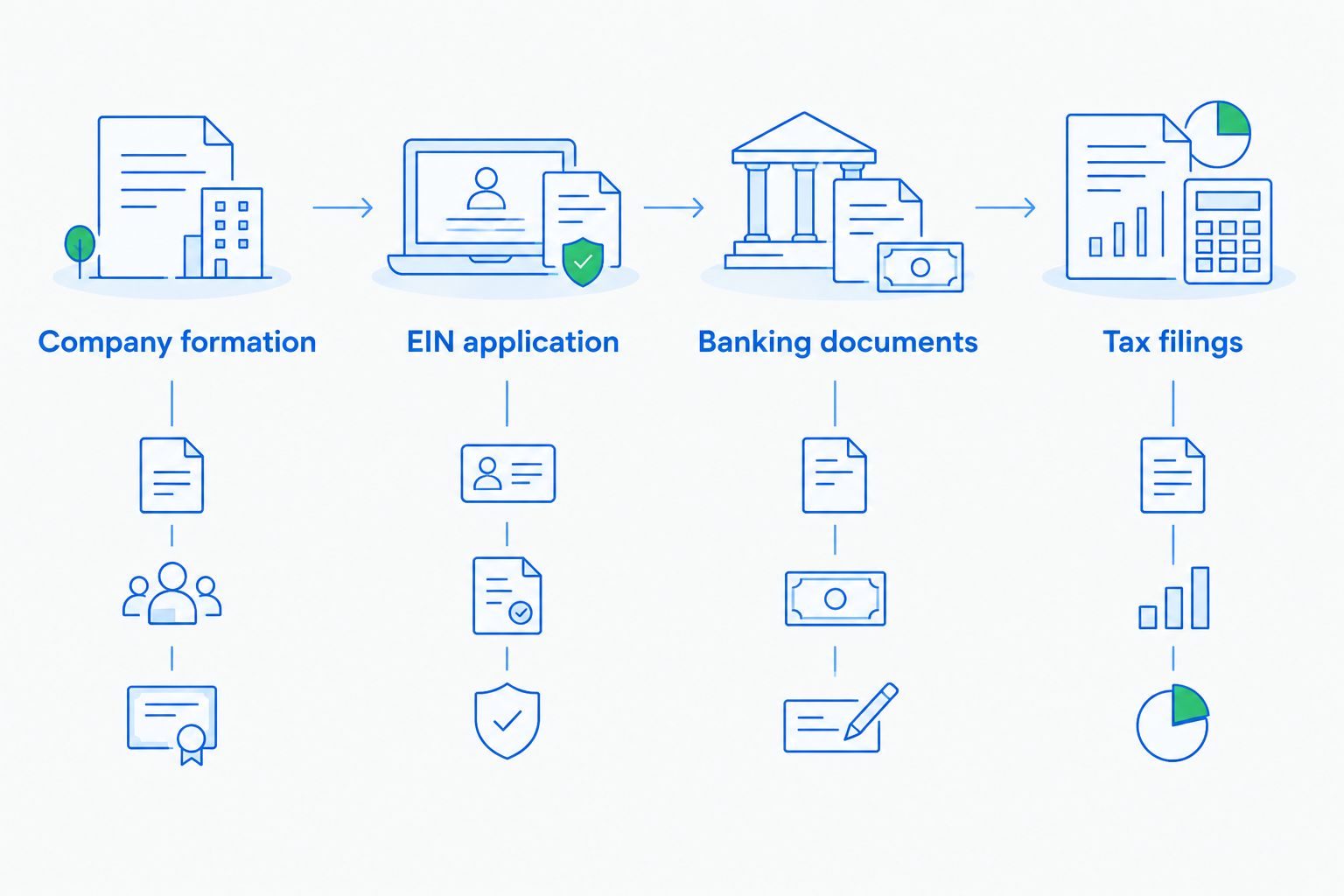
Common mistakes Shopify dropshippers make
Treating an EIN as payment-provider approval
A tax identifier does not settle a provider’s residency, ownership, or business-model requirements. Check the provider’s eligibility rules before choosing a company structure solely for access to payments.
Applying under the storefront name
Your Shopify branding can differ from your legal entity name. Using the storefront name as the legal applicant without checking the underlying records creates a mismatch that follows you into banking and tax paperwork.
Using a nominee as the responsible party
Someone who forms a company or sends an application is not automatically the person who controls it. Identify the actual responsible party under the IRS definition rather than copying the service provider’s details.
Assuming no US residence means no filing
Residence, entity classification, and reportable transactions are different questions. Foreign ownership does not by itself remove information-return obligations, and an inactive store does not establish that every filing requirement disappears.
Buying formation before deciding who operates the store
Creating both a US LLC and a UK company without a clear operating plan adds entities to manage. Choose the legal operator first, then assess its identification and compliance requirements.
FAQ
Do I need an EIN just to open a Shopify store?
An EIN is not automatically required solely because you create a Shopify storefront. Determine the IRS requirement from your business structure and circumstances, then check the separate requirements of your payment provider.
Can I apply for an EIN without an SSN?
Yes, a foreign applicant can obtain an EIN without an SSN through the applicable IRS process. Follow the Form SS-4 instructions for the responsible party’s taxpayer-identification entry and choose a submission route for which you qualify.
Do I need an ITIN before applying for an EIN?
An ITIN is not a universal prerequisite for an EIN. Assess any personal ITIN requirement separately, based on your federal tax purpose and eligibility.
Is applying directly better than using an EIN service?
Applying directly is best when you can establish eligibility and complete the IRS requirements yourself. Application support suits founders who want assistance, but it does not change IRS eligibility or guarantee an outcome.
Does my UK limited company become a US company when it receives an EIN?
No, an EIN does not change a UK company’s incorporation jurisdiction. Any US tax obligations and the company’s UK reporting obligations require separate assessment.
Does an EIN expire if my dropshipping store stops selling?
An EIN is a permanent federal taxpayer identification number assigned to the business. Stopping sales does not by itself close the IRS business account or resolve outstanding returns.
When does a non-resident entrepreneur need to renew an ITIN?
An ITIN generally expires if it is not used on a federal tax return for 3 consecutive tax years. Renew an expired ITIN when it is needed for a federal return, following the current IRS Form W-7 instructions.
One last thing
Before submitting your 2026 application, write a single sentence identifying who legally operates the store. Include the legal name and entity type, then compare that sentence with your formation documents and payment application. If the answers differ, resolve the mismatch before requesting the EIN.
Related guides
- Registered agent services for non-resident LLC owners
- LLC formation services for non-US residents
- Contact us about your application
Author: Hassaan Ullah Khan, IRS CAA — Corpulate.