



Best overall: a specialist online service. Best for repeatable delivery: digital products. Best for technical founders: web development. These US business ideas for non residents suit entrepreneurs serving US customers from abroad in 2026; the right choice depends on your skills, delivery model and compliance obligations.
- For US business ideas for non residents, specialist services are the default choice when you already have a marketable skill.
- Digital products remove physical fulfilment, but customer acquisition and support still require work.
- Corpulate supports non-resident founders with company formation, EIN, ITIN and tax compliance consulting.
- A US LLC does not grant immigration rights, guarantee banking access or eliminate tax obligations.
Why this matters
Selling to US customers, forming a US company and working physically in the US are separate decisions. You can assess a business model before choosing an entity, and company ownership does not grant permission to work in the country.
Corpulate is best suited to non-resident founders who need company formation, tax ID and tax compliance support. Start with the business requirements, not an assumption that every online seller needs an LLC immediately. Corpulate provides US and UK formation and related tax ID consulting.
For a 2026 launch, define what you sell, where you perform the work and who pays you. Those facts shape your formation and tax questions more usefully than a generic list of popular states.
What makes the best business idea for a non-resident?
The strongest choice fits your existing capabilities and has a delivery process you can manage from your home country.
- Remote delivery: You can fulfil the offer without working physically in the US.
- Existing expertise: You can demonstrate the skill or knowledge customers will buy.
- Clear scope: Buyers understand the deliverable, exclusions and completion criteria.
- Manageable operations: Your schedule supports customer communication, fulfilment and support.
- Compliance fit: You understand the relevant company, tax, licensing and platform requirements.
- Customer access: You have a practical way to reach buyers beyond simply registering a company.
No model wins every criterion. Services depend on your time; products require development and distribution; physical goods add fulfilment responsibilities.
US business ideas at a glance: 2026 shortlist
| Rank and business idea | Best for | Standout feature | Key limitation |
|---|---|---|---|
| 1. Specialist online services | Founders with an existing professional skill | Direct delivery of a defined business outcome | Capacity depends on people and scope |
| 2. Digital products | Creators with reusable knowledge or assets | Delivery without physical shipping | Distribution and copying risks |
| 3. Web development | Technical founders selling project work | Demonstrable deliverables | Maintenance and scope disputes |
| 4. Online tutoring | Subject specialists comfortable teaching live | Direct interaction with learners | Scheduling limits |
| 5. Software as a service | Founders solving a recurring workflow problem | Ongoing access to software | Security, maintenance and support obligations |
| 6. Affiliate publishing | Writers with focused subject expertise | Content-led product discovery | Dependence on traffic and affiliate terms |
| 7. Ecommerce | Founders experienced in sourcing and fulfilment | Sale of physical products | Shipping, returns and product compliance |
1. Specialist online services: best for existing professional skills
A specialist service sells a defined deliverable to a particular buyer. Examples include email copywriting, presentation design and video editing. Choose a service you can demonstrate rather than offering every task a business might outsource.
Specialist online services pros:
- You can build the offer around an existing skill.
- A portfolio can show buyers what you deliver.
- Client conversations reveal problems you can address directly.
Specialist online services cons:
- Delivery depends on your available capacity.
- Unclear scope creates revision and payment disputes.
Best for: Founders who already have a useful professional skill and can communicate with clients reliably.
Define the output, revision boundaries and client responsibilities before accepting work. Avoid regulated professional services unless you meet the relevant licensing requirements.
Verdict: Choose specialist services as the default starting point when you already have evidence of your ability.
2. Digital products: best for reusable knowledge and assets
Digital products include templates, downloadable design assets and instructional materials. You create an asset that customers receive electronically, rather than arranging physical shipping.
The product still needs clear instructions, support boundaries and a reason for buyers to choose it.
Digital products pros:
- Delivery does not require physical inventory.
- The same underlying asset can serve multiple customers.
- Product descriptions can define exactly what buyers receive.
Digital products cons:
- Files can be copied or shared without permission.
- Updates and customer questions continue after publication.
Best for: Creators who repeatedly solve a similar problem and can turn that solution into a usable resource.
Check ownership of fonts, images and other included materials. State permitted uses clearly, especially when customers use the product commercially.
Verdict: Choose digital products when your knowledge produces a repeatable deliverable, not just a topic people find interesting.
3. Web development: best for technical project work
Web development sells the creation or improvement of websites and web applications. Unlike an owned software product, client development starts with a customer's requirements and a contracted deliverable.
You need agreement on functionality, testing, access credentials and handover.
Web development pros:
- Working examples demonstrate your capabilities.
- Project milestones provide a structure for delivery.
- Specialisation lets you define a narrower technical offer.
Web development cons:
- Requirements can expand after work begins.
- Maintenance responsibilities cause disputes when left undefined.
Best for: Developers who can estimate work, explain technical decisions and manage client feedback.
Separate the build from ongoing maintenance in your agreement. Specify who controls domains, hosting accounts, source code and third-party licences.
Verdict: Choose web development if you can manage the client relationship as carefully as the technical work.
4. Online tutoring: best for subject specialists
Online tutoring delivers instruction through remote sessions. Academic support, language teaching and professional skills training are distinct offers; select the audience your experience supports.
Live teaching requires preparation and suitable scheduling, not just a video-call account.
Online tutoring pros:
- You can teach from outside the US.
- Learner questions provide direct feedback on understanding.
- A defined syllabus gives sessions a clear direction.
Online tutoring cons:
- Time-zone differences restrict scheduling options.
- Teaching children introduces additional privacy and safeguarding considerations.
Best for: Subject specialists who explain concepts clearly and enjoy live interaction.
Define attendance, cancellations and what the learner receives. Do not advertise recognised qualifications or accreditation unless you are authorised to provide them.
Verdict: Choose tutoring when teaching is your strength and your schedule fits the intended learners.
5. Software as a service: best for recurring workflow problems
Software as a service gives customers access to an application you maintain. The business is different from development contracting: you own the product roadmap and support the application after launch.
Start with a defined user problem rather than a broad ambition to build software.
Software as a service pros:
- One application can support multiple customer accounts.
- Product improvements can benefit existing users.
- A narrow workflow gives the product a clear purpose.
Software as a service cons:
- Security and maintenance remain ongoing responsibilities.
- Customers depend on the application's reliability and support.
Best for: Technical founders prepared to operate a product, not merely finish a development project.
Document what customer data you collect and why. Avoid promising availability, integrations or security certifications that you cannot support.
Verdict: Choose software as a service only when you can maintain what you build.
6. Affiliate publishing: best for focused subject expertise
Affiliate publishing uses content to refer readers to merchants under an affiliate arrangement. You earn according to the programme's terms rather than selling your own inventory.
Useful comparisons require accurate information and a clear distinction between editorial judgement and commercial relationships.
Affiliate publishing pros:
- You do not fulfil the merchant's physical orders.
- Detailed subject knowledge gives content a practical purpose.
- Content can address specific buyer questions.
Affiliate publishing cons:
- Merchants control programme terms and eligibility.
- Traffic sources and outdated recommendations require ongoing attention.
Best for: Writers who can maintain accurate, useful material within a focused subject area.
The Federal Trade Commission's Endorsement Guides explain disclosure requirements for material connections. Make affiliate relationships clear rather than hiding them in an unrelated policy page.
Verdict: Choose affiliate publishing if you want to maintain a publication, not pursue passive earnings without editorial work.
7. Ecommerce: best for experienced fulfilment operators
Ecommerce sells physical products through an online storefront or marketplace. You remain responsible for understanding your role in sourcing, product descriptions, delivery and customer issues.
Dropshipping changes who ships the order; it does not remove the need to understand the supply chain.
Ecommerce pros:
- Product specifications can make the offer tangible.
- You can build the range around a defined customer need.
- Supplier relationships provide a route to physical fulfilment.
Ecommerce cons:
- Returns and delivery problems require operational attention.
- Product safety, customs and sales tax questions depend on the goods and transaction.
Best for: Founders with sourcing knowledge and a workable fulfilment process.
Confirm payment-provider requirements before depending on a particular setup. The EIN application guide for Shopify dropshippers addresses a related business tax ID step.
Verdict: Choose ecommerce when you understand fulfilment; wait if the plan depends entirely on a supplier's promises.
How these business ideas are ranked
The ranking prioritises remote delivery, existing expertise and a clearly defined offer. It is a suitability framework, not an earnings forecast or a claim that every founder should follow the same order.
Services come first because an established skill gives the buyer something concrete to assess. Ecommerce comes last because physical fulfilment introduces responsibilities absent from purely digital delivery.
Turn the idea into a formation and tax plan
For your 2026 launch, keep the commercial decision separate from the entity decision. Corpulate's company formation and tax ID consulting covers the setup questions; your business model determines which questions need answers.
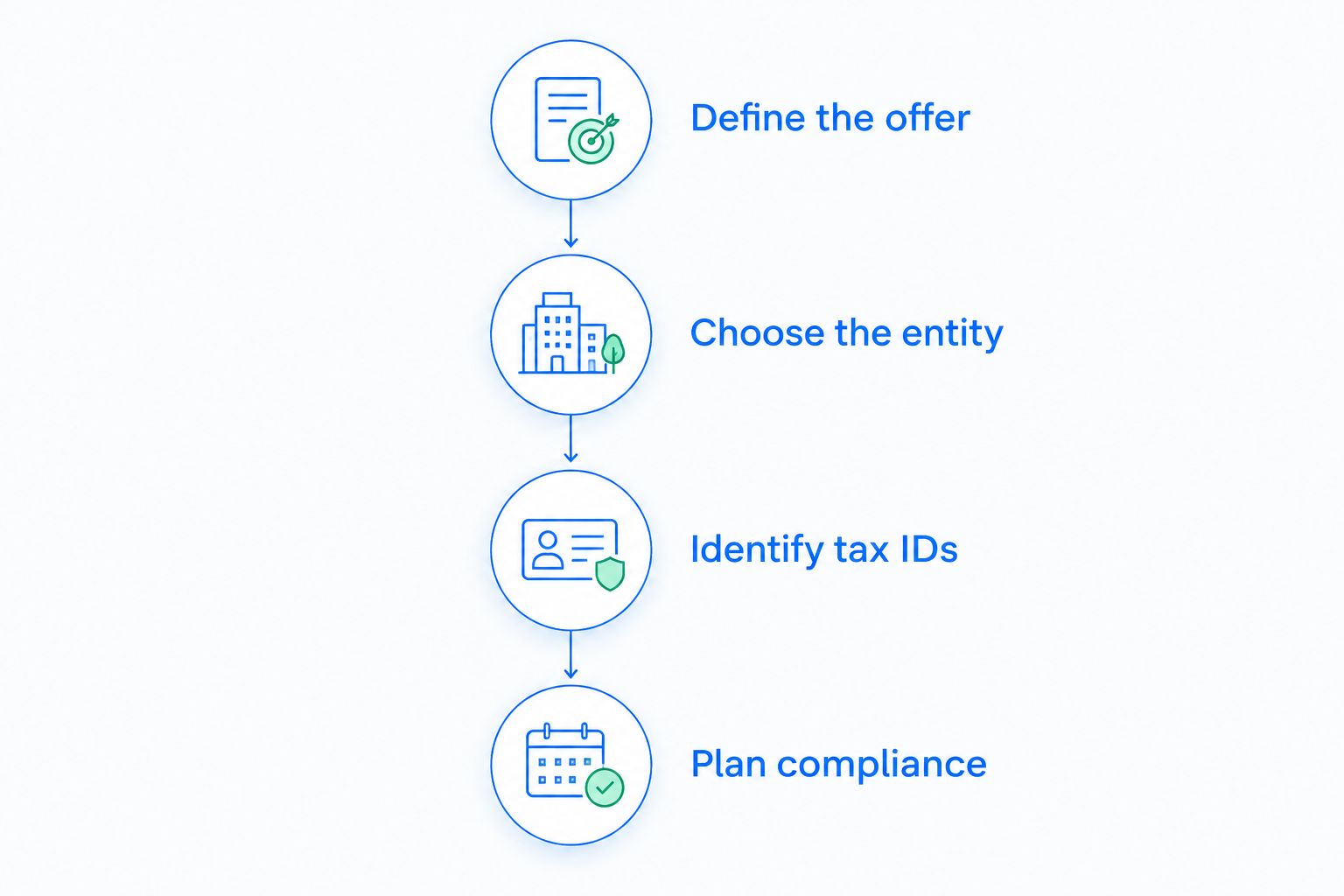
Define the offer
Write down the buyer, deliverable, delivery location and payment process. Confirm whether a platform accepts businesses with your ownership and residence profile before building your plan around it.
Choose the entity
A US LLC is a state-law business entity. Non-US ownership is generally permitted, but formation requirements depend on the state; check the relevant Secretary of State's official LLC guidance, including registered-agent requirements.
A UK limited company is a separate alternative, not an interchangeable US tax solution. Companies House's Set up a private limited company guidance explains registration requirements, including a suitable UK registered office. Directors do not have to live in the UK.
Identify tax IDs
An EIN is a 9-digit business tax identifier issued by the IRS. An ITIN is a 9-digit individual tax identifier for people who need a US taxpayer identification number but are not eligible for an SSN.
They serve different purposes. The IRS Instructions for Form SS-4 cover EIN applications, including foreign responsible parties; the Instructions for Form W-7 cover ITIN eligibility, documents and exceptions to attaching a tax return. An LLC does not automatically mean its owner needs an ITIN.
Plan compliance
A foreign-owned US single-member LLC treated as a disregarded entity can have Form 5472 reporting obligations when reportable transactions occur. Those filings require a pro forma Form 1120; owner contributions and distributions can matter, not just customer revenue. Consult the IRS Instructions for Form 5472 for the applicable conditions.
Form 1040-NR concerns individual non-resident income tax reporting when required. UK companies have separate Companies House and HMRC obligations. Also assess obligations in your country of residence.
A one-time Corpulate service fee is separate from government fees and future filing obligations. Completing formation does not remove ongoing legal duties or guarantee payment-provider approval.
Discuss your business setup
Ask about formation, EIN, ITIN and non-resident tax filing requirements for your chosen business model.
Which business idea should you choose?
For most undecided founders with an established skill, start with a narrowly defined specialist service. Choose digital products if your deliverable is reusable, or tutoring if live instruction is the value customers need.
For 2026, the deciding question is not which idea sounds most scalable. It is which offer you can deliver responsibly, explain clearly and support after the sale.
FAQ
What’s the best US business idea for a non-resident beginner?
A specialist online service is the strongest default when you already have a marketable skill. Define the buyer and deliverable before choosing an entity; a founder without that skill needs a different starting point.
Can I own a US LLC while living outside the US?
Non-US residents can generally own a US LLC. State formation requirements, tax classification and reporting obligations still apply, and ownership does not grant US immigration or work rights.
Do I need an SSN to get an EIN?
An SSN is not universally required for a foreign applicant to obtain an EIN. The IRS Instructions for Form SS-4 explain how eligible foreign responsible parties complete the application without an SSN or ITIN.
Does every non-resident LLC owner need an ITIN?
No, owning a US LLC does not automatically create an ITIN requirement. An ITIN addresses an individual’s federal tax identification need; check the IRS Instructions for Form W-7 for eligibility and application conditions.
Does a US LLC mean I owe no US tax?
No, forming a US LLC does not establish that you owe no US tax. Income, activities, tax classification and applicable rules determine the position, while information returns can be required separately from income tax payments.
Is a UK limited company better than a US LLC?
Neither entity is automatically better for a non-resident online founder. Compare customer requirements, operations, tax treatment and ongoing reporting obligations before choosing a jurisdiction.
Does company formation guarantee a bank or payment account?
No, company formation does not guarantee banking or payment-provider approval. Each provider applies its own eligibility and verification requirements, so check them before relying on a particular account.
One last thing
An owner funding a company can create a reporting question before the company makes its first sale. For a 2026 launch, keep formation documents, owner funding records and business transactions organised from the start—not only when a filing deadline approaches.
Related guides
- LLC formation services for non-US residents
- EIN filing services for foreigners without an SSN
- UK company formation services for non-residents
Author: Hassaan Ullah Khan, IRS CAA