




Your US business launch checklist for 2026 should cover your business structure, state registration, registered agent, EIN, banking documents, licences and tax-filing obligations before you start trading. If you live outside the US, separate the company’s requirements from your personal tax position: forming an LLC does not automatically give you banking access, remove tax obligations or make an ITIN necessary.
- Use this US business launch checklist to separate company formation, tax IDs and ongoing compliance before trading.
- Corpulate serves non-resident entrepreneurs seeking US company formation and tax-ID assistance.
- An EIN identifies your business; an ITIN identifies an eligible individual for federal tax purposes.
- Company registration does not guarantee banking approval or eliminate future tax filings.
What belongs on your US business launch checklist in 2026?
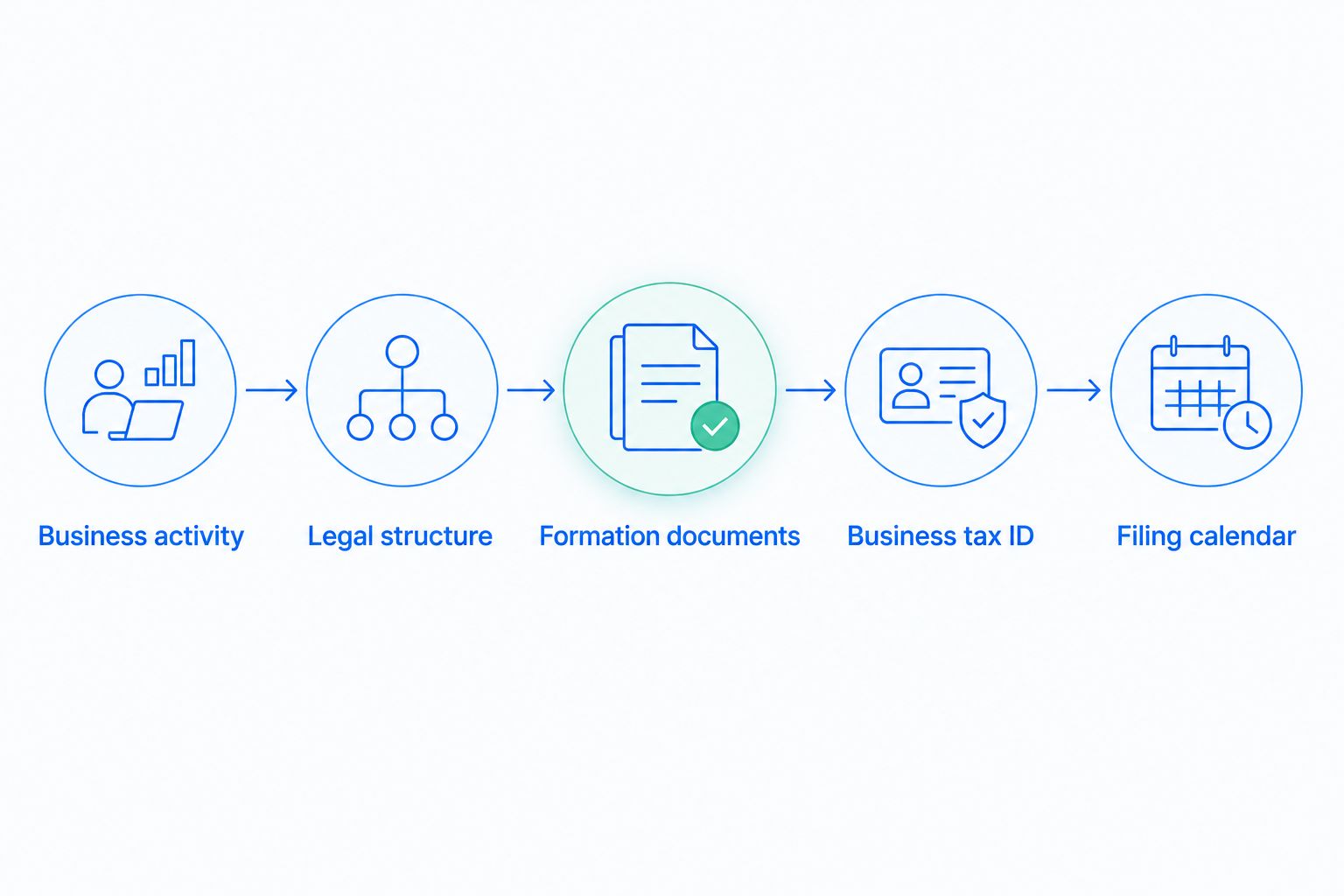
Complete the checklist below before treating your company as ready to trade. A formation certificate confirms registration; it does not confirm that your entire business is compliant. Keep the supporting documents together so your bank, payment provider and tax preparer receive consistent information.
For help connecting registration with tax-ID applications, Corpulate provides company formation, EIN, ITIN and non-resident tax compliance consulting.
Establish the business activity
Write down what you will sell, where you will perform the work, where customers are located and whether anyone will work for you in the US. Include physical goods, warehouses and inventory rather than describing every online business simply as ecommerce.
These facts affect licensing, state registration and tax analysis. Your website address alone does not explain where your business operates.
Choose the legal structure
Decide whether an LLC or corporation fits your ownership and operating plans. An LLC is a legal structure created under state law; its federal tax treatment is a separate question.
Do not assume that every LLC files the same tax return. The IRS’s guidance on Limited Liability Companies distinguishes treatment according to ownership and tax elections, so establish that treatment before choosing filing services.
Select the state deliberately
Check the formation requirements, registered-agent rules and continuing obligations on the relevant state authority’s website. Consider where you actually conduct business before choosing a state solely because its formation process looks straightforward.
Registering in one state does not automatically remove registration requirements elsewhere. The US Small Business Administration’s Register Your Business guidance explains that businesses operating across states can need additional registration, commonly called foreign qualification.
Appoint the registered agent
A registered agent receives official legal documents for your company under the relevant state’s rules. Confirm the agent’s responsibilities and keep its details current.
Do not treat a registered-agent address as interchangeable with your operating address, mailing address or the address requested by a bank. Each recipient applies its own requirements, and the information you submit must accurately describe your business.
File and retain the formation documents
Submit the required formation filing to the state and retain the accepted documents. For an LLC, prepare an operating agreement that records ownership and management arrangements, even when there is only one owner.
Keep the legal name consistent across subsequent applications. An informal trading name, website name and registered company name are not automatically interchangeable.
Apply for the business tax ID
Determine whether your business needs an employer identification number, or EIN, and use the application route that fits the responsible party’s circumstances. The responsible party is the individual who ultimately owns or controls the entity, subject to the IRS definition.
Applicants outside the US should not assume they qualify for the IRS online application. The EIN filing guide for foreigners without an SSN addresses that specific application situation; eligibility and application instructions still come from the IRS.
Assemble banking and payment documents
Prepare the company’s formation records, ownership information, identity documents, EIN confirmation and an accurate explanation of its activities. Then check the chosen bank or payment provider’s own requirements.
An EIN is not a banking approval. A provider can request additional evidence or decline an application, so do not promise customers a payment method before the account is approved and usable.
Check licences and sales-tax responsibilities
Review the rules for your activity and the locations connected with it. An online business is not automatically exempt from licences, permits or sales-tax registration.
For sales tax, examine physical presence and applicable economic-nexus rules, which connect registration obligations to business activity in a state. Use the relevant state revenue department’s guidance rather than applying one state’s threshold nationwide.
Establish bookkeeping before transactions begin
Record formation expenses, owner funding, withdrawals, customer receipts and business expenses from the start. Keep invoices, agreements and evidence of transfers rather than relying only on bank descriptions.
Separating business records from personal spending makes classification easier. It also helps identify transactions between a foreign owner and a US entity that require particular attention during tax preparation.
Build the filing calendar
List federal tax filings, state reports, registered-agent renewals and any applicable licence renewals. Assign responsibility for each item and record where filing confirmations will be stored.
Your 2026 calendar should follow your entity’s tax classification and actual activity. Do not copy another founder’s deadlines without checking that the same rules apply to your company.
Why this matters before you accept payments
A non-resident founder has separate relationships with the state registry, the IRS, banks and payment providers. Approval from one does not replace the requirements of the others, and submitting the same incomplete information repeatedly does not solve the underlying issue.
Corpulate is for non-resident entrepreneurs who need company formation and tax-ID assistance. The practical limitation is that consulting support cannot guarantee government approvals, account access or tax outcomes.
For a 2026 launch, focus on having an explainable structure and complete records. A company that exists on paper but lacks a filing plan is not finished with its launch preparation.
EIN: the business identifier
An EIN is a 9-digit federal tax identification number assigned by the IRS to a business or other entity. It is not a personal immigration document and does not establish your right to live or work in the US.
The IRS Instructions for Form SS-4 explain the application fields, responsible-party requirements and routes available to applicants. Those instructions also address situations in which a foreign responsible party has no SSN or ITIN and is ineligible to obtain one.
Use your registered legal details rather than improvising answers to fit an online form. If you already have an EIN, check whether a new one is actually required before applying again; the IRS publishes separate guidance on changes that require a new EIN.
ITIN: the individual taxpayer identifier
An ITIN is a 9-digit tax processing number for an individual who needs a US taxpayer identification number but is not eligible for a Social Security number. Owning a US company alone does not establish an ITIN application purpose.
The IRS Instructions for Form W-7 explain the federal tax purpose, identity documentation and return-attachment requirements, including specified exceptions. Establish which application reason applies before collecting documents or arranging certification.
For renewals, the IRS states that an ITIN expires if it is not included on a US federal tax return for 3 consecutive tax years. Check whether renewal is needed for an upcoming filing rather than treating every existing ITIN as automatically current.
| Identifier | Best for | What it identifies | Main limitation |
|---|---|---|---|
| EIN | Handling an entity’s federal tax identification requirements | A business or other entity | Does not replace an owner’s personal tax ID |
| ITIN | Meeting an eligible individual’s federal tax identification requirement | An individual ineligible for an SSN | Does not provide work authorisation or banking approval |
Choose the identifier that matches the filing requirement, not the one another founder obtained. Some owners need both identifiers; others do not need an ITIN at launch.
Separate company filings from your personal tax return
A foreign-owned US LLC can have reporting obligations even when its owner assumes that no US income tax is payable. Identify the entity’s classification and transactions before deciding which returns are necessary.
For example, IRS Instructions for Form 5472 address reporting by a foreign-owned US disregarded entity with reportable transactions. A disregarded entity generally is not treated as separate from its owner for federal income-tax purposes, but special reporting rules still apply.
Those instructions describe the associated pro forma Form 1120 filing. Owner contributions and distributions deserve attention in that analysis; do not look only at customer revenue when preparing the records.
Your personal position is separate. Form 1040-NR is the US Nonresident Alien Income Tax Return, but company ownership alone does not mean every owner must file it. The IRS Instructions for Form 1040-NR explain who must file and the relevant income and filing circumstances.
For 2026 planning, ask for a written list of applicable returns, the facts supporting that list and who will submit them. “Tax support included” is not a substitute for identifying the actual deliverables.
Why your launch requirements vary
Your checklist changes when the facts change. Review these factors before ordering formation or tax-ID assistance:
- Entity and ownership: An LLC’s owner count and tax elections affect federal treatment and filing requirements.
- Operating locations: US staff, inventory or premises can create requirements that a fully overseas operation does not share.
- Tax-ID eligibility: The business’s EIN application and the owner’s ITIN application have different purposes and evidence requirements.
- Transactions and income: Owner transfers, customer receipts and the nature of income affect the filing analysis.
- Existing registrations: A founder with an existing company or EIN needs a review of those records, not an automatic duplicate application.
The useful question is not whether another non-resident formed a company successfully. It is whether your proposed setup matches your own activity, ownership and documentation.
Can you launch a US business without an SSN?
An SSN is not universally required for a non-resident to form a US company or obtain an EIN. State formation rules and IRS application procedures are separate, so follow the route applicable to each rather than assuming an online form is the only option.
You still need accurate ownership information and supporting documents. An application route without an SSN does not remove identity checks or guarantee approval.
Should you form the company before you are ready to trade?
Form the company when its registration supports a defined operational need and you understand the obligations that start with it. Incorporating early can leave you managing reports and records before the business has customers.
For your 2026 decision, identify what formation enables now and what obligations begin immediately. Do not select a registration date solely to obtain a certificate sooner.
What should you confirm before hiring formation support?
Ask for a written scope that distinguishes formation documents, EIN assistance, ITIN work and tax-return preparation. These are separate deliverables; inclusion of one does not establish inclusion of the others.
Corpulate service fees are one-time costs, not monthly subscriptions. Keep those service fees separate from government charges and future filing obligations, and verify the current scope before instructing any work.
Request the document checklist and clarify which submissions remain your responsibility. Also establish how you will receive official confirmations and retain access to your company records after the engagement ends.
Clarify your launch requirements
Discuss company formation, tax IDs and non-resident filing needs before submitting applications.
Official sources for your 2026 checks
Use the IRS Instructions for Forms SS-4, W-7, 5472 and 1040-NR for federal application and filing requirements. Use the Small Business Administration’s Register Your Business and Apply for Licenses and Permits guidance for the formation framework.
Confirm state-specific requirements directly with the relevant state registry and revenue department. Check the instructions applicable to your filing period; a guide helps organise the work but does not replace the governing requirements.
FAQ
What should a non-resident put on a US business launch checklist?
A non-resident’s US business launch checklist should cover structure, state registration, a registered agent, tax IDs, banking documents, licences, bookkeeping and filing obligations. Separate the company’s requirements from the owner’s personal tax position.
Do I need an ITIN before applying for an EIN?
An ITIN is not a universal prerequisite for a foreign applicant to obtain an EIN. Follow the IRS Instructions for Form SS-4 for the responsible party’s circumstances and the appropriate application route.
Does a US LLC automatically give me a business bank account?
A US LLC does not automatically give you a business bank account. Banks apply their own identity, ownership and business-activity checks, and an EIN does not guarantee approval.
Does a company with no sales still need tax filings?
A company with no sales can still have filing obligations. For a foreign-owned US disregarded entity, review reportable owner transactions under the IRS Instructions for Form 5472 rather than assessing customer revenue alone.
When does an ITIN need renewal?
An ITIN expires if it is not included on a US federal tax return for 3 consecutive tax years. Check the IRS renewal instructions before using an expired ITIN on a return.
Are Corpulate service fees monthly subscriptions?
Corpulate service fees are one-time costs, not monthly subscriptions. Government charges and future filing obligations remain separate from the service fee.
Can forming a US company replace immigration permission?
Forming a US company does not give you permission to live or work in the US. Company ownership, tax identification and immigration permission are separate matters.
One last thing
Record your first owner transfer as carefully as your first sale. Funding a newly formed company is a business event, not merely moving money between accounts, and its treatment belongs in your bookkeeping and tax-filing analysis.
Before launching, save the transfer evidence alongside your formation records and explain its purpose. That small administrative step gives your tax preparer information that a year-end account balance cannot supply.
Related guides
- Should you register your US LLC now or wait until January?
- Registered-agent services for non-resident LLC owners
- Tax-filing services for non-resident aliens
Author: Hassaan Ullah Khan, IRS CAA