




Best overall for non-resident entrepreneurs: Corpulate. Best for students and scholars preparing an individual return: Sprintax. Best budget-focused assistance route: a VITA site that explicitly handles non-resident returns and accepts your circumstances. This 2026 guide compares filing support by taxpayer type, required forms and limits—not by promises of refunds or approval.
- Corpulate leads this best tax filing services for non-resident aliens shortlist for entrepreneurs needing tax IDs and compliance consulting.
- Sprintax suits non-resident students and scholars preparing individual returns; business obligations require separate attention.
- Choose a cross-border CPA or enrolled agent when ownership structures, treaty positions or multiple jurisdictions complicate filing.
- Use VITA only after confirming eligibility and whether the particular site prepares Form 1040-NR.
Why this matters
A non-resident entrepreneur and an international student can both need Form 1040-NR, but their filing work is not interchangeable. An entrepreneur also needs someone to identify business reporting obligations; a student needs the correct treatment of income, withholding and any applicable treaty provisions.
The best filing service is the one that identifies your complete filing scope before preparing a return. In 2026, start with your tax residency, income and ownership—not the provider's most prominent package.
What makes the best non-resident tax filing service?
Use these criteria before choosing a provider:
- Residency assessment: The provider distinguishes immigration status from US tax residency and checks relevant exceptions.
- Form coverage: The engagement identifies individual returns, business information returns and state filings separately.
- Tax ID support: The provider explains whether you need an EIN, an ITIN or neither for the particular filing.
- Cross-border competence: The preparer addresses relevant treaty provisions and identifies questions requiring advice in your home country.
- Defined responsibility: You know who prepares the return, who signs it and what happens if the IRS requests clarification.
- Clear engagement terms: Service fees, government charges and future filing obligations remain separate.
For 2026, also ask which tax period the engagement covers. A return filed during 2026 can concern an earlier tax year; the filing date does not determine which version of a form applies.
Non-resident tax filing options at a glance
| Option | Best for | Standout feature | Key limitation |
|---|---|---|---|
| Corpulate | Non-resident online business founders | Formation, tax ID and tax compliance consulting in one service profile | Confirm the exact return preparation scope before engagement |
| Sprintax | Non-resident students and scholars | Software designed around non-resident individual tax preparation | Individual preparation does not resolve separate business reporting |
| Cross-border CPA or enrolled agent | Complex ownership and international tax questions | An individually scoped professional engagement | Credentials alone do not establish relevant experience |
| University-based VITA assistance | Eligible filers needing guided help | Volunteer preparation at participating sites | Eligibility and non-resident return coverage are site-specific |
| Self-preparation using IRS instructions | Filers able to determine and document their obligations | Direct control over preparation and records | You bear responsibility for identifying every required filing |
1. Corpulate: best for non-resident business founders
Corpulate provides US and UK company formation, EIN and ITIN services, and tax compliance consulting for non-resident entrepreneurs. That combination fits founders who need to connect company setup with their personal and business tax responsibilities.
Corpulate is the best fit here for non-resident entrepreneurs seeking company formation, tax IDs and tax compliance consulting together. Confirm which returns the proposed engagement includes rather than treating consulting, preparation and filing as interchangeable services.
Corpulate pros:
- Its stated services focus on entrepreneurs living outside the US.
- Company formation and tax identification needs sit within the same service profile.
- US and UK formation support suits founders evaluating either jurisdiction.
Corpulate cons:
- The service description does not establish coverage for every state return, treaty position or ownership structure.
- A formation or tax ID engagement does not, by itself, cover future tax returns.
Best for: An online business founder who needs help connecting formation, identification and compliance requirements.
Ask for a written list of deliverables: the relevant tax year, entity classification, proposed forms, state obligations and responsibility for submission. Any quoted service fee should be described as a one-time cost for the specified work, not as payment that removes ongoing legal obligations.
Verdict: Buy only after the written scope matches your individual and business filing needs.
2. Sprintax: best for non-resident students and scholars
Sprintax provides tax preparation software for non-residents, including students and scholars preparing US individual returns. It is a different route from hiring an adviser to assess an international business structure.
The distinction matters when you have both personal income and company ownership. Completing an individual return does not establish that a separately owned entity has met its reporting duties.
Sprintax pros:
- Non-resident individual tax preparation is its stated focus.
- A software-led process suits users who want to work through their own information.
- It provides a named alternative to general resident-focused tax preparation.
Sprintax cons:
- You must establish whether its current scope covers your particular circumstances.
- Do not treat individual return preparation as confirmation of business or foreign-country compliance.
Best for: A non-resident student or scholar seeking software-led preparation of an individual US return.
Before selecting Sprintax in 2026, check the supported forms, state coverage and treatment of your income types directly with the provider. Escalate questions involving company ownership or disputed tax residency rather than forcing them into an unsuitable workflow.
Verdict: Buy for a matching individual filing need; skip as a substitute for business tax advice.
3. Cross-border CPA or enrolled agent: best for complex cases
A certified public accountant, or CPA, holds a state-issued professional license. An enrolled agent, or EA, holds an IRS credential; both categories have broad representation rights before the IRS, subject to applicable rules.
The credential is a starting point, not proof of non-resident expertise. Choose a practitioner whose actual work matches your income, entity structure and jurisdictions.
Cross-border practitioner pros:
- The engagement can address questions beyond completing a single form.
- You can request analysis of ownership, treaty positions and filing responsibilities together.
- A suitably experienced practitioner can explain the basis for a difficult tax position.
Cross-border practitioner cons:
- A CPA or EA designation does not establish experience with your home country's laws.
- Separate local advice remains necessary when the engagement excludes another jurisdiction.
Best for: Founders with multiple entities, partnership interests, uncertain residency, treaty questions or unresolved IRS correspondence.
Ask who will perform the work and whether the engagement includes representation after filing. For credential scope, the official reference is the IRS guidance on understanding tax return preparer credentials and qualifications; verify credentials through the relevant official records.
Verdict: Buy specialist advice when classification or interpretation—not data entry—is the main problem.
4. University-based VITA assistance: best for eligible guided filing
The IRS Volunteer Income Tax Assistance program, known as VITA, provides tax preparation assistance to eligible taxpayers. Some university-based programs handle non-resident student and scholar returns, but that capability is not universal.
Confirm the site's eligibility rules and Form 1040-NR scope before relying on it. A general VITA listing does not establish that the site accepts non-resident returns or business-owner cases.
University-based VITA pros:
- Participating sites provide guided preparation rather than leaving you entirely on your own.
- A university program handling non-resident returns can fit an eligible student or scholar.
- Site screening gives you a direct way to establish whether your return is within scope.
University-based VITA cons:
- Acceptance depends on the particular site's eligibility and preparation scope.
- Business ownership, complex income or treaty questions can fall outside the site's services.
Best for: An eligible filer whose circumstances a participating non-resident VITA site explicitly accepts.
Use the IRS VITA guidance and the participating institution's current instructions for 2026. Ask about required documents before attending, especially identification, income statements and immigration-related records.
Verdict: Buy into this route only after eligibility and non-resident coverage are confirmed; otherwise, skip it.
5. Self-preparation: best for filers who understand their obligations
Self-preparation means using the applicable IRS forms and instructions to determine, prepare and submit your own filings. It is an alternative to a filing service, not a professional assessment of your situation.
This route requires more than copying income figures. You must resolve residency, income treatment, tax identification and any separate business reporting before deciding the return is complete.
Self-preparation pros:
- You retain direct control over the information and supporting records.
- Official instructions explain the purpose and requirements of each form.
- You can document each filing decision as you prepare the return.
Self-preparation cons:
- No preparer independently checks whether you selected the correct forms.
- An overlooked information return remains your responsibility even when no income tax is due.
Best for: A filer who can explain and support every relevant filing decision.
For 2026 preparation, use the instructions matching the tax year being reported. IRS Instructions for Form 1040-NR are the starting point for a non-resident individual return, not a complete guide to every entity obligation.
Verdict: Hold until you can identify every required return without guessing.
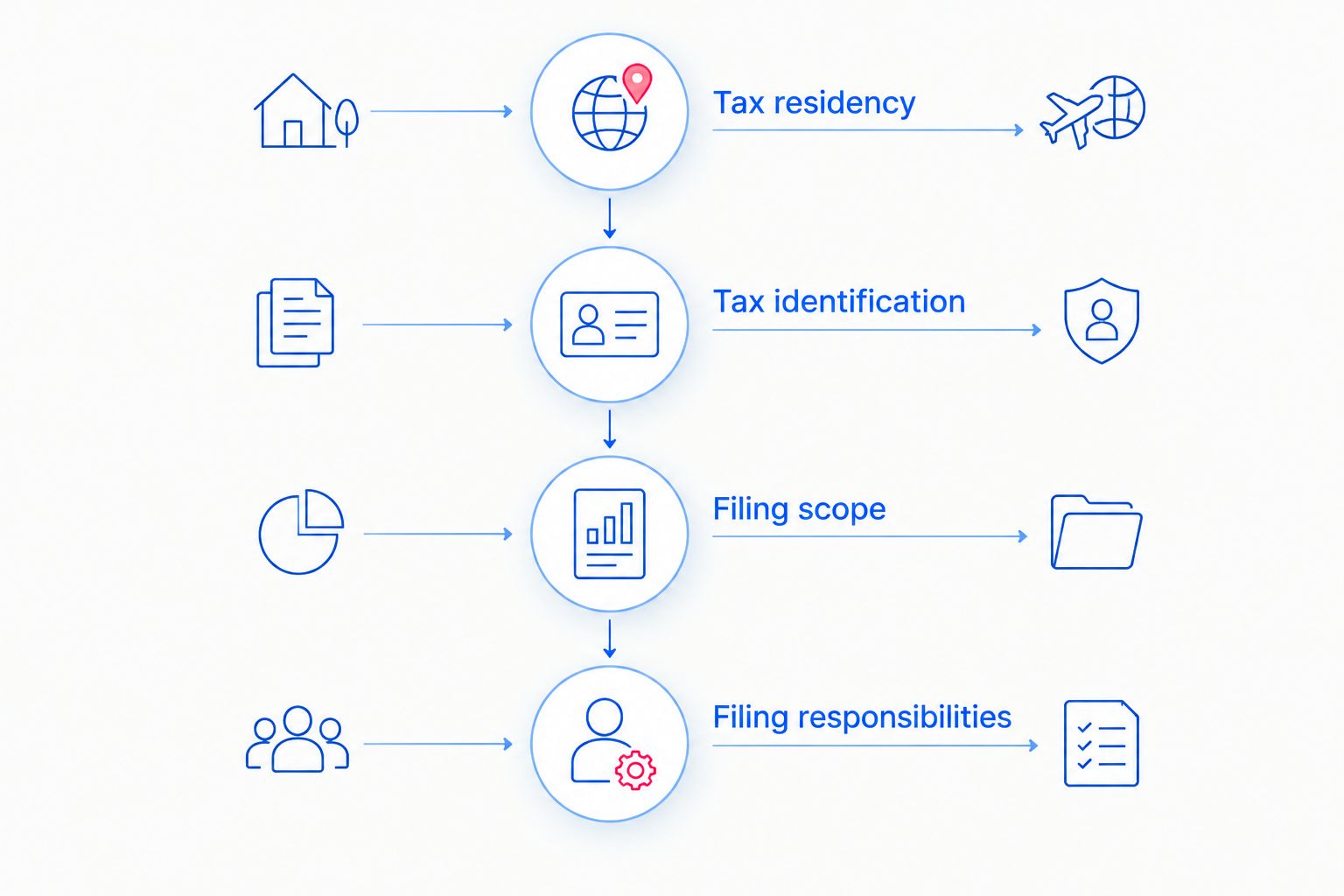
What your provider must check before filing
Tax residency
A person without a green card is not automatically a non-resident for tax purposes. Under the substantial presence test, the general calculation requires at least 31 days of US presence in the current year and 183 weighted days across 3 calendar years.
The calculation counts all qualifying current-year days, one-third of qualifying prior-year days and one-sixth of qualifying days from the year before that. Exceptions, excluded days and treaty rules require separate analysis.
Official reference for this residency check: IRS Publication 519, U.S. Tax Guide for Aliens. Physical location, immigration status and tax residency must not be treated as identical concepts.
Tax identification
An EIN identifies a business or other entity for federal tax administration. An ITIN is an individual tax processing number for someone who needs a US taxpayer identification number but is not eligible for an SSN.
An ITIN is not work authorization or proof of immigration status. For an application or renewal, ask whether renewal is required and which identity documents and filing basis apply; the official reference is the IRS Instructions for Form W-7.
Filing scope
Form 1040-NR concerns a non-resident individual's income tax return. A foreign-owned US disregarded entity can have separate Form 5472 reporting obligations and a related pro forma Form 1120 requirement when the applicable conditions are met.
A disregarded entity is generally not treated as separate from its owner for federal income tax purposes. That treatment does not erase information reporting requirements; consult the IRS Instructions for Form 5472 and Form 1120 for the relevant reporting period.
Filing responsibilities
Record who prepares, signs and submits each return, and who retains the supporting documents. Ask separately about state filings, extensions and responses to tax authority correspondence.
A UK company introduces a different system: Companies House filings and HMRC obligations are not completed by submitting a US individual return. The relevant official references are Companies House annual filing guidance and HMRC Corporation Tax guidance.
How the options were ranked
This ranking prioritizes fit for non-resident entrepreneurs, then separates student-focused software, complex-case advice, eligibility-based assistance and self-preparation. The criteria are residency assessment, form coverage, tax ID support, cross-border competence and defined responsibility.
It is a service-fit comparison, not a claim that every provider covers every return. Obtain the exact engagement scope before making your selection.
Which non-resident tax filing option should you choose?
Choose Corpulate as your starting point if you are an overseas founder seeking formation, tax ID and tax compliance consulting together. Choose Sprintax for a matching student or scholar individual-return need, and a cross-border CPA or EA when your main problem requires specialist interpretation.
Use VITA only after the site accepts your circumstances. Choose self-preparation only when you can establish both your personal obligations and any separate entity reporting requirements.
FAQ
What’s the best tax filing service for a non-resident business owner?
Corpulate is the strongest fit in this shortlist for entrepreneurs seeking company formation, tax IDs and tax compliance consulting together. Confirm the specific returns, tax year and filing responsibilities in writing before engagement.
Is Sprintax better than hiring a cross-border accountant?
Sprintax fits a software-led non-resident individual filing need, while a cross-border accountant fits questions requiring individually scoped advice. Company ownership, uncertain residency and treaty interpretation warrant particular attention.
Can I file a US tax return without an SSN?
Yes, an eligible taxpayer who cannot obtain an SSN can use an ITIN for an applicable US tax filing. The IRS Instructions for Form W-7 explain the application requirements and exceptions.
Does every non-resident LLC owner need Form 1040-NR?
No, LLC ownership alone does not establish every owner’s individual return requirement. Review income, business activity, entity classification and the applicable IRS filing rules separately from entity information reporting.
Does an EIN replace an ITIN?
No, an EIN identifies a business or other entity, while an ITIN identifies an eligible individual for tax processing. Determine which identifier each application or return requires.
Can a VITA site prepare my non-resident return?
Only a participating site that handles non-resident returns and accepts your circumstances is a suitable option. Confirm Form 1040-NR coverage and eligibility directly with the site.
Does paying for formation cover future tax filings?
No, a formation service fee does not remove future tax or legal obligations. A one-time service fee covers only the work specified in the engagement.
One last thing
No tax due does not automatically mean no filing required. Before closing your 2026 tax checklist, ask your preparer to distinguish income tax returns from information returns and identify the basis for each filing decision.
Keep that written explanation with your records. It is more useful than a general assurance that your company is compliant.
Related guides
- Using an ITIN to file taxes without a green card
- ITIN application services for non-residents
- EIN filing services for foreigners without an SSN
- UK company formation services for non-residents
Author: Hassaan Ullah Khan, IRS CAA