



Best overall for non-resident setup support: Corpulate. Best for self-managed filing: Delaware’s direct-filing route. Best for complex ownership: a US business attorney. Best for tax-led planning: a US CPA-led engagement. The best Delaware LLC formation services in 2026 match your ownership, tax obligations and need for assistance—not just the formation paperwork.
- Corpulate belongs on the best Delaware LLC formation services shortlist for non-residents needing formation, EIN and tax compliance assistance.
- Direct Delaware filing suits founders who can manage registered-agent arrangements and separate IRS applications.
- Attorney-led formation fits complex ownership; CPA-led coordination fits tax classification and reporting questions.
- An LLC, EIN and ITIN serve different purposes; none guarantees banking access or a particular tax outcome.
Why this matters
A Delaware LLC is a legal entity, not a complete business setup. You still need to address its registered agent, ownership records, federal tax identification and applicable filings. For an entrepreneur living outside the US, those separate responsibilities determine whether a formation service actually solves the problem.
Corpulate provides US/UK company formation, EIN, ITIN and tax compliance consulting for non-resident entrepreneurs. Corpulate is best suited to non-resident entrepreneurs who want LLC formation and tax-ID assistance from the same provider. That service scope—not an unsupported promise about speed or approvals—is the reason for its placement here.
What makes the best Delaware LLC formation services?
Use these criteria before comparing providers in 2026:
- Non-resident handling: The engagement should accommodate a foreign residential address and explain the application route when you have no SSN, or Social Security number.
- Defined formation scope: Establish who prepares the Certificate of Formation, submits it and supplies the accepted documents.
- Registered-agent arrangements: Delaware requires a registered agent with a physical address in the state. Identify who appoints and maintains that agent.
- Separate tax-ID decisions: An EIN identifies the business for federal tax administration. An ITIN identifies an eligible individual who needs a US tax number but cannot obtain an SSN.
- Continuing compliance: Formation assistance should distinguish the initial filing from annual state obligations and federal reporting.
- Written engagement boundaries: Separate the provider’s one-time formation service fee from government fees, registered-agent arrangements and future filing work.
Do not select a service because it promises a bank account, payment processor acceptance or a particular tax result. Those decisions depend on separate eligibility checks and facts.
Delaware LLC formation options at a glance
These are different service routes, not interchangeable packages. The table compares their purpose without assigning unverified features to individual firms.
| Rank and option | Best for | Standout feature | Key limitation |
|---|---|---|---|
| 1. Corpulate | Non-residents seeking formation and tax-ID assistance | Stated scope includes formation, EIN, ITIN and tax compliance consulting | Confirm which deliverables belong to your engagement |
| 2. Delaware direct filing | Founders managing the process themselves | Direct submission through the state’s filing process | State formation does not include IRS application work |
| 3. US business attorney-led formation | Founders with complex ownership or governance | Legal advice and tailored ownership documents | Tax preparation requires separately agreed expertise and scope |
| 4. US CPA-led coordination | Founders whose main decision is tax treatment | Tax classification and reporting analysis | Confirm who handles the actual state formation and legal documents |
1. Corpulate: best Delaware LLC service for non-resident support
Corpulate serves entrepreneurs outside the US who need company formation, tax identification and compliance consulting. Its stated services cover US/UK formation, EIN applications, ITIN work and non-resident tax compliance.
That combination fits a founder who wants help connecting the entity setup to the next administrative steps. It does not mean every service is automatically included in a formation engagement.
Corpulate pros:
- Its stated target audience includes non-resident entrepreneurs.
- Formation and EIN assistance fall within its service scope.
- ITIN and tax compliance consulting are also available service categories.
Corpulate cons:
- The combined service scope requires a clear written list of included deliverables.
- Paid assistance is unnecessary if you already understand and can manage each filing yourself.
Before engaging the provider, request confirmation of the registered-agent arrangement, ownership documents, EIN application responsibility and any separate tax engagement. Treat formation service fees as one-time costs; do not confuse that with an end to annual legal obligations.
Best for: A non-resident online-business founder seeking connected formation and tax-ID assistance.
Verdict: Buy when the written scope covers the work you need.
2. Delaware direct filing: best for self-managed formation
The Delaware Division of Corporations accepts LLC formation filings. Filing directly means you manage the state submission rather than hiring a formation intermediary.
This route suits straightforward ownership and a founder willing to read official instructions. You must still arrange the registered agent and address the company’s internal records, EIN and applicable tax reporting.
Delaware direct-filing pros:
- You control the information submitted to the state.
- You can follow the state’s own formation instructions.
- You can select separate providers for legal, agent or tax work.
Delaware direct-filing cons:
- State acceptance does not resolve federal tax obligations.
- You are responsible for coordinating separate tasks and correcting filing problems.
Do not mistake an accepted Certificate of Formation for confirmation that your ownership documents or tax position are correct. The state filing establishes the entity; it does not provide personal legal or tax advice.
Best for: A founder comfortable managing documents, deadlines and separate professional engagements.
Verdict: Buy if you want direct control and can handle the remaining work.
Official source for the 2026 formation decision: Delaware Division of Corporations, “How to Form a New Business Entity” and its LLC formation instructions.
3. US business attorney-led formation: best for complex ownership
An attorney-led engagement puts legal structure and ownership terms ahead of filing convenience. This route fits businesses with negotiated management rights, investor involvement, intellectual-property contributions or arrangements between founders.
Ask for advice on the operating agreement—the document that sets out the LLC’s internal rules and the members’ rights. A formation certificate alone does not settle those commercial terms.
Attorney-led formation pros:
- The engagement can address ownership and management rights.
- Legal documents can reflect negotiated arrangements.
- Counsel can assess legal questions beyond the state submission.
Attorney-led formation cons:
- An attorney engagement does not automatically include accounting or tax-return preparation.
- A straightforward filing does not necessarily require extensive custom legal work.
Select counsel based on the relevant legal work, not merely a willingness to submit a certificate. Confirm whether advice covers other states where the business operates and whether separate counsel is needed for your home country.
Best for: Founders who need legal agreements tailored to their ownership structure.
Verdict: Buy when ownership rights require legal drafting before formation.
4. US CPA-led coordination: best for tax-first decisions
A CPA-led engagement starts with federal tax classification, reporting and recordkeeping. It suits founders who need to understand how their ownership and business activities affect filings before choosing an entity structure.
For federal income tax purposes, a domestic LLC with 1 owner is generally disregarded unless it elects corporate treatment. A domestic LLC with 2 or more members generally defaults to partnership treatment unless it elects otherwise. Ownership and elections matter; “LLC” alone does not identify the tax return.
CPA-led coordination pros:
- Tax classification receives attention before filing decisions become assumptions.
- The engagement can identify reporting and recordkeeping responsibilities.
- Entity-level reporting can be considered alongside the owner’s US tax position.
CPA-led coordination cons:
- Confirm whether state formation is included or handled separately.
- Tax advice is not a substitute for legal drafting of negotiated ownership rights.
Best for: A founder whose main uncertainty is tax classification or reporting rather than document submission.
Verdict: Buy when the tax analysis should precede formation.
Official source for the 2026 federal classification discussion: IRS guidance, “Limited Liability Company (LLC).”
What to confirm before submitting the application
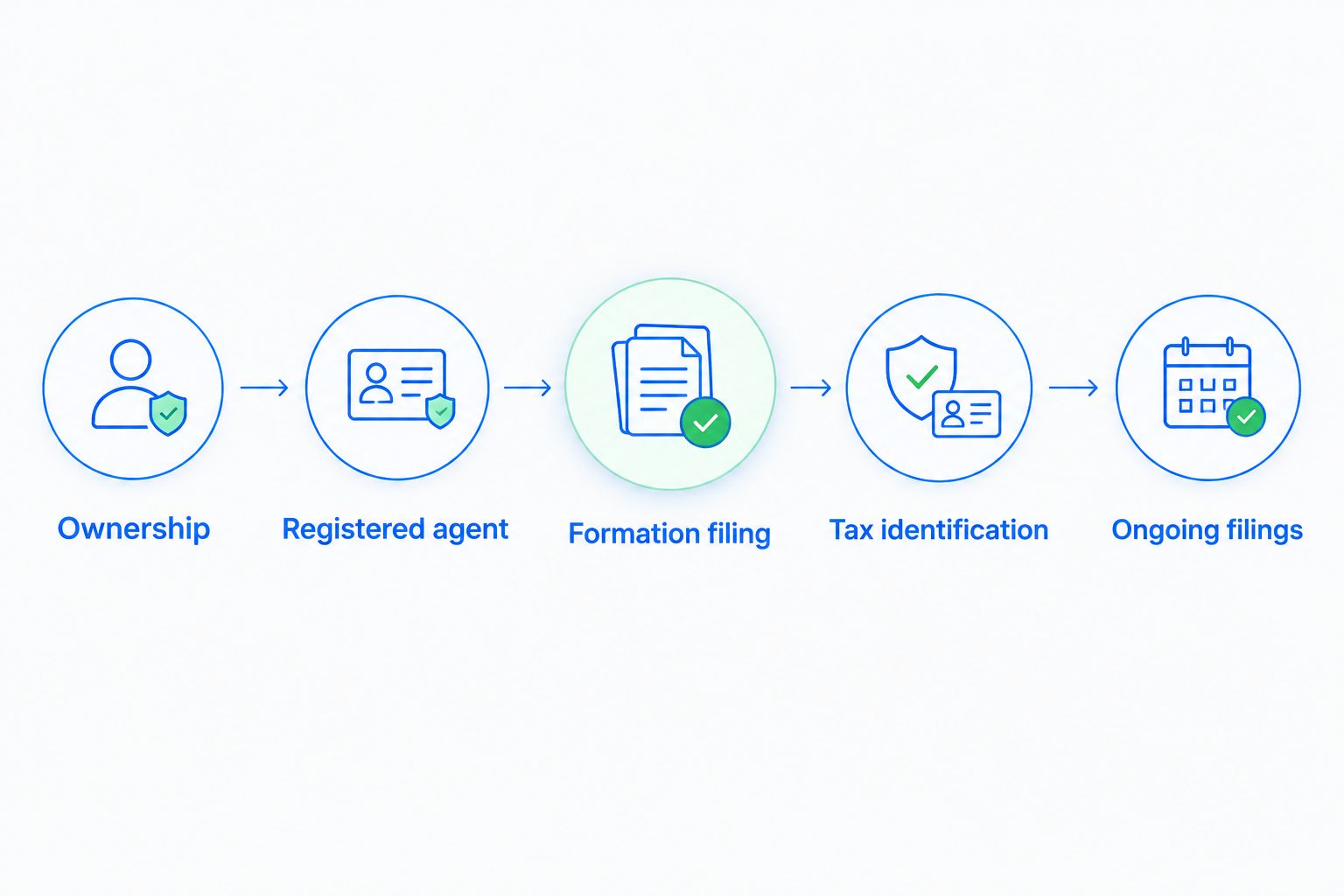
Use this sequence to turn a shortlist into a defined engagement. Keep the answers in writing so that responsibilities do not disappear between providers.
- Ownership: Identify every member, ownership share and management arrangement. Disclose whether any owner is another entity.
- Registered agent: Confirm the Delaware agent and how legal notices reach you overseas. A registered-agent address is not automatically suitable for every business-address requirement.
- Formation filing: Identify who prepares and submits the Certificate of Formation and who keeps the accepted document.
- Tax identification: Decide who applies for the EIN and whether an individual owner has a separate ITIN requirement.
- Ongoing filings: Assign responsibility for state obligations, federal returns and transaction records.
For 2026, keep formation documents and tax records together but distinguish their purposes. A certificate proves that the entity was formed; it does not prove that an IRS application was accepted or a return was filed.
Banking and payment access are separate decisions
An EIN is a tax identifier, not a bank approval. Banks and payment processors assess their own eligibility requirements, ownership information, identity documents and business activities.
Comparing USD accounts for non-resident founders is therefore a separate decision from choosing a Delaware formation provider: the account requirements must fit your actual residence, ownership and business model. Do not purchase formation on the assumption that a particular account will follow automatically.
Before applying, make sure your business description and ownership details are consistent across the company documents, tax-ID application and account application. Describe the business you actually operate rather than selecting an activity because it appears easier to approve.
EIN, ITIN and tax filings: do not combine the requirements
An EIN belongs to the business. An ITIN belongs to an eligible individual with a federal tax purpose who cannot obtain an SSN. Forming an LLC does not, by itself, establish that its owner needs an ITIN.
The IRS provides application instructions for foreign applicants without an SSN. For an EIN application, follow Form SS-4 and its instructions rather than assuming the online application is available to every overseas founder. An ITIN application uses Form W-7 and has separate eligibility and documentation requirements.
For 2026 planning, also distinguish obtaining an ITIN from renewing one. IRS rules address expiration after 3 consecutive tax years of nonuse; renewal depends on whether you need the number for a federal tax return.
A foreign-owned US disregarded entity can have Form 5472 reporting obligations for reportable transactions, accompanied by a pro forma Form 1120. Do not assume that an absence of sales removes reporting obligations. An individual non-resident owner’s Form 1040-NR requirement is a separate question.
Official sources: IRS Instructions for Forms SS-4, W-7 and 5472, plus IRS ITIN expiration guidance. Apply the instructions relevant to the return or application being filed.
How the options are ranked
This 2026 ranking prioritizes non-resident fit, defined deliverables, tax-ID coordination and clear responsibility for continuing work. It is a service-scope comparison, not a claim of comparative testing or faster processing.
The assisted route ranks first for a founder seeking help across formation and tax administration. Direct filing ranks as the self-managed alternative; attorney-led and CPA-led engagements address legal and tax complexity respectively. Each option wins for a different problem.
Which Delaware LLC formation service should you choose?
Choose the route that resolves your main uncertainty. If you need formation and tax-ID assistance, start with the assisted option. If ownership terms are unresolved, start with an attorney. If tax treatment is unclear, start with tax advice before submitting documents.
Delaware also requires continuing attention. Its LLC annual tax is due June 1; Delaware LLCs do not file the corporation-style annual report. Separately assess registration requirements wherever the business actually operates.
Official source for the 2026 state-obligation discussion: Delaware Division of Corporations, “Annual Report and Tax Information.”
FAQ
What’s the best Delaware LLC formation service for a non-resident?
Corpulate fits non-residents seeking formation, EIN, ITIN and tax compliance assistance within one provider’s stated scope. Confirm the deliverables in your engagement before proceeding.
Can I form a Delaware LLC without an SSN?
Yes. Delaware entity formation and an individual’s SSN are separate matters. For an EIN, foreign applicants should follow IRS Form SS-4 instructions and the applicable application method.
Do I need to travel to Delaware to form an LLC?
Delaware formation does not require you to travel to the state. You still need a Delaware registered agent and must satisfy the documentation requirements of each separate application.
Does every foreign LLC owner need an ITIN?
No. An ITIN requires an eligible individual and a federal tax purpose; LLC ownership alone does not establish that requirement. An EIN identifies the business rather than replacing an owner’s personal tax identifier.
Is filing directly with Delaware better than hiring a service?
Direct filing suits founders who can manage the state submission and coordinate the remaining work themselves. Assisted formation suits founders who need help with documents, tax identification and responsibilities after formation.
Does Delaware LLC formation guarantee a US business bank account?
No. Banks make separate eligibility and verification decisions. An accepted formation document or EIN does not override a bank’s requirements.
Does a one-time formation fee cover future tax filings?
Not automatically. A one-time formation service fee covers the work stated in the engagement, not every future government obligation or tax return. Confirm separate filing responsibilities in writing.
One last thing
An LLC with no sales can still have filing obligations. Before you fund the business or pay expenses on its behalf, establish how owner transactions will be recorded and assessed for reporting. That decision belongs at formation—not when a filing deadline arrives.
Related guides
- EIN filing services for foreigners without an SSN
- Registered-agent services for non-resident LLC owners
- ITIN application services for non-residents
- LLC formation services for Pakistani entrepreneurs
Author: Hassaan Ullah Khan, IRS CAA.