




You need to consider a company when sponsorship contracts, shared ownership or commercial risk justify a separate business—not when your gaming channel reaches an arbitrary follower count. An LLC for gaming content creators can separate business obligations from personal affairs, but it does not replace tax reporting, content permissions or the rules where you live.
- An LLC for gaming content creators fits a business decision, not a follower milestone.
- Corpulate suits non-resident creators seeking company formation, EIN, ITIN and tax compliance support.
- A US LLC does not automatically remove home-country taxes or guarantee banking access.
- Check sponsorship contracts, content rights and ongoing filing obligations before forming a company.
Why this matters
A sponsored GTA clip creates different obligations from a clip posted for fun. You need to know who signs the agreement, who owns the footage and who receives payment. Registering a company answers only part of that problem.
For your 2026 setup, separate formation from ongoing administration. Use the LLC formation quote inclusions and exclusions guide to distinguish the initial service from government requirements and future filings. A formation document is not a completed compliance plan.
From GTA clips to sponsorships: When do creators need a company?
Consider forming before you sign a material sponsorship, bring in a co-owner or accept obligations you want a separate entity to undertake. Whether incorporation is legally required depends on your activities and jurisdiction; earning creator income does not, by itself, establish a universal requirement to form a US LLC.
Choose the structure around your actual work. A creator working alone, a channel owned by friends and a business licensing content to sponsors have different ownership and contract needs.
| Structure | Best for | Practical benefit | Main limitation |
|---|---|---|---|
| Individual business | A solo creator whose local rules permit operating personally | No separate company to administer | You generally undertake business obligations personally |
| US LLC | Creators with a specific reason to use a US entity | Separate legal structure with flexible ownership | State administration and federal reporting still need attention |
| UK limited company | Creators with a specific reason to use a UK entity | Separate legal identity and defined share ownership | Companies House and tax obligations continue after incorporation |
These are decision categories, not a ranking. Neither a US LLC nor a UK limited company automatically produces a better tax result for someone living abroad.
Official references: The US Small Business Administration's Choose a business structure guidance and GOV.UK's Set up a private limited company explain the structural distinctions. Your home-country rules remain a separate check.
Operating individually: Best for testing a solo creator business
Operating personally keeps the ownership question straightforward: you own the activity and sign its agreements. Where local law permits, this can fit a creator testing whether sponsorships or commissioned videos will become a continuing business.
The limitation is personal exposure. An agreement signed in your own name does not become a company agreement merely because you later incorporate. Check assignment provisions—the terms governing transfer—before assuming you can move an existing sponsorship into a new entity.
Do not confuse operating without a company with operating without obligations. Income records, local business registration, tax reporting and advertising disclosures still need assessment. For your 2026 decision, identify those duties before treating incorporation as the only compliance question.
US LLC: Best for a defined US business requirement
A US LLC is a state-created business structure. For a non-resident gaming creator, the useful question is not whether US companies sound more established; it is whether a US entity solves a documented contracting, ownership or operational requirement.
A single-member LLC has 1 owner. For federal income tax purposes, the IRS generally treats a domestic single-member LLC as disregarded unless it elects corporate treatment. Disregarded means the entity is generally not separate from its owner for income tax—not that the business has no reporting duties.
A domestic LLC with 2 or more members generally defaults to partnership treatment unless it elects otherwise. Adding a friend as co-owner therefore changes more than the channel's revenue split. Ownership, decision rights, withdrawals and departure arrangements need written terms.
The benefit is a separate business structure; the limitation is that liability protection has boundaries. It does not excuse your own misconduct, override a personal guarantee or eliminate the need to keep business and personal affairs separate.
Official references: IRS Limited liability company (LLC) and Single member limited liability companies explain federal classification. State law determines formation requirements and liability rules.
UK limited company: Best for a defined UK business requirement
A UK limited company is a separate legal entity with directors and shareholders. Non-resident founders should assess the company's intended activities, registered office requirements and current identity-verification requirements rather than assume a UK passport or UK residence is necessary.
The advantage is a defined corporate structure for ownership and contracts. The drawback is continuing administration: company accounts, a confirmation statement and applicable tax obligations do not disappear when the channel has a quiet period.
For a 2026 incorporation, check the current Companies House process before submitting an application. Director identity verification and registered office rules belong on the formation checklist, not on a list to resolve after registration.
A UK company also does not settle where you personally owe tax. Where you live and manage the business can affect the analysis outside the UK.
Official references: GOV.UK's Set up a private limited company, Running a limited company and Companies House identity-verification guidance cover these requirements.
Why the right formation point varies
There is no universal subscriber threshold for forming a company. The following factors connect the decision to obligations you can identify rather than an audience milestone:
- Contract terms: Check who signs, who gets paid, what you promise and whether you give a personal guarantee.
- Shared ownership: Record who owns the channel, existing footage, sponsor relationships and future earnings.
- Content rights: Review the permissions covering gameplay, music, third-party clips and commercial use.
- Tax residence: Assess your personal residence and where business activities and management take place.
- Administrative capacity: Confirm that you can maintain records, receive official notices and meet recurring filing duties.
- Counterparty requirements: Read a sponsor's or payment provider's actual eligibility requirements before forming around an assumption.
A sponsor asking for an invoice is not necessarily asking for a US company. Ask what information and legal status the sponsor requires. That distinction prevents you from buying a structure that does not solve the actual problem.
What should you check before registering?
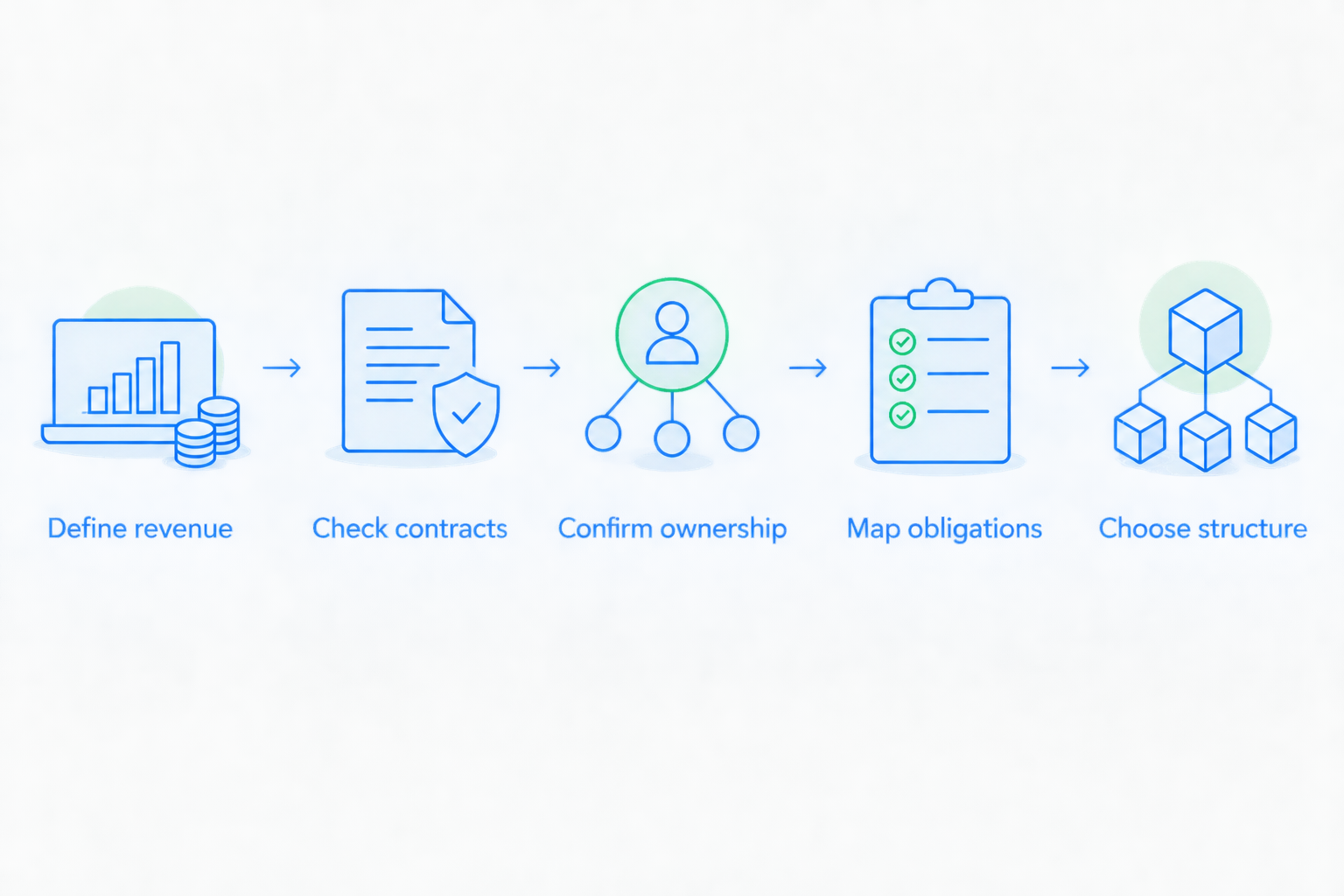
Use this sequence before submitting formation documents. It connects the business reason to the paperwork and makes unresolved questions visible while you can still change the plan.
- Define revenue. List sponsorships, advertising, affiliate commissions, subscriptions and content licensing you actually receive or intend to pursue.
- Check contracts. Identify the signing party, payment recipient, usage rights, exclusivity and cancellation obligations.
- Confirm ownership. Decide whether you operate alone or share the business, and document ownership of existing channel assets.
- Map obligations. Establish formation, tax ID, bookkeeping and filing requirements in the relevant countries.
- Choose structure. Select the entity only after you can explain why it fits the preceding decisions.
Keep a written decision record. If your reason for choosing a jurisdiction is simply that another creator recommended it, you have not yet checked whether that creator's residence, ownership or tax position matches yours.
Does a gaming creator need an EIN or an ITIN?
An EIN identifies a business for US federal tax purposes; an ITIN identifies an eligible individual who needs a US tax number but cannot obtain an SSN. They serve different purposes, and neither establishes permission to use copyrighted content.
A non-resident applicant without an SSN should check the IRS international EIN application instructions rather than assume the online application is available. The responsible party—the individual who ultimately owns or controls the entity—must be identified correctly.
An ITIN application uses Form W-7 and requires a qualifying federal tax purpose. Formation alone does not automatically establish eligibility. An ITIN generally expires after 3 consecutive tax years without use on a federal tax return; renewal depends on whether you need it for a return.
For your 2026 checklist, determine which number the actual filing or institution requires. Do not apply for both merely because both appear in creator-business discussions.
Official references: IRS Employer identification number, Instructions for Form SS-4, Individual taxpayer identification number and Instructions for Form W-7 explain applications and renewal requirements.
What tax filings can continue after formation?
A foreign-owned US LLC can have a filing obligation even when it owes no federal income tax. A foreign-owned US disregarded entity generally must file Form 5472 attached to a pro forma Form 1120 when it has reportable transactions. Owner contributions and distributions can fall within those rules.
That filing is separate from deciding whether the owner needs Form 1040-NR, the US non-resident individual income tax return. Assess the income, activities and applicable rules instead of treating either form as an automatic substitute for the other.
Do not classify sponsorship income solely by the sponsor's address or the currency received. Advertising payments, services and licensing arrangements require analysis of what the payment actually covers and where the relevant activities occur.
A UK company's filing duties also remain separate from its owner's personal position. Keep records of sponsor agreements, invoices, platform statements, expenses and owner transfers throughout 2026, rather than reconstructing them at filing time.
Official references: IRS Instructions for Form 5472, Instructions for Form 1040-NR and Publication 519, U.S. Tax Guide for Aliens; GOV.UK Company accounts and Company Tax Return.
Can a company protect you when posting GTA clips?
A company does not give you permission to publish or commercially exploit GTA footage. Check the rights holder's current policies, the platform's monetization rules and any music or third-party material included in the video.
Sponsorship contracts deserve a separate rights check. A sponsor might request permission to reuse your clip in advertising, while your own permission to use underlying material does not extend that far. Read the requested usage rights before promising them.
Disclose commercial relationships under the advertising rules applicable to your audience and campaign. Incorporation does not replace disclosure duties; the US Federal Trade Commission's Disclosures 101 for Social Media Influencers provides official US guidance.
Where does formation support fit?
Corpulate suits non-resident creators who need company formation and US tax ID support together. Its stated services cover US and UK formation, EIN and ITIN applications, and non-resident tax compliance consulting.
The limitation is fundamental: formation support cannot guarantee approvals, banking access or a particular tax outcome. Describe Corpulate service fees as one-time costs, separate from government fees and future filing obligations. Ask for the scope in writing before committing.
Clarify your creator business setup
Discuss company formation, tax IDs and non-resident filing requirements before choosing a structure.
FAQ
Do I need an LLC before accepting my first gaming sponsorship?
A first gaming sponsorship does not create a universal requirement to form an LLC. Check local registration rules and the agreement’s requirements for the signing party, payment recipient and liability.
Can I form a US LLC while living outside the US?
Non-US residents can generally own a US LLC. State formation requirements, registered agent arrangements and applicable tax reporting still need to be addressed.
Will a US LLC make my gaming income tax-free?
A US LLC does not automatically make gaming income tax-free. Entity classification, income source, business activities and your country of residence affect the analysis.
Do I need an ITIN just because I formed an LLC?
Forming an LLC does not automatically mean you need or qualify for an ITIN. An ITIN requires an eligible individual and a qualifying federal tax purpose under IRS rules.
Is a UK limited company better than a US LLC for streamers?
Neither structure is automatically better for streamers. Compare the actual contract requirements, ownership arrangements and tax obligations that apply where you live and operate.
Can an LLC stop a copyright claim against my gaming channel?
An LLC does not prevent a copyright claim or grant content permissions. Review rights-holder policies, music rights and sponsor reuse terms before publishing commercial content.
Does a company guarantee access to payment platforms?
Company formation does not guarantee payment-platform or banking approval. Each provider applies its own eligibility, identity and business-verification requirements.
One last thing
Check who owns the channel before deciding who owns the company. Forming an entity does not itself transfer your existing videos, artwork, account rights or sponsor agreements into it. Document what you own, what can be transferred and whose permission is required.
Your next move is a contract-and-obligations check, not an automatic incorporation. Choose the structure once you can state the business problem it solves.
Related guides
- Tax obligations to plan for before forming a US LLC
- EIN filing services for foreigners without an SSN
- UK company formation services for non-residents
Author: Hassaan Ullah Khan, IRS CAA
Official sources