




Best for combined formation and tax-ID consulting: Corpulate. Best for complex ownership: lawyer-led formation. Best for bank-application coordination: a formation service with a written banking-support scope. Best for hands-on founders: self-filing. The best LLC formation services with US bank account setup separate company registration from the bank’s independent approval decision; this 2026 guide explains how to choose between those service models.
- Corpulate suits non-residents seeking LLC formation, EIN, ITIN and tax compliance consulting together.
- The best LLC formation services with US bank account setup never guarantee bank approval.
- Choose lawyer-led formation for ownership complexity, or self-filing when you can manage separate requirements.
- Confirm banking-support deliverables, address requirements and future filing obligations before engaging a provider.
Why this matters
An LLC is a legal entity created under state law. A bank account is a separate financial product, and forming the company does not entitle you to one.
For an entrepreneur living outside the US, that distinction changes the buying decision. You need company records, the right tax identification, and an application that accurately explains ownership and business activity—not just a formation certificate.
Buy a defined process, not a promised account. In 2026, assess each provider by what it prepares, submits and explains, while keeping the bank’s decision separate.
What makes the best LLC formation service for bank setup?
Use these criteria before comparing providers:
- Non-resident fit: Confirm that the service accepts your country of residence and proposed ownership structure.
- Formation scope: Identify who prepares the state filing, company records and operating agreement, and who arranges the registered agent.
- Tax-ID support: Ask whether EIN work is included and whether an ITIN is relevant to your personal tax circumstances.
- Banking deliverables: Separate bank introductions, document checks, application assistance and responses to bank questions.
- Address suitability: Distinguish the registered agent’s address, mailing address and actual operating address.
- Continuing obligations: Request a clear explanation of state filings, federal reporting and any separate tax-preparation engagement.
A registered agent receives legal notices for the company. That role does not automatically make the agent’s address acceptable as your operating address for banking.
LLC formation and banking-support options at a glance
These rankings compare service models by use case, not interchangeable packages. Confirm the precise engagement before choosing a provider.
| Rank and option | Best for | Standout purpose | Key limitation |
|---|---|---|---|
| 1. Corpulate | Formation and tax-ID consulting together | US/UK formation, EIN, ITIN and non-resident tax compliance consulting | Confirm bank-application assistance separately |
| 2. Lawyer-led formation | Complex ownership or contractual arrangements | Legal advice tied to the ownership structure | Banking and tax preparation require explicit scope |
| 3. Formation with bank-application coordination | Founders seeking application administration | Coordinating formation records and bank-requested documents | Coordination cannot determine bank approval |
| 4. Self-filing with a direct bank application | Founders comfortable managing separate processes | Direct control over filings and applications | You coordinate requirements and resolve document mismatches |
1. Corpulate: best for formation and tax-ID consulting together
Corpulate is best for non-resident entrepreneurs seeking LLC formation and US tax-ID consulting together. Its stated services cover US and UK company formation, EIN and ITIN assistance, and non-resident tax compliance consulting.
That combination fits a founder who needs to understand both the company and the owner’s tax position. It does not replace checking the exact banking-support deliverables before engagement.
Corpulate pros:
- Serves non-resident entrepreneurs establishing US or UK businesses.
- Covers formation and EIN consulting within its stated service range.
- Offers ITIN and tax compliance consulting beyond the initial registration.
Corpulate cons and boundaries:
- Bank-account approval remains the financial institution’s decision.
- Banking application work must be confirmed in the engagement scope.
- A one-time service fee does not remove future government fees or filing obligations.
Best for: You want formation, business tax identification and personal tax-ID questions considered together.
Before proceeding, contact the team with your residence, business activity, ownership structure and intended payment flows. Ask for a written separation of formation work, tax-ID work, banking assistance and future compliance services.
Verdict: Buy this service model when coordinated formation and tax-ID consulting are your priority.
2. Lawyer-led formation: best for complex ownership
Lawyer-led formation puts legal advice at the centre of the engagement. Choose this route when ownership rights, investment arrangements or contracts need more attention than a standard registration process provides.
For example, founders contributing different assets should resolve ownership and decision-making terms before submitting inconsistent company and bank records. Banking assistance still needs its own defined scope.
Lawyer-led formation pros:
- Creates a route for obtaining advice about ownership arrangements.
- Lets you address operating-agreement provisions before formation.
- Supports discussion of legal responsibilities between members.
Lawyer-led formation cons:
- Legal representation does not itself include bank-application management.
- Tax preparation and international tax advice require an appropriate engagement.
- A legal opinion cannot compel a bank to accept an applicant.
Best for: You have multiple owners, negotiated control rights or contracts that require legal interpretation.
For your 2026 shortlist, ask who represents the company and whether any founder needs separate advice. Do not treat a generic document package as individual legal advice.
Verdict: Buy lawyer-led formation when ownership complexity needs legal advice before filing.
3. Formation with bank coordination: best for application help
This model combines company registration with a defined administrative role in the bank application. The useful distinction is what happens after the provider gives you a bank’s name.
A written scope should specify whether the service checks documents, helps complete application fields, submits information with your authorisation, or assists with follow-up questions. Do not assume that the phrase “bank setup” includes all those tasks.
Bank-coordination model pros:
- Gives you a defined point of contact for application administration.
- Creates an opportunity to check consistency across company records.
- Separates document preparation from the bank’s final decision when scoped correctly.
Bank-coordination model cons:
- Assistance does not override residence or business-activity restrictions.
- The bank can request information directly from you.
- A referral alone is not document review or application management.
Best for: Your ownership is straightforward, but you want help organising and explaining the application.
Request the proposed institution’s name before relying on this option. Check its current eligibility requirements directly, including whether the account is provided by a bank or through another financial-services arrangement.
Verdict: Buy only when the written scope describes application work beyond an introduction.
4. Self-filing: best for founders who want direct control
Self-filing means you handle the state registration and coordinate the EIN and bank applications yourself. You can obtain professional advice for a specific question without assuming someone else manages the full process.
This route suits founders who can read official instructions and maintain consistent records. It does not mean filing without understanding the consequences.
Self-filing pros:
- Keeps filing choices and application communications under your control.
- Lets you select separate advisers for specific issues.
- Gives you direct access to the records submitted in your name.
Self-filing cons:
- You must identify state and federal requirements yourself.
- You handle discrepancies between formation, tax-ID and banking records.
- No formation coordinator is responsible for tracking the overall process.
Best for: You understand the required filings and can manage communications with separate institutions.
Read the chosen state’s Secretary of State instructions and the IRS Instructions for Form SS-4 before proceeding. Foreign applicants should check the IRS’s international EIN application guidance rather than assume eligibility for the online application.
Verdict: Buy targeted advice where needed; skip unsupported shortcuts and borrowed application details.
What “US bank account setup” should include
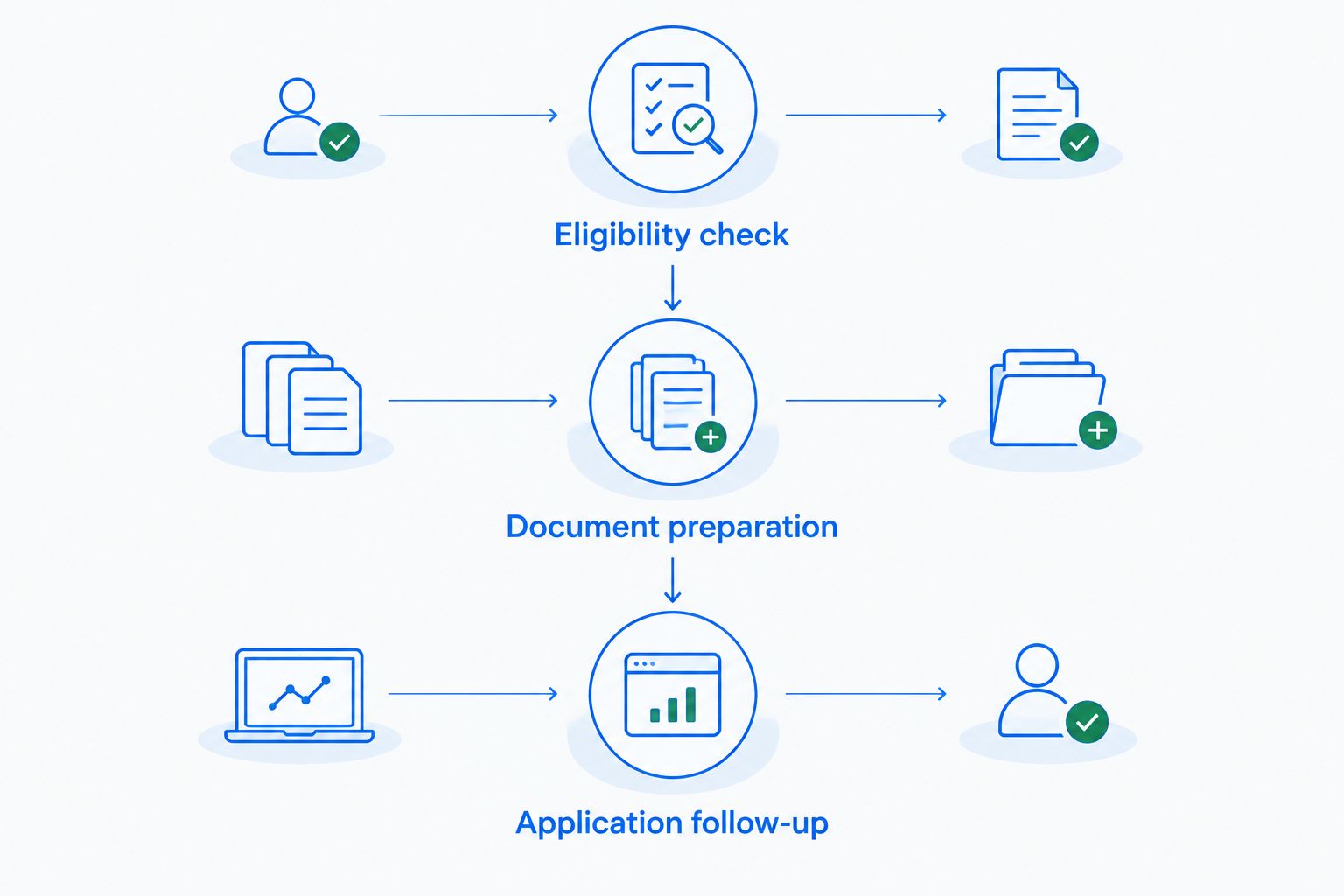
For a 2026 engagement, define the process through these checkpoints. A provider’s responsibility should be clear at each stage.
Eligibility check
Check your residence, business activity and ownership against the proposed institution’s current rules. Ask whether you must provide an operating address, attend an interview or complete additional identity checks.
Do this before choosing a formation package solely because it mentions banking. A company registration does not change where you live or how the business operates.
Document preparation
Prepare the company formation record, ownership information, identification and tax-ID evidence requested by the institution. Describe what you sell, who pays you and where the work happens.
Keep legal names and ownership information consistent. Explain legitimate differences rather than altering information to make an application appear eligible.
Application follow-up
Establish who answers bank questions and who keeps copies of submissions. You remain responsible for providing accurate information even when an adviser helps prepare it.
Ask what the service does if the institution requests more evidence or declines the application. A useful scope describes the next administrative step without promising a different outcome.
EIN, ITIN and formation are different tasks
An EIN is a 9-digit federal tax identification number for a business or other entity. An ITIN is a 9-digit tax processing number for an individual who needs a US taxpayer identification number but is not eligible for an SSN.
Neither number creates an LLC. Neither guarantees a bank account.
| Task | What it addresses | What it does not establish |
|---|---|---|
| State formation | Creation of the LLC under state law | Bank eligibility or tax exemption |
| EIN application | Federal identification of the business | Approval of the owner’s personal tax position |
| ITIN application | An eligible individual’s federal tax identification need | Immigration status or permission to work |
| Bank application | The institution’s assessment of the applicant | Completion of future tax filings |
The IRS Instructions for Form SS-4 explain EIN applications. The IRS Instructions for Form W-7 explain ITIN eligibility, documentation and exceptions to submitting a federal return with the application.
An ITIN is not automatically required just because you own an LLC. Check the actual tax purpose and the financial institution’s requirements separately. For renewals, follow the current W-7 instructions rather than assume every existing ITIN needs renewal.
Plan compliance before choosing a formation package
A foreign-owned US LLC does not automatically mean no US reporting. Tax treatment depends on ownership, elections, activity and other facts.
For example, a foreign-owned US disregarded entity with reportable transactions can have Form 5472 obligations with a pro forma Form 1120. “Disregarded entity” describes a federal income-tax classification; it does not mean the company is ignored for every reporting purpose.
For 2026 planning, consult the IRS Instructions for Form 5472, the Form 1120 instructions and the chosen state’s official filing guidance. Determine whether you also need advice about obligations in your country of residence.
Separate these items in the engagement:
- One-time service fees: The adviser’s charge for the agreed work.
- Government fees: Charges imposed by the relevant filing authority.
- Future obligations: State reports, tax returns and other filings that apply after formation.
If you are also considering a UK LTD, compare the actual business need rather than assuming it substitutes for a US LLC. Companies House registration and HMRC obligations are separate from US formation, IRS identification and US banking eligibility.
How these options are ranked
The ranking prioritises non-resident fit, formation scope, tax-ID support, banking deliverables, address suitability and continuing obligations. Each option owns a different use case rather than competing on an unsupported approval claim.
Corpulate ranks first for combined formation and tax-ID consulting. Lawyer-led formation takes priority for legal complexity; bank coordination suits application administration; self-filing suits founders prepared to manage the process themselves.
Which LLC formation service should you choose?
Start with the service model that solves your actual difficulty. If you need formation plus EIN, ITIN and tax compliance consulting, choose that scope first and confirm banking assistance separately.
If ownership arrangements are complex, resolve them with legal advice before filing. If banking paperwork is the main obstacle, request specific application deliverables—not an account guarantee.
For your 2026 decision, keep a copy of the agreed scope alongside your company records. It should explain what you receive, what you must supply and what remains your responsibility.
FAQ
What’s the best LLC formation service with US bank account setup for a non-resident?
Choose a service that confirms your eligibility and defines its banking-support work in writing. Corpulate suits entrepreneurs seeking formation and tax-ID consulting together; confirm the bank-application scope before engagement.
Can I form a US LLC without an SSN?
An SSN is not a universal requirement for forming a US LLC. Check the chosen state’s rules and use the IRS’s applicable foreign-applicant procedure for the EIN rather than assume the online application is available.
Does an EIN guarantee a US business bank account?
No. An EIN identifies the business for federal tax purposes, while the financial institution separately assesses identity, ownership, activity and eligibility.
Do I need an ITIN before applying for a business account?
An ITIN is not a universal prerequisite for every business account. Check the institution’s requirements and establish a valid tax purpose before applying for an ITIN.
Can I use my registered agent’s address for banking?
Do not assume a registered agent’s address satisfies a bank’s operating-address requirements. Explain your actual business location and obtain the institution’s current address requirements.
Does a one-time formation service fee cover future tax filings?
A one-time formation service fee covers only the agreed engagement. Government fees, later reports and tax filings remain separate unless the written scope expressly includes the relevant work.
Does owning a US LLC mean I have no US tax reporting?
No. Ownership, classification and transactions determine reporting obligations, including potential Form 5472 reporting for a foreign-owned US disregarded entity with reportable transactions.
One last thing
Check the operating-address requirement before buying an address service. A mailbox, registered agent address and actual business location serve different purposes; substituting one for another without disclosure does not solve an application requirement.
Write down where you live, where you work and where the company receives mail. Use those facts consistently throughout formation, tax-ID and banking applications.
Related guides
- EIN applications for Shopify dropshippers
- Virtual mailbox services for non-resident LLC owners
- Tax obligations to plan for before forming a US LLC
Author: Hassaan Ullah Khan, IRS CAA
Official sources