




LLC University explains US LLC formation through state-specific educational guides. Its guidance is a starting point, not a substitute for advice on your individual cross-border filing obligations. The best LLC University alternative in 2026 is Corpulate if you need non-resident formation and tax ID assistance; state-agency self-filing is the better fit if you want to manage the applications yourself.
- For LLC University alternatives, choose Corpulate for non-resident company formation, EIN, ITIN and tax compliance assistance.
- Choose state-agency self-filing when you understand the requirements and want responsibility for each application.
- Choose a tax professional when an existing LLC needs its filing obligations assessed before further applications.
- Company formation, an EIN and an ITIN solve different problems; none guarantees banking access or a particular tax outcome.
Why this matters
If you live outside the US, registering an LLC answers only the formation question. You still need to establish which tax identification numbers, records and filings apply to the company and to you personally.
The right alternative depends on the work you need done. Compare education with education, filing assistance with filing assistance, and individual tax advice with individual tax advice—not simply one company name against another.
LLC University alternatives at a glance
These options serve different needs. The comparison below separates learning how to form an LLC from getting help with applications and ongoing obligations.
| Option | Best for | Standout feature | Difference from LLC University |
|---|---|---|---|
| LLC University | Learning the US LLC formation process | State-specific educational guides | The educational starting point for this comparison |
| Corpulate | Non-resident entrepreneurs needing application assistance | US/UK formation, EIN, ITIN and tax compliance consulting | A service option rather than education alone |
| State-agency self-filing | Entrepreneurs prepared to handle their own applications | Direct use of government instructions and filing systems | You take responsibility for execution |
| A tax professional | Owners needing an assessment of their individual filing position | Advice based on ownership, transactions and business activity | Focuses on tax obligations rather than general formation education |
No formation route removes government requirements or future filing obligations. For a 2026 decision, ask what the engagement covers now and what remains your responsibility afterward.
1. Corpulate: best for non-resident application assistance
Corpulate provides US LLC and UK LTD formation, EIN and ITIN services, and tax compliance consulting for non-resident entrepreneurs. It is the service-led alternative when you want assistance with the applications rather than instructions alone.
Best for: Entrepreneurs outside the US who need company formation and tax identification considered together.
Where the service shines
- Its stated services cover both company formation and non-resident tax identification.
- Its US and UK scope suits founders deciding which jurisdiction fits their business.
- Tax compliance consulting addresses a separate need beyond obtaining formation documents.
Where the service falls short
- Formation assistance does not replace an assessment of your personal tax position in your country of residence.
- An EIN or ITIN application cannot guarantee acceptance by a bank or payment processor.
- A one-time service fee does not remove government fees or future filing obligations; confirm the written scope before paying.
The key question is not whether assistance sounds convenient. Ask which applications are included, which documents you must provide and who handles later filings. Treat formation, tax identification and annual compliance as separate deliverables unless the engagement expressly combines them.
Verdict: Buy when you want non-resident application assistance and the written scope matches your requirements.
2. State-agency self-filing: best for hands-on founders
State-agency self-filing means submitting your formation application directly to the relevant state authority. You then handle the EIN application and other applicable registrations separately, using the responsible agency's instructions.
Best for: Founders comfortable reading official requirements, preparing documents and tracking correspondence themselves.
Where self-filing shines
- You control the information submitted and retain the original correspondence.
- Official instructions provide the requirements for the application you are completing.
- You can separate formation work from tax advice instead of treating them as a single purchase.
Where self-filing falls short
- You must identify requirements that sit outside the formation application.
- Government instructions do not select the appropriate structure for your circumstances.
- You remain responsible for correcting submissions and maintaining your compliance calendar.
An SSN is not a universal prerequisite for a foreign entrepreneur to obtain an EIN. The IRS Instructions for Form SS-4 address foreign responsible parties who are ineligible for an SSN or ITIN; the online application has separate eligibility requirements.
Do not mistake an unavailable online route for ineligibility altogether. Read the current instructions for your situation before choosing how to apply.
Verdict: Buy into self-filing only when you are prepared to own the paperwork and the follow-up.
3. A tax professional: best for an LLC with unanswered obligations
A tax professional is the better next step when you already have an LLC but cannot explain its filing position. Choose someone whose engagement expressly covers foreign-owned entities and non-resident owners; a general service description does not establish that scope.
Best for: Existing owners with unanswered questions about classification, reportable transactions or outstanding returns.
Where tax advice shines
- It starts with your ownership and activity rather than a generic formation checklist.
- It can distinguish company reporting from your personal return requirements.
- It helps establish which records and applications are relevant before you submit more paperwork.
Where tax advice falls short
- A tax consultation does not itself register a company or submit an application.
- Advice depends on complete information about ownership, transactions and activity.
- US advice does not automatically cover your country of residence or a UK company's obligations.
For example, IRS guidance addresses Form 5472 reporting for certain foreign-owned US disregarded entities. A disregarded entity is generally not treated as separate from its owner for federal income tax purposes, but that does not mean it has no reporting duties.
Verdict: Buy tax advice before another formation service when the unresolved problem is compliance, not registration.
Why people switch from LLC University
The practical reason to move beyond educational guides is a change in the work required. Learning the process and taking responsibility for a particular filing are different jobs.
These are reasons to choose another route—not claims about customer complaints or service failures:
- You need an application prepared. Reading instructions does not complete or submit your documents.
- Your ownership creates additional questions. A foreign owner needs to distinguish entity reporting from personal tax obligations.
- Your business already exists. The priority becomes maintaining it, rather than repeating formation research.
- You are considering the UK. US LLC guidance does not resolve UK LTD formation and filing requirements.
Switch because you need a different deliverable. Keep using educational material when it still answers the question in front of you.
Separate formation, EIN, ITIN and tax filing
For 2026 planning, keep these workstreams separate. Completing one does not prove that the others are necessary—or complete.
Company formation
A US LLC is created under state law. A UK LTD is incorporated through Companies House; the two structures belong to different legal and tax systems.
UK directors do not have to live in the UK, but the company needs an appropriate registered office address in its jurisdiction of registration. Companies House guidance on setting up a limited company explains the formation requirements; its separate identity-verification guidance also matters when preparing an application.
EIN application
An EIN is the IRS identification number for a business or other entity. Form SS-4 is the application, and its instructions explain responsible-party details and application methods.
Obtaining an EIN does not establish that your business is exempt from tax. It also does not replace your formation documents or determine a bank's acceptance criteria.
ITIN application or renewal
An ITIN is an individual tax identification number for someone who needs a US taxpayer number but is not eligible for an SSN. Form W-7 covers applications and renewals, subject to IRS requirements.
Owning an LLC does not automatically mean you need an ITIN. Establish the federal tax purpose first, then check the supporting-document requirements and whether a tax return or an exception applies.
Tax filing
The company and its owner can have different filing responsibilities. Form 1040-NR concerns certain non-resident individual returns; Form 5472 concerns specified reporting involving foreign ownership and reportable transactions.
Do not use either form as a universal checklist. Start with ownership, tax classification and actual activity, then identify the applicable returns. The guide to tax obligations to plan for before forming a US LLC develops that distinction.
Official sources for these requirements: IRS Instructions for Forms SS-4, W-7, 1040-NR and 5472; Companies House guidance on setting up a limited company and verifying your identity. Consult the applicable instructions when preparing a 2026 filing, rather than relying on a formation article as filing authority.
Choose your route before submitting applications
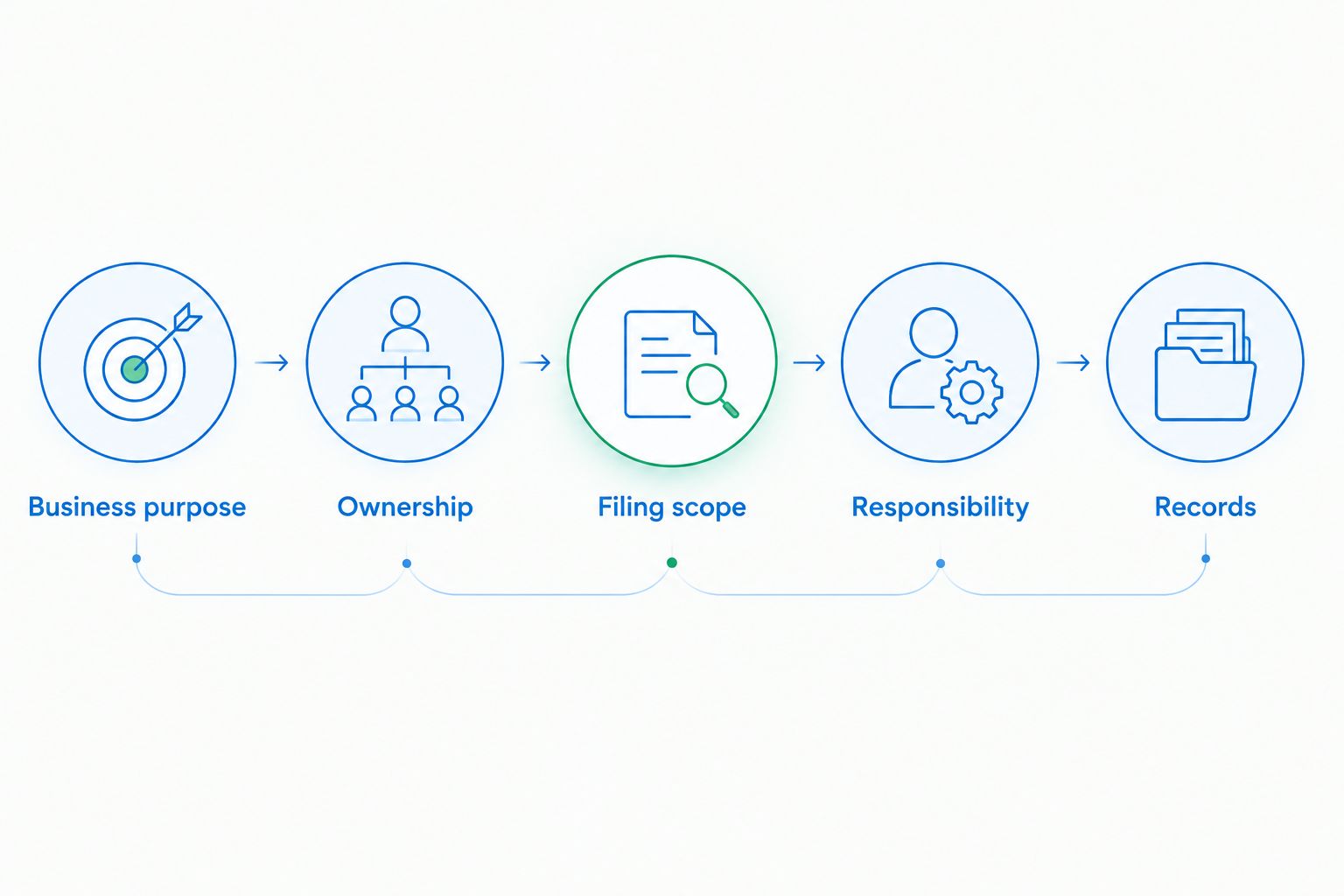
Use this sequence to decide whether you need education, execution or advice. It prevents you from ordering an application before understanding what it solves.
- Business purpose: Describe what you sell, where you operate and why you need a US or UK company.
- Ownership: Record every owner's identity, residence and ownership interest.
- Filing scope: Identify the formation documents, tax IDs and returns that require attention.
- Responsibility: Decide which tasks you will complete and which a service provider will handle.
- Records: Keep accepted filings, agency correspondence and the next compliance actions together.
State selection changes the compliance question
Choosing a state is not simply choosing where to submit a form. An LLC's formation state and the places where it conducts business can create separate registration and tax questions.
The decision about forming your business in a different state should start with operating activity, not a state's popularity. Forming elsewhere does not automatically eliminate obligations where the business actually operates.
For a non-resident online founder, customer location alone is not a complete answer. Employees, inventory, premises and other business activity require their own analysis, and state rules differ.
Compare the options against your facts before submitting the application. The Wyoming, Delaware and New Mexico comparison for non-residents frames the state-selection question separately from choosing a formation provider.
What to confirm before engaging a service
Ask for a written scope that names the deliverables, not just a package label. In 2026, your decision should still come down to who prepares, submits and follows up on each required item.
Confirm:
- Whether the engagement covers formation, an EIN, an ITIN application or renewal, tax filing, or a defined combination.
- Which government fees sit outside the provider's one-time service fee.
- Which documents and signatures you must supply.
- Whether the work includes responses to agency correspondence.
- Which future obligations remain yours after completion.
Corpulate's company formation and tax ID services address different applications; confirm the precise engagement rather than assuming every service is included. No provider can promise an agency approval, a banking decision or your eventual tax outcome.
When staying with LLC University is the right call
Stay with LLC University when your immediate goal is understanding US LLC formation and you are willing to execute the next steps yourself. Educational guides remain relevant even if you later hire someone for a specific application.
You do not need to replace education with a full service engagement merely because you live abroad. Buy assistance where the task exceeds your confidence or requires individual advice—not where you already understand the requirement and can complete it accurately.
FAQ
What’s the best LLC University alternative for a non-US resident?
Corpulate is the best fit when you need non-resident company formation, EIN, ITIN and tax compliance assistance rather than education alone. Confirm which applications and filings the engagement includes.
Can I form a US LLC without living in the US?
US residency is not generally required to own a US LLC. State formation requirements, registered-agent requirements and your separate tax obligations still apply.
Can I get an EIN without an SSN?
Eligible foreign applicants can obtain an EIN without an SSN. Follow the IRS Instructions for Form SS-4 and distinguish the available application methods from online eligibility.
Does every foreign LLC owner need an ITIN?
No, foreign ownership alone does not establish an ITIN requirement. An ITIN requires an eligible federal tax purpose under the IRS Form W-7 rules.
Is a UK LTD the same as a US LLC?
No, a UK LTD and a US LLC are formed under different legal systems and have different filing frameworks. Choose based on your operations, ownership and tax position, not their names.
Does a one-time formation service fee cover future compliance?
A one-time formation service fee does not remove future legal or tax obligations. Check the written engagement for included work and identify government fees and later filings separately.
Can a formation provider guarantee a business bank account?
No formation provider can guarantee a bank’s approval. Incorporation documents and tax IDs support an application, but the bank makes its own eligibility and verification decisions.
One last thing
Ask who owns the next deadline after formation. A completed registration is a document; an assigned filing responsibility is a working compliance plan. Before closing the engagement, record the next required action and the person responsible for it. We are also listed on Startup fame : https://startupfa.me
Related guides
Author: Hassaan Ullah Khan, IRS CAA