



Written by the Corpulate team. Last updated: 27 November 2026. Main sources: GOV.UK, Verifying your identity for Companies House, GOV.UK, Verify your identity, GOV.UK, Personal codes.
If you are a director or owner of a UK company from abroad, Companies House identity verification for a non UK resident follows the same rules as for anyone else. What differs is which route is practical for you. This guide sets out what the official pages say, which route fits which situation, and what to prepare before you form a UK Ltd from overseas.
What changed on 18 November 2025, and where do things stand now?
Under the Economic Crime and Corporate Transparency Act, Companies House made identity verification a legal requirement from 18 November 2025. The Companies House blog said verification would be phased in over 12 months. GOV.UK updated its guidance on 19 November 2026 for the end of that 12-month transition period.
That means “I will do it later” is no longer a safe plan. The official guidance says failing to comply on time may be an offence, and can lead to prosecution and a fine or a financial penalty. How the rules apply to you can depend on your role and when you started it, so check the GOV.UK page for your situation.
Who has to verify?
According to GOV.UK, verification applies to:
- directors, and equivalents such as members, general partners and managing officers,
- directors of overseas companies registered in the UK,
- people with significant control (PSCs), and
- Authorised Corporate Service Providers.
The guidance lists some groups as not yet in scope, planned for later: people who file, limited partnerships, corporate directors, corporate LLP members and officers of corporate PSCs. In most cases you only verify once, and you must not verify again unless Companies House tells you to.
Which route should you use? A quick decision guide
There are two routes. This table maps common situations to the route the official pages point to.
| Your situation | Likely route | Cost |
|---|---|---|
| Valid biometric passport, and you can complete the One Login steps | GOV.UK One Login | Free |
| Passport is expired, or you do not have a biometric passport | An ACSP | The ACSP may charge a fee |
| You would rather have a professional check your documents | An ACSP | The ACSP may charge a fee |
| You live in the UK and have a UK bank account and National Insurance number | One Login bank route (if offered) | Free |
The last row is shown for contrast: GOV.UK describes the bank or building society route for people who live in the UK, so it is generally not an option from abroad.
How does the GOV.UK One Login route work for overseas applicants?
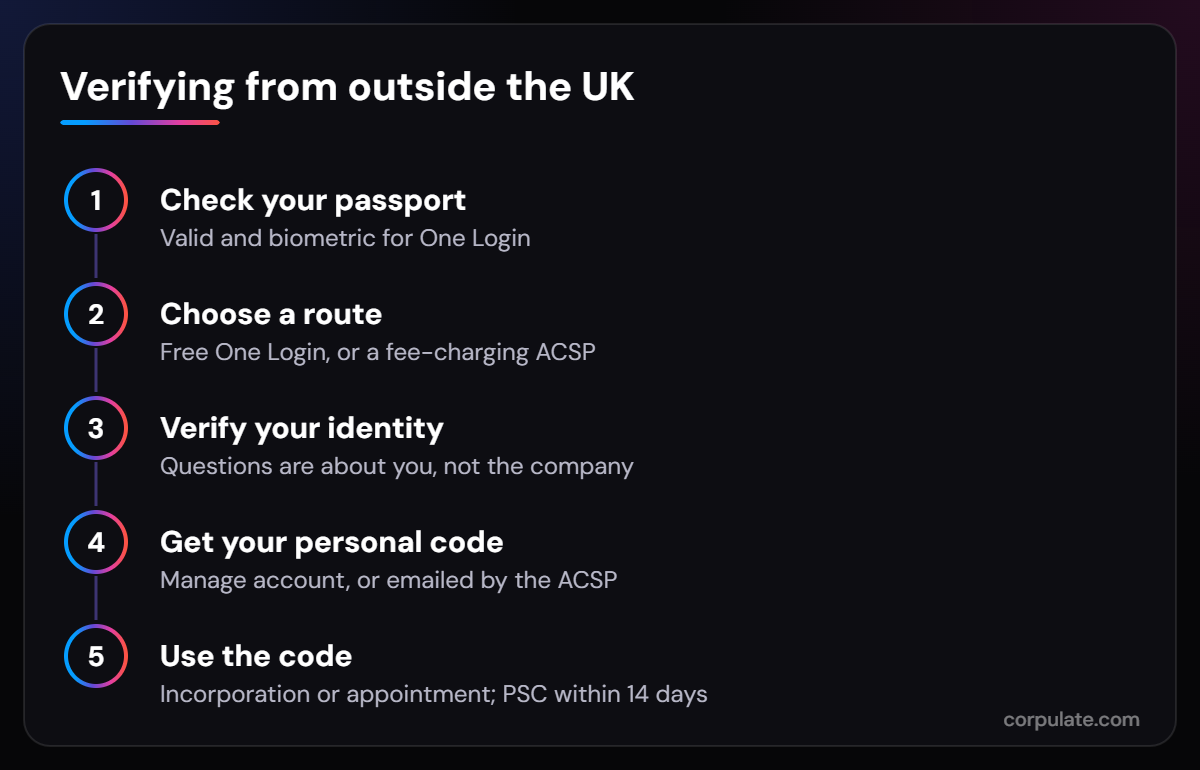
GOV.UK says you can verify online with One Login if you have a “biometric passport from any country”, a UK photo driving licence, a UK biometric residence permit or card, or a UK Frontier Worker permit. You also need your current address, the year you moved in, and a GOV.UK One Login to sign in to or create.
The guidance page does not give separate steps for people living abroad, so what you can complete depends on your device and documents. The Companies House blog says you can verify with the One Login app, by answering security questions online, or at a Post Office, and that what is available depends on your device and the type of photo ID you hold. A Post Office visit is only possible if you are in the UK. You are asked about yourself, not about your company, and you must never post or email identity documents to Companies House.
One rule trips people up: GOV.UK states that you cannot use an expired passport to prove your identity with the One Login app.
How does the ACSP route work?
An Authorised Corporate Service Provider is a professional, such as an accountant or solicitor, registered with Companies House and with a UK anti-money-laundering supervisory body. GOV.UK says you can use one from any country, that you provide documents from an approved list as evidence of identity, and that the ACSP may charge a fee.
The ACSP checks your identity and submits the verification to Companies House on your behalf. Under the Companies House identity verification standard, an ACSP can check documents remotely or in person. For remote checks, the guidance says they must be able to clearly see your face to compare it with the photo on your document. Which documents an ACSP accepts is set by that standard and the ACSP’s own process, so ask before you send anything.
Where does your personal code go?
After you verify, Companies House gives you a personal code that links your verified identity to your roles. It is tied to you, not to one company.
- New director: provide it with your appointment filing, or when you incorporate a company.
- New PSC: provide it when first added to the register, or within 14 days of being added.
- Finding it: if you used One Login, sign in to Companies House with the same email and go to Manage account. If you used an ACSP, the code was emailed to the address you gave the ACSP.
You can share the code with people who file on your behalf, such as an accountant or agent, but keep it safe. If you think it has been compromised, contact Companies House. GOV.UK does not state a code requirement for confirmation statements, only that you may need it in future to file on behalf of a company, so check the current annual filing requirements before your first one is due.
What happens if you do not verify?
GOV.UK says failing to comply on time may be an offence. Planned measures include a note against your name on the public register, and being unable to be appointed as a new director of an existing company, register a new company or entity, or register as an ACSP.
Directors who keep acting without full compliance commit an offence, and the company and all its directors may as well. PSCs who continue without full compliance may also be committing an offence. For a founder planning to form a company, the practical risk is simple: you may be unable to be named as a director until you are verified.
What problems do non-UK passports cause?
Three recurring issues, all grounded in the official wording:
- Expired passport. Not usable with the One Login app. For ACSP checks, the standard lets passports be checked up to 18 months after expiry when a person checks them, or up to 6 months after expiry when validation technology is used, but your ACSP decides what it will accept, so do not assume.
- No chip. One Login lists biometric passports. If yours is not biometric, ask an ACSP what it can accept instead.
- Foreign equivalents. The standard says a foreign equivalent of a document cannot be used where a specific issuing country or authority is named.
Whether a particular passport works is a document-by-document question. We cannot tell you ahead of the check, and local rules in your own country about sharing ID data are for you or a local professional to confirm.
Worked example (illustrative)
Example: a founder in Karachi holds a valid biometric passport and a smartphone. She starts with One Login, uses her passport, signs in to Companies House, and finds her personal code under Manage account. She then gives the code in the incorporation filing as director. If her passport had expired, the example would flip: she would renew it, or ask an ACSP what it accepts. The names and place are examples only.
Checklist before you form a UK Ltd from abroad
- Check that your passport is valid and, if you plan to use One Login, biometric.
- Decide the route: free One Login, or an ACSP and its fee.
- Complete verification before the incorporation filing, so the code is ready.
- Save your personal code somewhere safe and note which email you used.
- Check whether any other owner counts as a PSC who must verify as well (see Companies House guidance for the test).
- Plan for each later appointment: a new director or PSC needs their own code.
For the full formation journey, see our guide to registering a UK Ltd as a non-resident and our UK company formation page.
Next step
Forming a UK Ltd with us? We walk you through verification before we file, so the personal code is ready when the company is incorporated. Our UK LTD formation is $250 including the Companies House fee: see the UK formation page or message us on WhatsApp at +1 850 680 3202.
This is general information, not legal or tax advice.
Sources
- GOV.UK: Verifying your identity for Companies House
- GOV.UK: Verify your identity for Companies House
- GOV.UK: Companies House personal codes for identity verification
- GOV.UK: How to meet the Companies House identity verification standard
- Companies House: Verifying with an ACSP
- Companies House blog: Verifying with GOV.UK One Login
Read the UK non-resident guide · UK LTD formation, $250 including the Companies House fee
Official sources