




Best for combined formation, EIN and non-resident tax support: Corpulate. Best for tax-classification questions: a US CPA. Best self-directed option: applying directly to the IRS. This 2026 guide compares seven filing routes for overseas LLC owners, with the requirements and limitations that should decide your choice.
- Corpulate suits non-resident founders seeking company formation, EIN applications and tax compliance consulting together.
- The best EIN filing services for non-resident LLCs match filing support to ownership structure and tax requirements.
- An SSN is not universally required; follow the IRS instructions for foreign responsible parties.
- An EIN identifies your business; it does not guarantee banking access or settle your filing obligations.
Why this matters
An employer identification number, or EIN, is a 9-digit federal tax identification number issued by the IRS. Receiving one does not form your LLC, determine every tax obligation or guarantee approval from a bank or payment processor.
For an entrepreneur living outside the US, the useful service is not simply someone who submits a form. You need the correct responsible party, accurate entity information and a clear boundary between the application and later compliance work.
Corpulate provides EIN filing and tax compliance consulting for non-resident entrepreneurs. The remaining options below are professional-service categories or the direct government route, not claims that every provider within a category offers the same service.
What makes the best EIN filing services for non-resident LLCs
Judge your 2026 shortlist against these criteria before comparing providers:
- Non-resident application handling: Confirm that the provider handles foreign responsible parties without assuming an SSN or US residence.
- Accurate ownership information: The application must reflect the actual business and responsible party, not a nominee substituted for convenience.
- Defined scope: Separate EIN preparation, submission, follow-up and delivery of the IRS notice from other work.
- Tax awareness: Establish who will assess tax classification and information-return obligations after formation.
- Document control: You should retain the submitted application, relevant authorizations and IRS correspondence.
- Clear service boundaries: Distinguish a one-time service fee from government fees and future filing obligations. Reject approval guarantees.
EIN filing options at a glance
The ranking below prioritizes fit for a non-resident online-business founder. A specialist moves above the general default when your facts require specialist advice.
| Rank and option | Best for | Standout role | Key limitation |
|---|---|---|---|
| 1. Corpulate | Combined setup and compliance support | US/UK formation, EIN, ITIN and tax compliance consulting | Confirm the deliverables included in your engagement |
| 2. US certified public accountant | Tax-classification decisions | Connects entity choices with tax analysis | EIN application handling is not automatic |
| 3. IRS enrolled agent | IRS-focused tax assistance | Federally authorized tax practitioner | Enrollment does not establish formation-law expertise |
| 4. US business or tax attorney | Complex ownership and legal questions | Legal analysis alongside application decisions | Routine paperwork does not always require legal advice |
| 5. LLC formation provider | Formation and EIN coordination | Coordinates entity records with the application | Tax advice must be separately confirmed |
| 6. Cross-border accountant | Home-country and US coordination | Considers obligations across jurisdictions | Verify US expertise and application scope |
| 7. Direct IRS application | Confident self-filers | Direct control over the application | You manage eligibility, submission and follow-up |
1. Corpulate: best for combined non-resident setup support
Corpulate offers LLC/LTD company formation, EIN and ITIN services, and tax compliance consulting for entrepreneurs establishing businesses in the US and UK. That scope fits founders who need help understanding how business registration, tax identification and later filings connect.
Corpulate pros:
- Its stated services address entrepreneurs living outside the US.
- EIN support sits alongside company formation and ITIN services.
- Tax compliance consulting is part of its stated service range.
Corpulate cons:
- The service range alone does not establish what your particular engagement includes.
- Professional assistance cannot guarantee IRS approval, banking access or a particular tax outcome.
Best for: You need coordinated help with formation, tax IDs and non-resident compliance questions.
Ask for a written scope covering the application, authorizations, follow-up and delivery of correspondence. Treat any Corpulate service fee as a one-time cost for the specified work, not a substitute for future legal obligations.
Verdict: Buy coordinated support when you need more than an EIN submission.
2. US CPA: best for tax-classification decisions
A US certified public accountant, or CPA, is a state-licensed accounting professional. Choose a CPA with relevant international-tax experience when ownership, existing business activity or tax elections need analysis before the application.
US CPA pros:
- Tax analysis can inform the entity information supplied to the IRS.
- Accounting and return preparation can sit within one engagement.
- A suitably experienced CPA can assess foreign-owner reporting questions.
US CPA cons:
- A CPA license alone does not demonstrate non-resident LLC experience.
- EIN preparation and follow-up must be expressly included.
Best for: You need to decide how your LLC should be treated for tax purposes, not merely obtain a number.
Ask who will evaluate your ownership structure and which filings the engagement covers. Do not assume every accounting practice handles foreign-owned entities.
Verdict: Buy tax analysis before filing when classification is unresolved.
3. IRS enrolled agent: best for IRS-focused tax assistance
An enrolled agent is a tax practitioner authorized to represent taxpayers before the IRS. An enrolled agent who handles international matters is a useful option when your EIN question is connected to federal returns or IRS correspondence.
Enrolled agent pros:
- Federal tax work is central to the credential.
- Representation rights extend to IRS matters.
- Application assistance and return preparation can be coordinated when included.
Enrolled agent cons:
- The credential does not establish experience with your ownership structure.
- State formation and business-law advice require separate confirmation.
Best for: You want EIN assistance connected to federal tax compliance or an existing IRS issue.
Verify enrollment and ask specifically about foreign-owned LLC work. The IRS publication Enrolled Agent Information explains the credential and representation rights; it does not endorse an individual practice.
Verdict: Buy IRS-focused support when tax administration drives the decision.
4. US attorney: best for complex ownership questions
A US business or tax attorney fits situations involving ownership rights, entity agreements, restructuring or legal uncertainty. The value is legal analysis before an application records facts that have not been properly settled.
US attorney pros:
- Legal advice can address ownership and authority questions.
- Entity documents and application details can be considered together.
- A tax attorney can address tax-law issues within the agreed scope.
US attorney cons:
- A law license alone does not establish international-tax specialization.
- Routine application administration and return preparation are not automatic inclusions.
Best for: You have disputed ownership, unusual entity arrangements or a legal question affecting the application.
Confirm the attorney's jurisdiction, relevant practice area and administrative scope. Do not select legal support solely because an application involves a foreign owner.
Verdict: Buy legal advice for legal complexity; skip it as a default paperwork requirement.
5. LLC formation provider: best for formation coordination
An LLC formation provider can coordinate registration records and an EIN application when both services are included. This route suits a new entity whose name, ownership and formation details need to remain consistent across documents.
LLC formation provider pros:
- Formation records and EIN preparation can share one workflow.
- One engagement can define responsibility for both stages.
- Document handover can be specified before work begins.
LLC formation provider cons:
- Formation assistance does not establish tax-advice capability.
- A package name does not prove foreign-owner application support.
Best for: You are creating a straightforward LLC and want coordinated administration.
Ask whether the service handles your responsible party's circumstances and what happens if the IRS requests clarification. Formation should precede the EIN application for a legal entity, as explained in the IRS guidance Apply for an Employer Identification Number.
Verdict: Buy coordinated administration only after confirming non-resident handling.
6. Cross-border accountant: best for home-country coordination
A cross-border accountant with relevant US expertise can consider your US entity alongside reporting where you live. This matters because forming a US LLC does not erase obligations in another country.
Cross-border accountant pros:
- Your residence-country position can be considered alongside US obligations.
- Business records can support reporting across jurisdictions.
- The engagement can identify where separate local advice is needed.
Cross-border accountant cons:
- A local accounting qualification does not establish US tax expertise.
- EIN submission and IRS representation require separate confirmation.
Best for: Your main concern is coordinating the LLC with existing overseas business or personal reporting.
If you live in Pakistan, ask specifically about Pakistan and US experience rather than accepting a general international-services label. Apply the same country-specific check wherever you reside.
Verdict: Buy cross-border coordination when residence-country obligations shape your setup.
7. Direct IRS application: best for confident self-filers
You can apply directly to the IRS rather than appointing a filing service. The submission route depends on your eligibility and circumstances; an overseas applicant should not assume access to the online application.
Direct IRS application pros:
- You control the information submitted.
- You retain direct responsibility for records and correspondence.
- Official instructions explain the application requirements.
Direct IRS application cons:
- You must interpret the instructions and choose the correct route.
- No adviser is included to assess classification or later reporting.
Best for: Your facts are settled and you can complete the application accurately.
For a 2026 application, consult the IRS Instructions for Form SS-4 and its guidance for international applicants. Those instructions address foreign responsible parties who lack, and are ineligible for, an SSN or ITIN.
Verdict: Skip paid filing support only when you can manage the requirements yourself.
How we ranked these filing routes
The default ranking favors non-resident relevance, connected services and clear responsibility for the application. Specialist routes rank by the problem they solve: tax classification, federal administration, legal complexity or cross-border coordination.
This is a scope-based comparison, not a processing-speed leaderboard or a claim that credentials guarantee results. Choose the route that resolves your uncertainty before submitting Form SS-4.
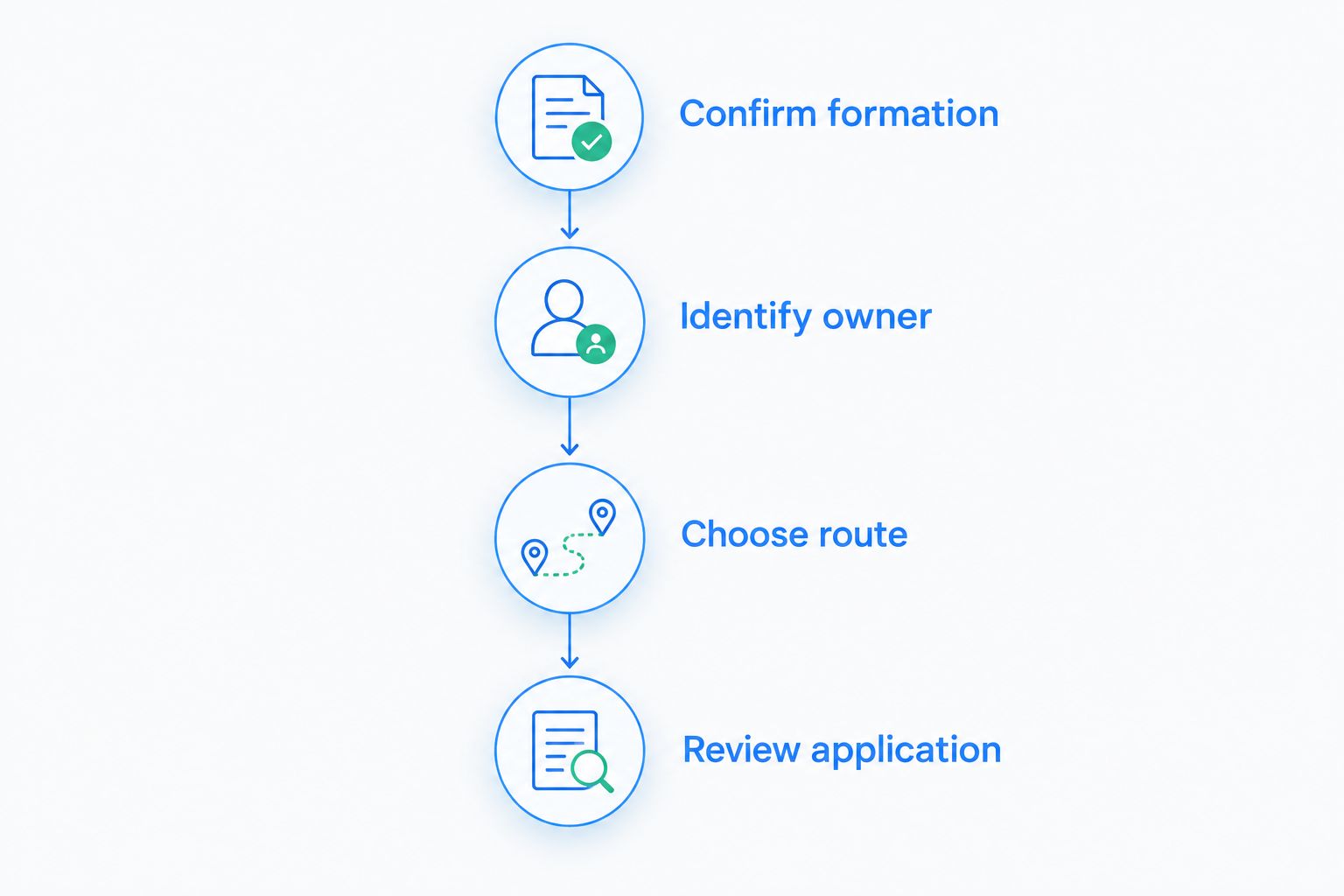
Prepare your 2026 EIN application in four steps
- Confirm formation: Keep the LLC's approved formation records and exact legal name ready.
- Identify owner: Establish the actual responsible party using the IRS definition, rather than substituting a filing agent.
- Choose route: Check online eligibility and the international application instructions before selecting a submission method.
- Review application: Check entity details, tax-related answers, signature authority and correspondence arrangements.
For the no-SSN issue specifically, compare EIN filing services for foreigners without an SSN. An adviser should explain the applicable IRS route, not insist that every foreign founder first obtain a personal tax number.
Keep EIN, ITIN and ongoing filings separate
An ITIN is a 9-digit individual tax processing number, not a business identifier. The IRS Instructions for Form W-7 explain eligibility, supporting documents, return-attachment requirements and exceptions; needing an EIN does not automatically establish ITIN eligibility.
An ITIN can expire after 3 consecutive tax years without use on a federal tax return. Before a 2026 filing, check the IRS renewal guidance rather than assuming an existing number remains usable.
Foreign-owned US LLC reporting depends on classification, ownership and transactions. The IRS Instructions for Form 5472 explain when a foreign-owned US disregarded entity must file Form 5472 with a pro forma Form 1120; Form 1040-NR concerns an individual's non-resident income-tax return and is not automatically required merely because an LLC exists.
A UK LTD is a separate formation route. Companies House registration and HMRC obligations do not replace US requirements when a UK business has a separate US filing obligation.
Which EIN filing route should you choose?
Choose combined support if you need formation, an EIN and help identifying later compliance work. Choose a CPA for unresolved classification, an enrolled agent for IRS-focused issues and an attorney for ownership or legal complexity.
For a settled, straightforward application, compare administrative assistance against direct filing. Keep control of your documents whichever route you choose.
FAQ
What’s the best EIN filing service for a non-resident LLC?
Corpulate fits founders seeking formation, EIN and non-resident tax compliance consulting together. Choose a specialist instead when your main issue requires tax classification, legal analysis or residence-country advice.
Can I get an EIN without an SSN?
Yes, an SSN is not universally required for an EIN application. Follow the IRS Instructions for Form SS-4 for foreign responsible parties who lack, and are ineligible for, an SSN or ITIN.
Do I need an ITIN before applying for an EIN?
Not automatically. An ITIN identifies an individual, while an EIN identifies a business; follow the separate eligibility and application rules for each.
Can I apply directly to the IRS from outside the US?
Yes, international applicants can apply directly using the applicable IRS route. Check current eligibility and submission instructions rather than assuming the online application is suitable.
Does getting an EIN guarantee a business bank account?
No, an EIN does not guarantee banking or payment-processor approval. Each institution applies its own eligibility and verification requirements.
Does an EIN mean my foreign-owned LLC has no more paperwork?
No, an EIN does not satisfy ongoing reporting obligations. Assess federal information returns, income-tax filings, state requirements and residence-country obligations separately.
One last thing
Before authorizing a 2026 application, ask one practical question: Who receives the IRS correspondence, and how will I receive a complete copy? Your tax identifier should never become information that only an intermediary controls.
Keep the application, authorizations and IRS notice with your formation records. These documents support later conversations with accountants and institutions without guaranteeing any particular outcome.
Related guides
- LLC formation services for non-US residents
- ITIN application services for non-residents
- Tax filing services for non-resident aliens
Author: Hassaan Ullah Khan, IRS CAA.