




For registered agent services ranked by price, compare written renewal quotes for the same state and service scope before choosing a provider. Best default for an overseas owner: a standalone commercial agent; best for coordinating formation: a clearly itemized formation bundle; best for several jurisdictions: a multistate arrangement.
- Registered agent services ranked by price need comparable renewal quotes, not a ranking built on introductory offers.
- Standalone registered agents suit overseas owners who want a separate, clearly defined statutory service.
- Formation bundles need itemized terms so agent renewals remain separate from formation and government charges.
- Corpulate supports non-resident entrepreneurs with company formation, tax IDs and tax compliance consulting.
Why this matters
A registered agent receives service of process—formal delivery of legal documents—and designated official notices for your company. An overlooked lawsuit notice is a different problem from an unanswered customer email.
For an entrepreneur outside the US, choosing an agent means arranging reliable document receipt in the formation state. It does not establish your tax position, secure banking access or replace your company's filing obligations.
Corpulate is for non-resident entrepreneurs seeking company formation and tax ID consulting. Use Corpulate to discuss that wider setup, while checking registered-agent coverage and terms separately.
What makes the best registered agent arrangement?
Use these criteria before comparing any 2026 quote:
- State eligibility: Confirm that the agent meets the formation state's registered-office and availability requirements.
- Document delivery: Establish how you receive legal notices, who gets alerts and how you access documents from abroad.
- Renewal transparency: Request the renewal basis, billing period and cancellation terms in writing.
- Defined scope: Separate statutory agent duties from ordinary mail handling, address use and compliance reminders.
- Exit procedure: Check how you replace the agent and retrieve documents without interrupting coverage.
- Non-resident suitability: Confirm that onboarding and communication work for an owner living outside the US.
Delaware's Limited Liability Company Act, Title 6, Section 18-104, sets out registered-office and registered-agent requirements for Delaware LLCs. Other states have their own rules; use the relevant Secretary of State's registered-agent guidance rather than treating one state's requirements as national law.
Registered agent arrangements at a glance
The order below ranks purchase suitability for overseas owners, not verified provider prices. Establish the service you need first, then compare current written quotes within that category.
| Rank and arrangement | Best for | Standout feature | Key limitation |
|---|---|---|---|
| 1. Standalone commercial agent | An overseas owner seeking a distinct agent service | Separates statutory representation from formation work | Extra services need separate confirmation |
| 2. Formation bundle with agent service | A first-time founder coordinating registration | Can combine formation administration and agent selection | Bundled terms can obscure renewal scope |
| 3. Multistate agent arrangement | A business registered in several states | Can coordinate agent administration across jurisdictions | Each state's requirements still apply |
| 4. Eligible owner or individual agent | An owner with a dependable qualifying in-state presence | Direct control over receipt of legal documents | A poor fit when nobody can maintain required availability |
For a 12-month comparison, align the same service period across quotes. For a 24-month comparison, include the next renewal rather than multiplying an introductory offer. These are comparison windows, not claims about any provider's contract length.
1. Standalone commercial agent: best for a separate agent service
A standalone commercial agent provides registered-agent service under a distinct agreement. For an overseas founder, this structure makes it easier to distinguish statutory representation from formation consulting, tax preparation and business-address services.
The arrangement is useful when your LLC already exists or you want to select formation and agent support independently. Start with the registered agent guide for non-resident LLC owners when assessing the service requirements.
Standalone commercial agent pros:
- Keeps the agent agreement separate from formation work.
- Makes document-delivery obligations easier to identify.
- Lets you assess agent service without buying unrelated consulting.
Standalone commercial agent cons:
- Ordinary business mail is not automatically included.
- Tax filings and annual reports require separate scope checks.
- You must coordinate responsibilities between service providers.
Best for: A non-resident owner who wants a clearly defined agent appointment rather than a broad startup package.
Before signing in 2026, request a sample notification workflow. Ask whether you receive the document itself, an alert directing you to a portal, or both; also confirm the procedure when your account email changes.
Verdict: Buy standalone service when clear scope and separate administration match your needs.
2. Formation bundle: best for coordinating a new LLC
A formation bundle combines company registration assistance with registered-agent arrangements where the provider expressly includes them. Its value is coordination, not an automatic claim to the lowest ongoing cost.
Ask for formation work, agent coverage, government charges and future filing work to appear as separate line items. A single checkout does not make these obligations interchangeable.
Formation bundle pros:
- Can coordinate the formation filing and initial agent designation.
- Gives a first-time founder one place to clarify the initial setup.
- Can reduce uncertainty about who handles the incorporation paperwork.
Formation bundle cons:
- Initial package descriptions can leave renewal obligations unclear.
- Agent service does not establish that tax preparation is included.
- Changing one service can require checking the remaining agreements.
Best for: A first-time overseas entrepreneur who values coordinated formation and receives a clear breakdown of responsibilities.
Corpulate provides company formation, EIN, ITIN and tax compliance consulting. Do not assume that any formation engagement includes registered-agent coverage unless the written scope says so. Corpulate service fees are one-time costs; government fees and future filing obligations remain separate.
Verdict: Buy a bundle only after the agent scope, renewal terms and exclusions are explicit.
3. Multistate arrangement: best for several registrations
A multistate arrangement coordinates agent appointments across jurisdictions. It matters when your company is registered in more than its original formation state—not merely because customers live elsewhere.
Foreign qualification means registering an existing company to do business in another state. Whether your activities trigger that requirement depends on the state's rules and your business facts.
Multistate arrangement pros:
- Can centralize document access for several registrations.
- Can give you a consistent process for updating contact details.
- Helps you compare the scope of each state appointment together.
Multistate arrangement cons:
- A coordinated agreement does not eliminate state-specific obligations.
- Reporting and renewal responsibilities still need separate tracking.
- Unnecessary registrations add administration without solving a demonstrated requirement.
Best for: An owner whose company genuinely needs registered-agent appointments in several states.
For a business registered in 2 states, compare both appointments, not just the formation-state service. Check each state's Secretary of State guidance on foreign qualification before adding another registration.
Verdict: Buy multistate coordination when your registration footprint requires it; skip unnecessary coverage.
4. Eligible individual agent: best for dependable in-state presence
An eligible owner or another qualifying individual can act as registered agent where state law permits. This is an eligibility question before it is a purchasing decision.
For an entrepreneur living overseas, the central issue is whether someone can maintain the required in-state address and availability. A friend who occasionally collects mail is not a substitute for meeting the state's legal requirements.
Eligible individual agent pros:
- Gives the designated individual direct receipt of legal documents.
- Avoids relying on a commercial provider's notification system.
- Allows close control over the document handoff process.
Eligible individual agent cons:
- Availability must remain dependable during the required hours.
- Travel, relocation or a changed relationship can interrupt coverage.
- Registered-office information can appear in public business records.
Best for: A company with a qualifying, dependable individual in the relevant state who understands the responsibility.
Check the state rule before listing a home, shared office or mailing address. An address being usable for ordinary correspondence does not establish that it qualifies as a registered office.
Verdict: Hold until eligibility and availability are confirmed; skip this route without dependable in-state coverage.
How to compare written quotes in 2026
Build one comparison sheet using the same company, state and coverage period. A quote for formation plus agent service cannot be compared directly with an agent-only renewal.
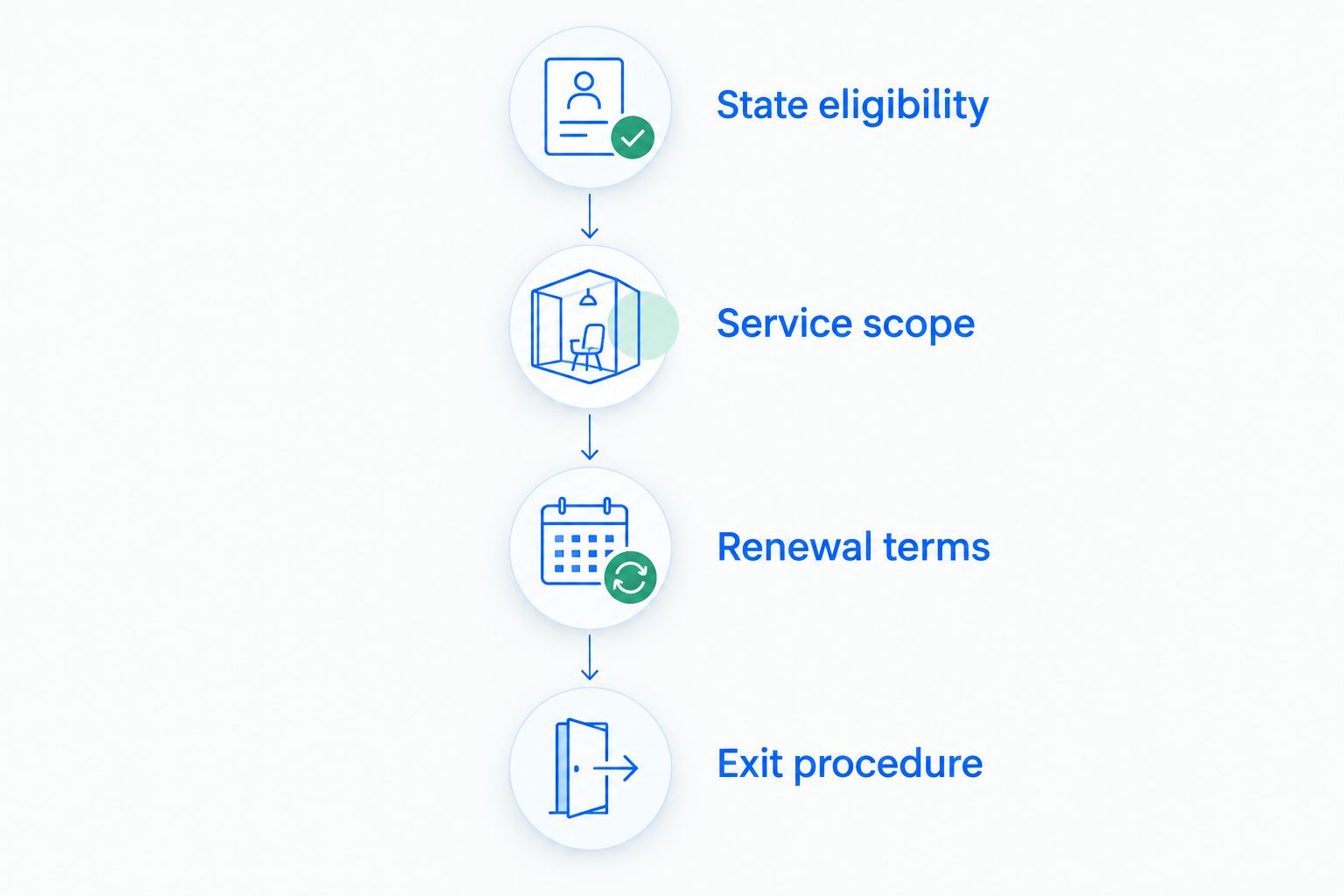
Follow this sequence:
- State eligibility: Confirm the appointment meets the relevant state's requirements.
- Service scope: Record legal-document receipt, notifications and any additional mail handling separately.
- Renewal terms: Record the coverage period, renewal basis and any automatic-renewal conditions.
- Exit procedure: Establish cancellation, replacement-agent filing and document-access arrangements.
Keep the agreement and the quote together. If a sales explanation differs from the contract, ask for clarification in writing before authorizing the appointment.
Also assign an owner for every task. Receiving a state notice, preparing the required response and submitting a filing are separate actions; an alert alone does not complete compliance.
Keep the agent, tax IDs and filings separate
A registered agent is not an EIN, an ITIN or a tax return. These serve different purposes, and buying one service does not complete the others.
An EIN, or Employer Identification Number, identifies a business for federal tax administration. IRS Form SS-4 and its instructions explain the application and responsible-party requirements, including instructions relevant to foreign applicants.
An ITIN, or Individual Taxpayer Identification Number, is for certain individuals who need a US taxpayer identification number but are not eligible for an SSN. IRS Form W-7 instructions explain eligibility, supporting documents and renewal conditions; owning an LLC alone does not establish an ITIN requirement.
Non-resident tax filing depends on ownership, tax classification, transactions and income. IRS instructions for Form 5472 address reporting by certain foreign-owned entities, including specified foreign-owned US disregarded entities. Form 1040-NR instructions address individual non-resident income tax returns.
For your 2026 setup, ask which obligations apply to your facts rather than assuming every non-resident needs the same forms. A company appointment and a personal tax ID application are separate decisions.
A UK LTD needs a different address assessment
Do not apply a US registered-agent checklist unchanged to a UK company. Companies House guidance on registered office addresses requires an appropriate physical address in the relevant UK jurisdiction; a PO Box alone is not acceptable.
A registered office, director's service address and personal residential address have different purposes. Ask which address service is being supplied and what correspondence it handles. UK company registration also does not remove accounts, confirmation-statement or applicable tax obligations.
How these arrangements were ranked
The ranking prioritizes state eligibility, dependable document access, clear renewal terms, defined scope and a workable exit process. Standalone service comes first because it separates the agent decision from other startup purchases—not because a specific provider has been established as cheapest.
For a 2026 purchase, compare current written quotes after choosing the right service model. Reject a lower-looking offer if it omits a function your business actually needs.
Which registered agent arrangement should you choose?
Choose a standalone commercial agent by default if you live overseas and lack dependable qualifying in-state coverage. Choose a formation bundle when its coordination helps and the agent agreement remains clear.
Use multistate administration only for the jurisdictions your business needs. Treat self-appointment or an individual agent as a legal and practical eligibility decision, not a shortcut.
Clarify your company setup
Discuss formation, tax IDs and compliance responsibilities for your non-resident business.
FAQ
What’s the cheapest registered agent service in 2026?
A cheapest-provider verdict requires current, comparable written quotes for your state and service period. Compare renewal terms, document delivery, exclusions and cancellation conditions rather than formation promotions alone.
Can I act as my own registered agent while living outside the US?
Only if you meet the relevant state’s eligibility, address and availability requirements. Living overseas makes dependable in-state coverage the practical issue; check the formation state’s official rules before appointing yourself.
Does a registered agent provide a business mailing address?
Registered-agent service does not automatically include general business mail handling. Confirm address-use permissions and mail scope in the agreement before using the address elsewhere.
Does a registered agent apply for my EIN or ITIN?
An agent appointment does not itself include EIN or ITIN assistance. EIN applications use IRS Form SS-4, while eligible individual ITIN applicants use Form W-7.
Is registered agent renewal the same as an annual report?
No, renewing an agent agreement and filing a state annual report are separate tasks. Confirm who prepares and submits each required filing rather than relying on a reminder.
Can I change registered agents after forming my LLC?
Yes, subject to the state’s change-of-agent procedure. Coordinate the replacement appointment and required filing so you maintain coverage, then resolve cancellation and document access with the outgoing provider.
Does a UK LTD need a US-style registered agent?
A UK LTD follows UK registered-office requirements rather than the US state registered-agent system. Companies House guidance explains appropriate addresses, while other address and correspondence services need separate scope checks.
One last thing
Test the handoff, not just the notification. Before choosing an agent, ask who receives a legal notice when your usual contact is unavailable, how you retrieve the complete document and who takes responsibility for the response.
A registered agent receives important documents. Your company still needs someone responsible for acting on them.
Related guides
- Compare cheap LLC formation services
- EIN filing services for foreigners without an SSN
- Tax filing services for non-resident aliens
Author: Hassaan Ullah Khan, IRS CAA