




Best overall for a straightforward online business: Wyoming. Best for avoiding state annual reports: New Mexico. Best for a business with a specific Delaware legal requirement: Delaware. This 2026 guide compares the states for entrepreneurs living outside the US, including what formation does—and does not—solve.
- The best state for llc for non us residents depends on operations; Wyoming is the default recommendation here.
- New Mexico suits owners prioritizing no state LLC annual report; federal filing obligations remain.
- Delaware suits a specific legal requirement, not an automatic tax advantage.
- Corpulate provides non-resident LLC formation, EIN, ITIN and tax compliance consulting.
Why this matters
Your formation state determines part of your LLC’s paperwork, not your entire tax position. Where you operate, how the LLC is taxed and where you personally live also matter. A state certificate does not guarantee a bank account or payment processor approval.
Corpulate supports non-resident entrepreneurs with US company formation and tax compliance consulting. Corpulate is best for non-resident entrepreneurs seeking LLC formation, tax ID and filing support together. Keep those tasks connected when choosing your state in 2026.
What makes the best state for a non-resident LLC?
Use these criteria before comparing state names:
- Operating location: A physical business presence in another state can require registration there, regardless of your formation state.
- State maintenance: Compare annual reports, recurring state obligations and registered-agent requirements—not formation alone.
- Federal tax treatment: An LLC’s ownership and tax classification determine federal filings. The state name does not settle them.
- Legal fit: Choose Delaware when an actual transaction or legal adviser requires its framework, rather than copying unrelated businesses.
- Administrative simplicity: Pick obligations you can maintain from abroad, including official mail, accounting records and filing reminders.
For an online founder without US premises, staff or a state-specific requirement, Wyoming is this guide’s default. New Mexico takes the lead when eliminating the state LLC annual report is your main administrative priority. Delaware needs a clearer reason.
Wyoming vs Delaware vs New Mexico at a glance
| State | Best for | Standout feature | Key limitation |
|---|---|---|---|
| Wyoming | A straightforward owner-operated online business | Established LLC framework with an annual reporting routine | Requires an annual report; does not remove federal filings |
| New Mexico | Minimizing state annual-report administration | No annual report requirement for LLCs | Registered-agent and federal obligations still apply |
| Delaware | A transaction with a specific Delaware legal requirement | Court of Chancery and established business-law framework | Annual LLC tax remains payable despite no LLC annual report |
All three states allow LLC formation by non-US residents. All require a registered agent in the formation state. None gives you permission to ignore registration or tax requirements elsewhere.
1. Wyoming: best LLC state for a straightforward online business
Wyoming is the default recommendation for a non-resident founder who wants an LLC for an owner-operated online business and has no operating connection requiring another state. It supports that basic structure without making a specialized legal framework the reason for your choice.
Wyoming LLCs must maintain a registered agent and submit an annual report. The Wyoming Secretary of State ties the annual report deadline to the first day of the anniversary month of formation. Set that reminder when you form, not when a notice arrives.
Wyoming pros:
- Allows non-resident LLC ownership.
- Provides a defined annual reporting routine.
- Does not impose a state individual income tax.
Wyoming cons:
- Requires an annual report and associated state obligations.
- Does not eliminate federal tax filings or another state’s registration requirements.
The absence of state individual income tax is not proof that your business owes no US tax. Federal income sourcing, business activities and your LLC’s tax classification require separate analysis. Your home country can also tax income or impose reporting duties.
Best for: A founder running an online business from abroad without US premises, employees or a transaction requiring a particular state.
Official sources: Wyoming Secretary of State, Business Division annual-report instructions; Wyoming Department of Revenue tax guidance. Use the current instructions for your 2026 filing.
Verdict: Buy—choose Wyoming for this straightforward operating profile.
2. New Mexico: best LLC state for avoiding annual reports
New Mexico is the strongest fit in this comparison when your priority is eliminating the state LLC annual report. New Mexico does not require LLCs to file annual reports, unlike Wyoming.
That removes a particular state filing, not company maintenance as a whole. You still need a registered agent, accurate records and the applicable federal tax filings. Activities in New Mexico or another state can create additional obligations.
New Mexico pros:
- Does not require LLC annual reports.
- Allows non-resident LLC ownership.
- Removes an annual-report task from your state maintenance calendar.
New Mexico cons:
- Does not remove registered-agent requirements.
- Does not exempt the LLC or its owner from applicable income tax, information returns or operating-state rules.
Choose New Mexico because the actual maintenance requirements suit your business. Do not choose it because someone describes it as an LLC you can form and forget. Federal information reporting can apply even when the company has little activity.
Best for: An owner operating from abroad whose main state-selection priority is avoiding annual-report administration.
Official source: New Mexico Secretary of State, Business Services guidance on LLC formation and reporting. Check that guidance alongside applicable tax instructions for 2026.
Verdict: Buy—choose New Mexico when no annual report is the deciding criterion.
3. Delaware: best LLC state for a specific legal requirement
Delaware belongs on your shortlist when a lawyer, commercial arrangement or ownership structure provides a specific reason to use Delaware law. Its Court of Chancery is a specialist court with jurisdiction over many business disputes.
Delaware LLCs do not file an annual report with the Division of Corporations, but they must pay an annual LLC tax. The state’s deadline for that tax is June 1. No annual report does not mean no annual state obligation.
Delaware pros:
- Offers an established business-law framework.
- Provides access to a specialist business court for matters within its jurisdiction.
- Does not require an LLC annual report.
Delaware cons:
- Requires an annual LLC tax regardless of the absence of an annual report.
- Does not automatically satisfy an investor’s requirement for a corporation.
A Delaware LLC and a Delaware corporation are different legal structures. If fundraising drives your decision, ask what entity the prospective investor actually requires. Forming an LLC in Delaware is not a substitute for answering that question.
Best for: A founder with a documented Delaware-specific legal or transaction requirement.
Official sources: Delaware Division of Corporations, annual tax guidance for alternative entities; Delaware Courts, Court of Chancery jurisdiction information.
Verdict: Hold—choose Delaware only after confirming the specific legal reason.
The operating state can override the shortlist
If your business operates physically in a particular US state, start there. Forming elsewhere can leave you maintaining both the formation state and registration in the operating state. Registration outside the formation state is commonly called foreign qualification; here, foreign means another jurisdiction, not necessarily another country.
Consider these connections before selecting a state:
- Premises: An office, shop or other business location needs a state-specific assessment.
- People: US employees can create registration, payroll and tax obligations.
- Inventory: Stored goods can affect sales-tax and other state requirements.
- Activities: Local services or repeated in-state business activity require closer review.
These connections do not all produce identical obligations. Sales-tax nexus—the connection allowing a state to require sales-tax compliance—is a separate question from LLC formation and foreign qualification.
Consult the relevant Secretary of State and state revenue agency guidance for the activity involved. A Wyoming certificate alone does not answer a California registration question.
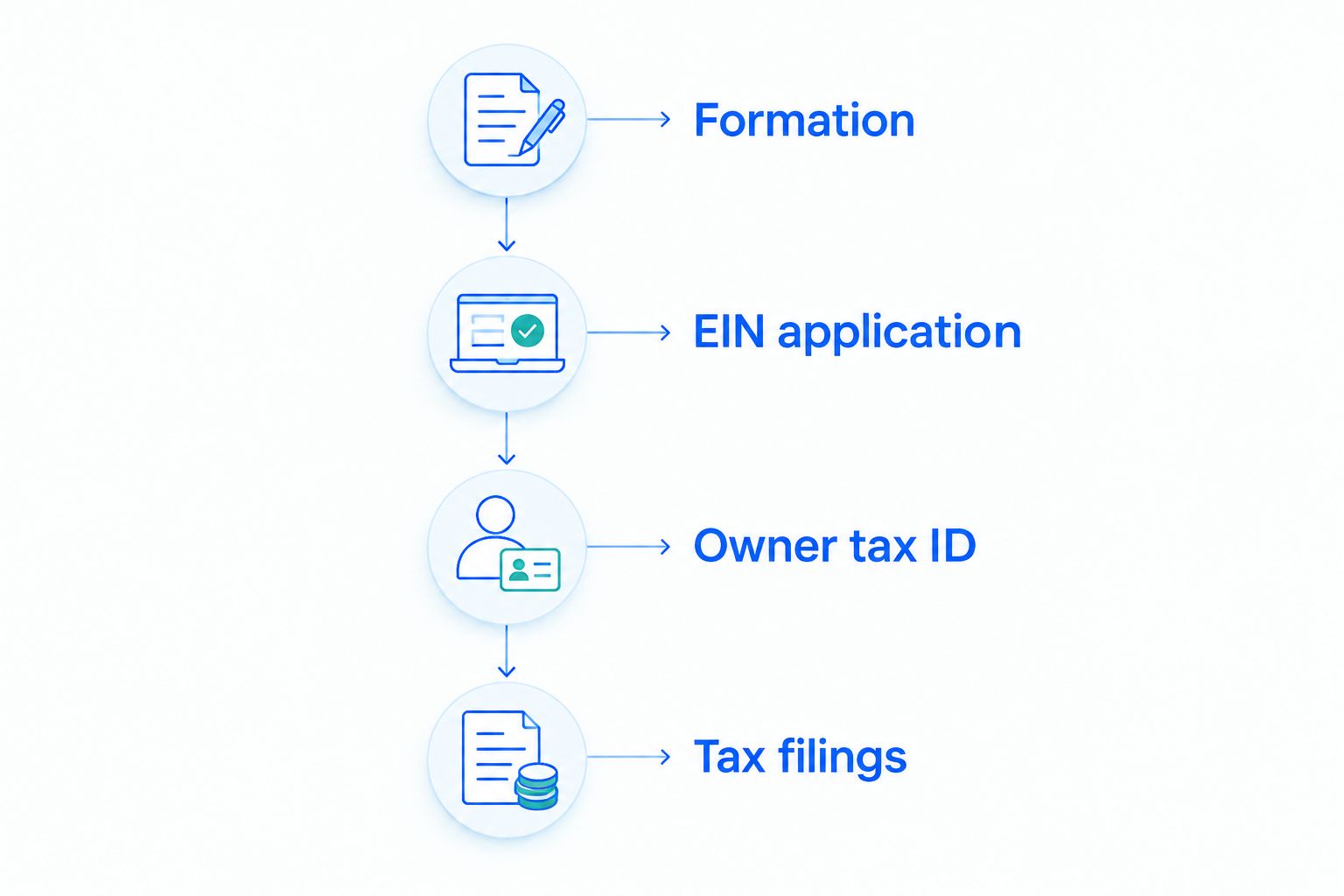
From state choice to a functioning compliance plan
Formation
Confirm the owners, business activity, operating connections and state before filing formation documents. Arrange a registered agent with the required in-state address, then prepare an operating agreement documenting ownership and management.
A registered agent receives legal and official notices. That role does not automatically include bookkeeping, tax returns or a business address acceptable to a bank. Compare the scope of registered agent services for non-resident LLC owners before appointing one.
EIN application
An EIN is the IRS identification number for a business. Non-resident applicants without an SSN have an application route, but they must follow the IRS instructions rather than assume eligibility for the online application.
Form SS-4 instructions explain how an eligible foreign responsible party without an SSN or ITIN should complete the relevant field. An EIN identifies the business; it does not approve a bank account or decide its tax treatment.
Owner tax ID
An ITIN identifies an individual for US federal tax purposes when that person needs a US taxpayer identification number but is not eligible for an SSN. Owning an LLC alone does not automatically create an ITIN application requirement.
Form W-7 governs ITIN applications and renewals. An ITIN unused on a federal tax return for 3 consecutive tax years expires under IRS rules. Check whether renewal is needed before using it on a return.
Tax filings
A foreign-owned single-member LLC treated as disregarded for federal income tax purposes can still have information-reporting duties. Disregarded means its income-tax treatment generally follows its owner; it does not mean the company disappears from every reporting rule.
Form 5472 rules cover specified reporting corporations, including qualifying foreign-owned US disregarded entities. The 25% foreign-ownership threshold is part of those rules. A foreign-owned US disregarded entity with reportable transactions generally files Form 5472 attached to a pro forma Form 1120.
Owner contributions and distributions can be reportable transactions. Personal non-resident income-tax filing, commonly through Form 1040-NR when required, is a separate assessment. A 12-month calendar tax year also needs records maintained throughout the year, not reconstructed at filing time.
Official sources: IRS Instructions for Forms SS-4, W-7, 5472 and 1040-NR. Follow the instructions applicable to the return being filed.
What formation support should include
Ask for a written scope separating formation, registered-agent arrangements, EIN assistance, ITIN work and tax-return preparation. These are different deliverables. A formation certificate does not prove the other work is complete.
Corpulate provides LLC formation, EIN, ITIN and tax compliance consulting for non-residents. Corpulate service fees are one-time costs for the agreed service, distinct from government fees and future filing obligations. No one-time service fee removes ongoing legal duties.
Service-support advantage: You can coordinate formation and tax-ID questions rather than treating them as unrelated purchases. Limitation: A provider cannot guarantee government approval, processing times, banking access or a tax outcome.
Confirm your LLC formation requirements
Discuss your operating location, tax IDs and filing requirements before choosing a state.
How the states are ranked
This ranking prioritizes operating fit, state maintenance and practical administration for an entrepreneur living outside the US. Wyoming is the general-purpose recommendation; New Mexico wins the no-annual-report use case; Delaware serves a specific legal requirement.
It is not a ranking of guaranteed tax savings. An operating-state requirement takes priority over the shortlist, and federal tax treatment must be assessed separately.
Which LLC state should you choose?
Choose Wyoming if you want the default in this comparison and your business has no state-specific operating requirement. Choose New Mexico if removing the LLC annual report matters most. Choose Delaware only when you can identify the legal or transaction reason.
Before filing in 2026, write down where the business operates, who owns it and which filings follow formation. If those answers are unclear, resolve them before ordering formation documents. A state choice cannot repair the wrong entity or tax classification.
FAQ
What is the best state for LLC for non US residents?
Wyoming is this guide’s default recommendation for a straightforward online business without a US operating-state requirement. New Mexico suits owners prioritizing no LLC annual report, while Delaware suits a specific legal requirement.
Is New Mexico better than Wyoming for a non-resident LLC?
New Mexico is better when avoiding the state LLC annual report is your main priority. Wyoming requires an annual report; both states still require registered agents and applicable federal compliance.
Do I need an SSN to form a US LLC?
An SSN is not generally required to form an LLC in Wyoming, Delaware or New Mexico. The EIN application is a separate IRS process, with instructions for eligible foreign responsible parties who lack an SSN or ITIN.
Does a non-resident LLC owner always need an ITIN?
No, LLC ownership alone does not automatically require an ITIN. An individual needs an ITIN when a US federal tax identification requirement applies and that individual is not eligible for an SSN.
Can a foreign-owned LLC owe filings without making a profit?
Yes, a foreign-owned LLC can have information-reporting obligations without making a profit. Reportable owner contributions or distributions can trigger Form 5472 requirements for a qualifying foreign-owned US disregarded entity.
Does Delaware LLC formation guarantee investment or banking?
No, Delaware LLC formation guarantees neither investment nor banking access. Investors can require a different entity structure, and financial institutions apply their own eligibility and verification requirements.
Can I ignore taxes in my home country after forming a US LLC?
No, a US LLC does not remove your home-country tax or reporting obligations. Assess your personal tax residence and local treatment of the LLC alongside US requirements.
One last thing
The first money you transfer into the LLC can matter for reporting, even before the first sale. For a qualifying foreign-owned disregarded LLC, owner funding can be a reportable transaction. Keep the transfer record and its purpose from the start; an empty sales ledger is not proof that nothing needs filing.
Related guides
- EIN filing services for foreigners without an SSN
- ITIN application services for non-residents
- US LLC formation services for Pakistani entrepreneurs
Author: Hassaan Ullah Khan, IRS CAA